
The United States’ luxury market, particularly the watch and jewelry sector, is currently navigating a challenging period marked by significant economic headwinds. Recent data from the US Department of Commerce reveals a continued downward trend in sales, painting a clear picture of shifting consumer behavior amidst persistent inflation and rising interest rates. This detailed analysis delves into the latest figures, explores the underlying economic factors, and considers the broader implications for the high-end retail landscape.
US Luxury Market Faces Headwinds: Watch and Jewelry Sales Continue to Dip
Analyzing Recent Sales Figures: A Continued Decline in Discretionary Spending
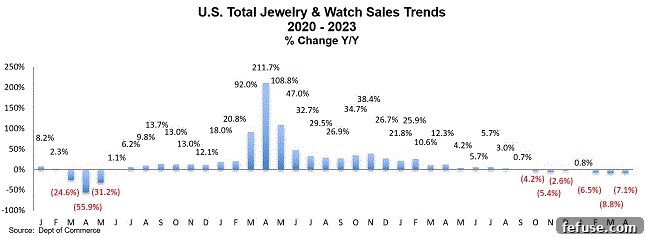
April proved to be another difficult month for watch and jewelry retailers across the United States, with sales registering a 7.1 percent decline. While this figure represents a marginal improvement compared to the steeper 8.8 percent drop observed in March, it nonetheless signals a prolonged period of contraction in consumer demand for luxury items. The sequential decline underscores a fundamental shift in purchasing priorities, as consumers grapple with a tighter economic environment.
A closer look at the year-on-year trends further illustrates the depth of this challenge. The luxury sector experienced modest growth from May 2022, a period that still reflected some lingering post-pandemic buoyancy and pent-up demand. However, this positive trajectory sharply reversed in October 2022, when year-on-year sales dipped below zero. With the exception of a brief and perhaps misleading 0.8 percent uptick in January—likely influenced by seasonal factors or temporary optimism—sales have remained in negative territory ever since. This consistent decline suggests that the current slowdown is not merely a seasonal fluctuation but a more deeply rooted response to broader economic pressures affecting discretionary spending across the nation.
The data, meticulously compiled and released by the US Department of Commerce, provides a critical barometer for the health of the retail sector. These figures are not just abstract numbers; they reflect the collective decisions of millions of American consumers who are increasingly cautious about where and how they spend their hard-earned money. For an industry heavily reliant on consumer confidence and a robust economic outlook, these trends present a formidable challenge that requires careful strategizing and adaptation.
Economic Undercurrents: Inflation, Interest Rates, and Recession Fears
The Persistent Shadow of Inflation
While the headline inflation rate in the US has shown signs of moderation, easing to 4.9 percent in April, the cumulative effect of many months of elevated prices cannot be overstated. Consumers have endured a sustained period of price increases, peaking at over nine percent last June, which has significantly eroded their purchasing power. Even as inflation cools, the damage has been done; the cost of everyday essentials has risen dramatically, leaving less disposable income for luxury purchases like watches and jewelry. This sustained inflationary pressure has forced households to re-evaluate their budgets, prioritizing necessities over wants.
The psychological impact of inflation also plays a crucial role. Years of stable prices conditioned consumers to expect certain spending power. The recent surge has disrupted this equilibrium, leading to a lingering sense of financial insecurity even as the rate of price increases slows. Consumers are not just looking at the current month’s inflation figure but are feeling the pinch of cumulative price hikes on their overall financial well-being, directly impacting their willingness to invest in high-value discretionary items.
The Federal Reserve’s Aggressive Stance: Hiking Interest Rates
In its determined effort to bring inflation under control, the Federal Reserve has embarked on an aggressive campaign of hiking interest rates. Month after month, the Fed has incrementally increased borrowing costs, a policy designed to cool down the economy by making credit more expensive for both businesses and consumers. While essential for long-term economic stability, these rate hikes have immediate repercussions.
Higher interest rates translate into more expensive mortgages, car loans, and credit card debt, placing additional strain on household budgets. For businesses, borrowing for expansion or inventory management also becomes pricier, potentially leading to reduced investment and hiring. In the context of luxury purchases, where financing might be considered for significant investments like high-end watches or engagement rings, increased interest rates make such options less appealing or altogether unaffordable for a segment of the market. This deliberate economic tightening by the Fed directly contributes to the current cautious spending environment.
The Specter of Recession Looms
The combination of persistent inflation and rising interest rates has led a growing consensus among economists: a recession in the United States is now largely inevitable. A recession, characterized by a significant decline in economic activity, typically brings with it job losses, reduced wages, and a general tightening of belts across the economy. Fears of job insecurity and a desire to build financial reserves in uncertain times prompt consumers to curtail non-essential spending drastically.
For the luxury market, a recession represents a significant headwind. Discretionary items like watches and jewelry are often the first to be cut from household budgets when economic uncertainty takes hold. Brands and retailers must brace for a period where consumers are more focused on saving and securing their financial future than on indulging in high-end purchases, making the competitive landscape even more challenging.
Implications for the Watch and Jewelry Industry: Adapting to New Realities
The ongoing decline in sales and the broader economic context necessitate significant adaptation within the watch and jewelry industry. Retailers are facing immense pressure to manage inventory effectively, avoid overstocking, and potentially revise pricing strategies. Brands must re-evaluate their marketing efforts, focusing on value, longevity, and emotional resonance rather than pure aspirational luxury that might feel out of touch in a more austere climate.
There’s also a noticeable shift in consumer preferences. While ultra-high-end pieces may retain a niche market among the very affluent, the broader luxury segment is seeing a move towards more considered purchases. Consumers might opt for fewer, but more meaningful, pieces or explore the burgeoning pre-owned and vintage luxury markets, which offer perceived better value and sustainability credentials. Brands that can successfully pivot to emphasize craftsmanship, heritage, and responsible sourcing may find a more receptive audience.
Moreover, the digital transformation continues to be crucial. An enhanced online presence, seamless e-commerce experiences, and personalized digital engagement are no longer optional but essential for reaching and retaining customers. Businesses must invest in understanding digital consumer journeys and leverage data analytics to tailor offerings and communications effectively in a competitive and cost-conscious environment.
Historical Context and Future Outlook: Navigating the Path Ahead
The luxury market has, throughout history, demonstrated remarkable resilience in the face of economic downturns. Following the 2008 financial crisis or the initial shock of the COVID-19 pandemic, the sector often found ways to rebound, sometimes even stronger. This resilience is often attributed to the enduring appeal of luxury as an investment, a symbol of status, or an expression of personal identity. However, the nature of recovery depends heavily on the duration and severity of the economic slump.
Looking ahead, the recovery of US watch and jewelry sales will likely be contingent on several key factors. A sustained deceleration of inflation, allowing real wages to catch up, would significantly boost consumer purchasing power. A more dovish stance from the Federal Reserve, potentially leading to interest rate cuts, could ease borrowing costs and stimulate economic activity. Most importantly, a renewed sense of consumer confidence, stemming from job security and a stable economic outlook, would be the primary catalyst for a rebound in discretionary spending.
In the interim, the industry must focus on innovation, customer experience, and differentiated offerings. Brands that cultivate strong relationships with their clientele, offer exceptional service, and create products with lasting value and emotional connection are better positioned to weather the storm. Exploring new demographics, emphasizing sustainability, and leveraging storytelling to connect with a more discerning consumer base will be vital strategies for long-term success. While the immediate future presents clear challenges, the underlying desire for quality, beauty, and craftsmanship that defines the luxury market remains, promising a eventual return to growth once economic conditions stabilize.
Strategies for Resilience: How Luxury Brands Can Adapt and Thrive
In a period defined by economic uncertainty, luxury watch and jewelry brands must adopt proactive strategies to not only survive but also to position themselves for future growth. Simply maintaining the status quo is no longer viable. The focus must shift towards enhancing value, building deeper customer relationships, and optimizing operational efficiencies.
One critical area is the **value proposition**. While luxury inherently implies high price, brands can reframe value by emphasizing longevity, heritage, craftsmanship, and the investment potential of their pieces. Highlighting the timelessness and artisanal skill involved in creating a watch or a piece of jewelry can resonate more strongly with consumers who are making fewer, more deliberate purchases. Limited editions, bespoke services, and unique storytelling around each product can also elevate perceived value beyond just the material cost.
**Customer experience** remains paramount. In a challenging market, personalized service, exceptional after-sales support, and memorable in-store or online interactions can differentiate a brand significantly. Building strong, loyal customer relationships through exclusive events, personalized communications, and loyalty programs encourages repeat business and word-of-mouth referrals. For many luxury consumers, the experience of purchasing is as important as the item itself.
**Digital engagement and e-commerce optimization** are non-negotiable. With consumers increasingly researching and even purchasing luxury items online, a seamless, secure, and visually appealing digital storefront is essential. This includes high-quality product imagery, detailed descriptions, virtual try-on features, and personalized recommendations. Leveraging social media for brand storytelling and direct engagement can also foster a stronger connection with potential buyers and reinforce brand identity.
**Innovation and sustainability** are emerging as key differentiators. Consumers, particularly younger generations, are increasingly conscious of ethical sourcing, environmental impact, and corporate responsibility. Brands that can transparently demonstrate their commitment to sustainable practices—from responsibly mined materials to eco-friendly packaging—can attract a growing segment of environmentally and socially aware luxury buyers. Innovation in design, materials, and technology also keeps brands relevant and exciting in a competitive landscape.
Finally, **market diversification** could offer new avenues for growth. While the US market faces headwinds, exploring emerging markets or strengthening presence in more resilient regions might mitigate some of the domestic slowdown. Additionally, considering diversification within product offerings – perhaps introducing more accessible entry-level luxury pieces alongside flagship collections – could broaden the customer base without diluting brand prestige.
Conclusion: Navigating Turbulence with Resilience and Strategy
The recent dip in US watch and jewelry sales is a clear indicator of the broader economic challenges facing consumers today. Persistent inflation, aggressive interest rate hikes by the Federal Reserve, and the looming threat of a recession have collectively squeezed household budgets and dampened discretionary spending. While the marginal improvement in April’s sales offers a glimmer of hope, the overall trend since October 2022 underscores a protracted period of caution in the luxury market.
However, the luxury industry is no stranger to economic cycles. Its history is replete with examples of resilience and adaptation. For watch and jewelry brands to navigate this current turbulence successfully, a strategic pivot is essential. This involves a renewed focus on delivering exceptional value, cultivating unparalleled customer experiences, optimizing digital engagement, embracing sustainability, and exploring innovative approaches to product and market development. By understanding the evolving consumer landscape and responding with agility and foresight, the US luxury market, though currently facing headwinds, holds the potential for eventual recovery and continued vibrancy in the long term.