
The Deceptive Threat of Moissanite: HRD Antwerp Uncovers Advanced Rough Diamond Imitations
The global diamond industry operates on a foundation of trust and meticulous authentication. However, sophisticated imitations consistently challenge this framework, requiring constant vigilance and advanced gemological expertise. HRD Antwerp, a leading authority in diamond certification and research, recently issued a significant alert regarding the detection of highly convincing rough diamond simulants. These weren’t just any fakes; they were expertly crafted moissanite stones specifically designed to mimic rough diamonds, even passing preliminary tests that typically differentiate genuine articles from their imitations.
This discovery underscores the evolving complexity of gem fraud and highlights the critical role of advanced laboratories in maintaining the integrity of the diamond supply chain. As technology advances, so too do the methods of those seeking to deceive, making continuous research and adaptation indispensable for the industry.
An Alarming Discovery: Moissanite Masquerading as Rough Diamonds
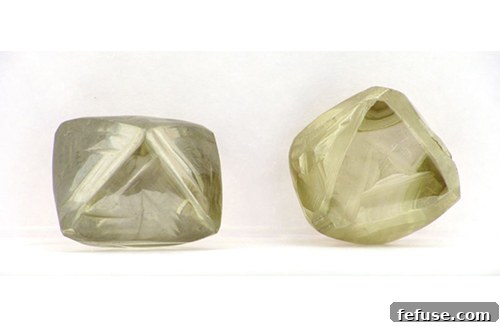
HRD Antwerp’s report detailed a notable incident involving two distinct stones, weighing 7.14 and 5.01 carats respectively. These specimens exhibited a subtle greenish hue and, crucially, had been expertly cut and shaped to closely resemble natural rough diamonds. What made this discovery particularly alarming and challenging was their initial ability to deceive even standard testing equipment. The lab noted that the stones not only visually appeared like rough diamonds but also “felt” like them – a tactile assessment often relied upon by experienced traders who handle countless rough stones.
More critically, common diamond testing pens, which operate based on thermal conductivity – a hallmark property of diamonds – misleadingly indicated that these stones were indeed genuine diamonds. For decades, thermal conductivity testers have been a primary and quick tool for initial diamond identification, leveraging the diamond’s unparalleled ability to conduct heat. However, synthetic moissanite shares a remarkably similar high thermal conductivity with diamond, rendering these basic testers ineffective in this specific scenario. It was only through a deeper, more comprehensive gemological analysis, specifically precise density measurements, that the true identity of these deceptive stones as moissanite was definitively established.
This incident serves as a stark reminder that superficial testing methods are no longer sufficient in an era of advanced simulants. The ability of moissanite to mimic diamond across multiple key properties necessitates a multi-faceted approach to identification.
Moissanite: A Master of Disguise in the Gemstone World
Moissanite, particularly its synthetic counterpart, presents one of the most significant challenges in diamond identification for gemologists and traders worldwide. Originally discovered in minute quantities within a meteorite as naturally occurring silicon carbide, synthetic moissanite has been commercially produced since the 1990s as a popular and affordable diamond simulant. Its remarkable physical and optical properties allow it to be an exceptionally convincing alternative, often blurring the lines for the untrained eye and even sophisticated equipment.
Key Properties That Enable Its Deceptive Nature:
- Exceptional Hardness: Moissanite boasts an impressive hardness of 9.25 on the Mohs scale, placing it just below diamond (10). This superior hardness means it is highly durable and resistant to scratching and abrasion, unlike many other diamond simulants. This characteristic contributes significantly to its realistic feel and long-lasting wearability, further enhancing its deceptive qualities when presented as a rough stone.
- High Refractive Index (RI): With a refractive index ranging from 2.6 to 2.7, moissanite exhibits a brilliance and fire (dispersion) often exceeding that of diamond. This intense sparkle, a result of its ability to bend and scatter light, can easily mislead observers, making it appear even more dazzling and vibrant than a natural diamond. The higher dispersion often results in a pronounced “rainbow effect,” which can be a clue for an expert but a captivating feature for a novice.
- High Thermal Conductivity: As highlighted by HRD Antwerp’s discovery, moissanite’s high thermal conductivity is perhaps its most deceptive property when it comes to basic testing. This characteristic makes it virtually indistinguishable from diamond using common thermal diamond testers, which are designed to detect the rapid heat dissipation unique to genuine diamonds. This shared thermal property is the primary reason why initial screening tests fail to identify moissanite.
- Appearance: Modern synthetic moissanite can be produced with very high clarity and a range of colors, including near-colorless and even subtle greenish tints, which align with certain types of rough diamonds. Coupled with expert cutting, this enhances its ability to imitate genuine rough material.
These combined properties make synthetic moissanite a formidable challenge for gemologists, traders, and consumers alike. The added layer of complexity in this instance, where the stones were also meticulously cut and shaped to imitate rough diamonds rather than the more common polished simulants, represents an escalation in the sophistication of fraudulent practices.
The Peril of Deception: Challenges for the Diamond Trade
While an experienced rough diamond trader or polisher might develop a keen intuition or “alarm bells” when encountering unusual stones, the increasing sophistication of imitations like these moissanite fakes presents substantial risks across the entire diamond supply chain. HRD Antwerp explicitly warned that although their experienced experts could eventually identify the stones, the potential for widespread detection problems escalates significantly under certain circumstances.
Specific Threats to the Diamond Supply Chain and Market Integrity:
- Mixing in Parcels: The most significant concern is the deliberate or accidental mixing of such imitation rough stones, especially in smaller sizes, into legitimate parcels of rough diamonds. In bulk quantities, meticulous individual inspection of every stone becomes incredibly time-consuming, labor-intensive, and expensive, vastly increasing the likelihood that fakes could slip through unnoticed.
- Economic Impact: The presence of imitations can lead to significant financial losses for buyers who unknowingly purchase them at genuine diamond prices. This misrepresentation not only devalues the entire parcel but also disrupts fair market pricing and undermines the economic value proposition of natural diamonds.
- Reputation Damage: For businesses, unknowingly trading in or selling imitations can severely damage their reputation and erode customer trust, which is paramount in the luxury goods sector. Once trust is compromised, it is incredibly difficult to rebuild.
- Processing Challenges: If these imitations reach diamond cutting and polishing factories, they can cause substantial damage to expensive diamond polishing equipment due to their different material properties. Moissanite requires different tools and techniques for cutting, and attempting to polish it with diamond-specific tools can lead to costly delays, equipment repairs, and wasted labor.
- Erosion of Confidence: The constant threat of imitations erodes overall confidence in the rough diamond market. Buyers may become more cautious, leading to slower transactions and a less fluid market, impacting profitability for all legitimate stakeholders.
The threat is not confined to rough stones alone. Smaller, polished moissanite pieces could also be discreetly mixed into parcels of polished diamonds, creating similar challenges for identification and verification. The integrity of the entire diamond pipeline, from mine to market, hinges on the ability to accurately and consistently identify genuine diamonds at every stage.
Unmasking the Imposter: Advanced Detection Methods
Given moissanite’s remarkable ability to bypass rudimentary thermal tests, gemological laboratories and experienced professionals rely on a comprehensive suite of advanced techniques to ensure accurate and definitive identification. The incident reported by HRD Antwerp underscores the critical importance of these precise diagnostic methods, moving beyond simple field testers.
Essential Identification Techniques for Moissanite vs. Diamond:
- Density Measurements (Specific Gravity): This was the decisive test in HRD Antwerp’s recent case. Diamonds have a specific gravity of approximately 3.52 g/cm³, while moissanite typically ranges from 3.19 to 3.22 g/cm³. This distinct difference in density, accurately measured using hydrostatic weighing, provides an unambiguous indicator of the stone’s identity. This technique is highly reliable because density is a fundamental material property.
- Birefringence (Doubling): Unlike diamonds, which are singly refractive (meaning light travels through them at a single speed and direction), moissanite is doubly refractive. This means that when viewed through a loupe or microscope, facets on the opposite side of the stone often appear “doubled” or blurred. This distinct optical phenomenon, visible as a slight doubling of facet edges, is a clear giveaway for moissanite and is entirely absent in diamonds. An experienced gemologist can easily spot this under magnification.
- Crystal System and Optical Properties: Diamonds crystallize in the cubic system, resulting in isotropic optical properties (light behaves uniformly in all directions). Moissanite, on the other hand, belongs to the hexagonal (or trigonal) crystal system, leading to its anisotropic (doubly refractive) nature. While not directly observable without advanced equipment, the optical effect of birefringence is a direct consequence of this fundamental structural difference.
- Electrical Conductivity: Some types of moissanite, particularly certain n-type silicon carbide, can exhibit electrical conductivity. This is a property never found in natural diamonds. Specialized electrical conductivity testers can detect this, offering another layer of verification.
- Advanced Spectroscopic Analysis: For definitive, scientific identification, gemological laboratories employ sophisticated instruments such as Raman spectroscopy and Fourier-transform infrared (FTIR) spectroscopy. These techniques analyze the unique vibrational fingerprint of a material’s atomic structure, providing an undeniable identification of moissanite versus diamond by revealing their distinct chemical compositions.
- Microscopic Examination: Careful examination under high magnification can reveal characteristic inclusions, growth patterns, and sometimes even unique polishing marks that differ between diamond and moissanite. For instance, specific types of needle-like inclusions are sometimes found in moissanite.
The reliance on a combination of these methods, performed by highly trained and experienced gemologists, is absolutely essential to confidently differentiate between genuine diamonds and increasingly sophisticated imitations like synthetic moissanite. Furthermore, continuous education and training for industry professionals are paramount to keep pace with evolving threats and ensure accurate identification at all stages of the supply chain.
HRD Antwerp’s Vigilance and the Broader Context
This recent discovery by HRD Antwerp is not an isolated incident but rather indicative of an ongoing and increasingly sophisticated battle against diamond fraud and misrepresentation. The lab itself noted that this was the second such ‘imitation’ rough diamond detected within a short period. In July of the same year, HRD had previously reported on two topaz crystals that had also been expertly cut to imitate rough diamonds. These repeated alerts highlight HRD Antwerp’s crucial role as a sentinel for the diamond industry, constantly monitoring for new forms of deception and sharing vital information to protect traders, manufacturers, and ultimately, consumers.
The increasing prevalence and ingenuity of such imitations underscore a broader trend: as detection technologies improve, so too do the methods of those attempting to circumvent them. The market for synthetic gems and simulants continues to grow, driven by demand for affordable alternatives. With this growth comes an increased potential for these materials to be intentionally misrepresented or accidentally mixed into genuine diamond parcels. This necessitates a proactive and adaptive approach from gemological labs, industry bodies, and individual businesses alike to safeguard the integrity and reputation of natural diamonds.
Safeguarding the Integrity of the Diamond Industry
Protecting the integrity of the diamond industry and ensuring consumer confidence requires a multi-faceted approach, combining advanced scientific capabilities with rigorous industry practices and constant education. The revelations from HRD Antwerp serve as a powerful and timely reminder of this ongoing necessity in an evolving marketplace.
Key Strategies for Robust Protection:
- Mandatory Gemological Testing and Certification: Regular and comprehensive testing by independent, reputable gemological laboratories like HRD Antwerp is indispensable, especially for rough diamond parcels, high-value stones, and any suspicious items. Certification provides an authoritative, unbiased assessment of a stone’s authenticity and characteristics.
- Continuous Education and Training: All industry professionals, from miners and brokers to manufacturers and retailers, must be continuously educated on the latest identification techniques, the properties of new synthetic diamonds, and the evolving characteristics of diamond imitations. Knowledge is the first line of defense.
- Investment in Advanced Technology: The diamond industry must continue to invest in and adopt cutting-edge detection technologies that can accurately and efficiently identify both synthetic diamonds and simulants. This includes handheld devices for initial screening and sophisticated lab equipment for definitive analysis.
- Robust Supply Chain Protocols: Implementing stringent protocols for tracking, verifying, and documenting diamonds throughout the entire supply chain, from mine to market, can significantly help minimize opportunities for fraudulent substitutions and enhance transparency.
- Industry Collaboration and Information Sharing: Regular communication and collaboration between gemological labs, trade organizations, and law enforcement agencies are vital to quickly identify and address new threats. Sharing information on detected fakes helps the entire industry stay informed and prepared.
- Consumer Awareness: Educating consumers about the importance of certified diamonds and reputable sellers empowers them to make informed purchasing decisions and demand authenticity.
The vigilance demonstrated by HRD Antwerp in identifying these deceptive moissanite rough diamonds is a testament to the critical role played by ongoing gemological research and certification bodies. It reinforces the fundamental message that while imitations will continue to evolve in sophistication, so too will the diamond industry’s unwavering commitment and capability to identify and prevent fraud, thereby preserving the unique value, rarity, and enduring trust associated with natural diamonds.