

Unearthing Transparency: DPA’s Landmark Report on Sustainable Diamond Mining
In a groundbreaking move towards greater transparency and accountability, the Diamond Producers Association (DPA) — a formidable global alliance comprising the world’s seven leading diamond mining companies, collectively responsible for an astounding 75% of global diamond production — has unveiled its inaugural independent research report. This pivotal document meticulously details the profound impact of its members on local communities, dedicated employees, and the environment, marking a significant milestone for the natural diamond industry.
Authored by Trucost, a specialist in environmental, social, and governance (ESG) analysis and part of S&P Global, the report, aptly titled “The Socioeconomic and Environmental Impact of Large-Scale Diamond Mining,” stands as the world’s first truly comprehensive analysis of the contributions made by DPA members. It meticulously scrutinizes both the socioeconomic benefits and environmental impacts, offering an unprecedented look into the operations that underpin the global supply of natural diamonds.
A Global Alliance Driving Responsible Practices
The Diamond Producers Association represents a collective commitment to responsible diamond mining. Its members include industry giants such as ALROSA, De Beers Group, Dominion Diamond Mines, Lucara Diamond Corp., Murowa Diamonds, Petra Diamonds, and Rio Tinto. These companies collectively employ over 77,000 individuals worldwide and operate diamond mines across diverse geographies, including Botswana, Russia, Canada, Namibia, South Africa, Lesotho, Australia, Zimbabwe, and Tanzania. This broad operational footprint underscores the global scale of their commitment to sustainable and ethical practices.
Trucost’s Independent Analysis: Unveiling Significant Benefits
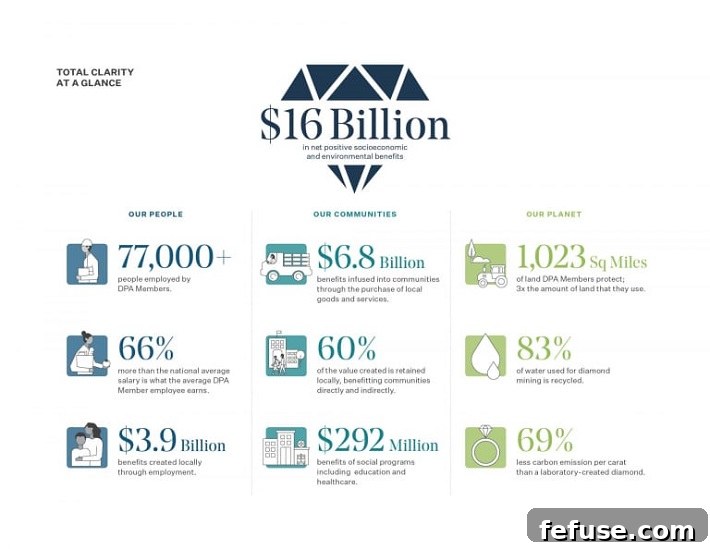
The rigorous data analysis conducted by Trucost ESG Analysis reveals a compelling narrative: DPA members generate an impressive net total of over US$16 billion (£12.2 million) in socioeconomic and environmental benefits through their extensive diamond mining operations. This staggering figure highlights the substantial positive contributions flowing directly from the diamond industry into the regions and communities where it operates. The report asserts that the vast majority of these benefits are channeled directly into local communities, manifesting through various crucial avenues: local employment, strategic sourcing of goods and services, significant tax contributions and royalties, impactful social programs, and vital infrastructure investments.
Beyond these financial infusions, the report also sheds light on the exceptional employment standards maintained by DPA members. It uncovers that employees and contractors within these companies receive salaries that are, on average, 66% above national average salaries in their respective countries. Furthermore, DPA companies place a strong emphasis on continuous employee training and development, ensuring a highly skilled and well-compensated workforce that is equipped for long-term career growth within the industry.
Establishing a Baseline for Future Progress
One of the report’s critical functions is to establish a robust baseline from which DPA members can meticulously track and demonstrate future progress towards their ambitious emission reduction goals. The data indicates that, collectively, DPA members emitted the equivalent of 160 kg of carbon dioxide per polished carat produced. To put this into relatable context, this figure is roughly equivalent to the amount of carbon dioxide generated by driving an average passenger vehicle for approximately 390 miles (or 628 kilometers). Recognizing this footprint, each member company has proactively set specific, measurable goals to further reduce these emissions, which currently represent the largest component of diamond mining’s overall environmental impact. This commitment underscores a forward-looking approach to environmental stewardship.
Challenging Outdated Stereotypes and Fostering Transparency
Despite the considerable progress achieved over the past 15 years in establishing more responsible and transparent practices, the contemporary reality of the diamond mining sector often remains largely misunderstood by the public. This report aims to bridge that knowledge gap, offering an unprecedented level of insight.
Jean-Marc Lieberherr, CEO of the Diamond Producers Association, articulated the report’s significance: “This report marks an industry first. Diamond producing companies representing three-quarters of the world’s production have come together to provide a window into the impacts and benefits of their activities on the communities and environments of the countries and regions in which they operate. This independent research report breaks outdated stereotypes and misconceptions and identifies the next set of challenges that must be met to continue to evolve and improve as an industry. It also provides a baseline for industry participants and observers to track future progress.” His comments highlight the collective will of the industry to foster genuine understanding and continuous improvement.
Libby Bernick, Managing Director and Global Head of Trucost Corporate Business, echoed this sentiment, stating, “This report marks the first time Trucost has seen an industry come together to measure its environmental, social and economic benefits and impacts. This data provides a baseline for future progress on issues, including environmental impact.” Her remarks validate the report’s methodological rigor and its groundbreaking nature within industrial sector reporting.
To ensure robust and credible findings, Trucost meticulously measured the total benefits and impacts of DPA members’ diamond mining activities across 21 key socioeconomic and environmental indicators. This extensive analysis was based on data collected for over 150 different metrics, sourced from DPA sites that collectively represent 70% of the DPA Members’ total rough diamond production. All collected data underwent thorough verification by Trucost and was then analyzed using their proprietary natural and social capital quantification and valuation methodologies—approaches that have been successfully applied in more than 100 studies over the past 15 years. Further details on Trucost’s sophisticated methodologies are readily available on their official website, underscoring the scientific foundation of this report.
Key Findings: A Deeper Dive into Impact
People: Empowering Local Communities and Workforce
DPA Members are committed to offering more than just jobs; they provide high-paying employment opportunities, comprehensive job training, and an unwavering dedication to maintaining a safe work environment. These companies prioritize employing individuals from local communities, thereby providing high-quality employment that often evolves into long-term, stable careers, fostering sustainable economic growth within these regions.
Key Findings:
- Salaries and wages paid directly by DPA Members generated an impressive US$3.9 billion in direct and indirect economic benefits, recirculating wealth within local economies.
- Globally, DPA Members employ a substantial 77,000 people in their operations. This workforce size is comparable to that of major Fortune 500 companies such as The Coca-Cola Company, Hewlett Packard Enterprise, Alphabet, Nordstrom, and Nike Inc., illustrating the industry’s significant employment footprint.
- DPA Members’ employees and contractors are exceptionally well-compensated and highly trained. On average, a DPA Member employee or contractor earns 66% more than the national average salary in their country and receives nearly five times the living wage, significantly improving quality of life.
- A fundamental commitment to “zero harm” in the workplace is shared by all DPA members. The report vividly demonstrates that safety incidents at Member companies are a mere fraction of those observed in comparable industrial sectors. For example, the construction industry, on average, experiences 17 times more lost time injuries than the DPA diamond mining sector, highlighting the robust safety protocols in place.
Communities: Fostering Sustainable Development and Lasting Impact
Beyond direct employment, the diamond mining industry makes an invaluable contribution to the socioeconomic development of diamond-producing countries and their communities. Members strategically source the vast majority of goods and services required for their operations from local businesses, creating a profound and lasting ripple effect on local economies. Furthermore, a substantial portion of their revenues is paid to diamond mining nations in the form of taxes, royalties, and dividends. The transformative power of these revenues is exemplified by countries like Botswana, which has seen remarkable development over the past 50 years, largely propelled by its diamond wealth. Modern diamond mining is fundamentally a long-term investment, and DPA Members actively cultivate enduring partnerships with the communities in which they operate, ensuring mutual benefit and sustainable progress.
Key Findings:
- A significant 60% of the total benefits generated by DPA Members are directly infused into local communities. This occurs through local sourcing of goods and services, payment of taxes and royalties, implementation of social programs, and crucial infrastructure investment.
- DPA Members injected a substantial US$6.8 billion in benefits into local communities through their extensive purchase of local goods and services, providing a vital economic stimulus.
- Local communities receive US$3.9 billion in positive benefits derived from employment and comprehensive social programs, including essential health and education initiatives (with US$292 million specifically allocated to these social programs).
- DPA Members contributed an impressive US$3 billion in tax revenue, royalties, and dividends. These funds, in turn, are critical for funding local infrastructure projects and other vital civic improvements that enhance community welfare.
Environment: A Commitment to a Greener Future
The DPA and its member companies unequivocally recognize that environmental stewardship is a paramount obligation of the diamond mining industry. Every DPA Member actively collaborates with local governments and communities to rigorously control and mitigate their environmental footprint. Today, the continuous reduction of this footprint stands as a clear and unwavering priority for diamond mining companies. DPA Member companies are proactively addressing this challenge through a diverse array of initiatives, including increasing access to renewable energy sources, implementing innovative energy reduction programs, and investing in advanced carbon capture research programs, all aimed at minimizing ecological impact.
Key Findings:
- The largest component of DPA Members’ environmental footprint is their CO2e (carbon dioxide equivalent) emissions, calculated at 160 kg of CO2e per polished carat.
- Significantly, the estimated CO2e associated with energy use in laboratory-created diamond production is nearly three times greater than the emissions generated by the natural diamonds produced by DPA members in 2016. This finding strongly underscores the relatively lower carbon intensity of natural diamond mining by DPA members compared to its synthetic counterparts.
- Collectively, DPA Members have protected an expansive area of more than 260,000 hectares (equivalent to 1,000 square miles) of pristine natural land across diverse regions including Russia, Botswana, South Africa, Tanzania, Australia, and Canada. This commitment means that Members protect three times the land area they actually use for mining globally, demonstrating a net positive contribution to biodiversity and wilderness conservation.
- To provide a tangible comparison, the environmental cost of producing a natural diamond is estimated to be approximately 37% of the cost of a single one-way airline ticket from New York City to Los Angeles, illustrating that the environmental impact is often less than commonly perceived.
- DPA Members are actively implementing long-term, comprehensive biodiversity conservation programs, aiming to preserve and restore ecological balance in their operating regions and beyond.
Furthermore, each DPA Member meticulously produces individual sustainability reports, which are publicly available on the DPA’s website. These reports serve as crucial tools to measure, analyze, and communicate their ongoing initiatives and progress towards environmental goals.
Commitments: The Path Forward for Sustainable Diamond Mining
The Diamond Producers Association has effectively facilitated active collaboration and the sharing of best practices among its Member companies, focusing on two absolute priority areas: energy conservation and CO2e emissions reduction, and ensuring exemplary employee health and safety standards. Moving forward, the DPA is committed to regularly reporting on ongoing sustainability progress. This will include sharing individual and collective advancements made by DPA Members towards these critical objectives and, more broadly, towards achieving the ambitious United Nations Sustainable Development Goals (SDGs). This demonstrates a sustained, long-term commitment to global sustainability frameworks.
Conclusion: A New Era of Transparency and Responsibility in Diamonds
This landmark report from the Diamond Producers Association, in collaboration with Trucost, heralds a new era of transparency and accountability within the natural diamond industry. By meticulously quantifying the substantial socioeconomic and environmental benefits, the DPA and its members are actively challenging outdated perceptions and demonstrating their profound commitment to responsible mining practices. From empowering local communities with high-quality employment and vital infrastructure to meticulously protecting vast natural landscapes and diligently working towards reducing carbon footprints, the natural diamond industry, led by DPA members, is proving its dedication to making a positive, lasting impact. This report not only provides a crucial baseline for future progress but also invites a deeper, more informed understanding of the journey a natural diamond takes from the earth to market, a journey increasingly defined by ethics, sustainability, and unparalleled commitment.
NewsSource: professionaljeweller