
Unlocking Global Opportunities: How Free Trade Agreements Empower India’s Gems & Jewellery Exports
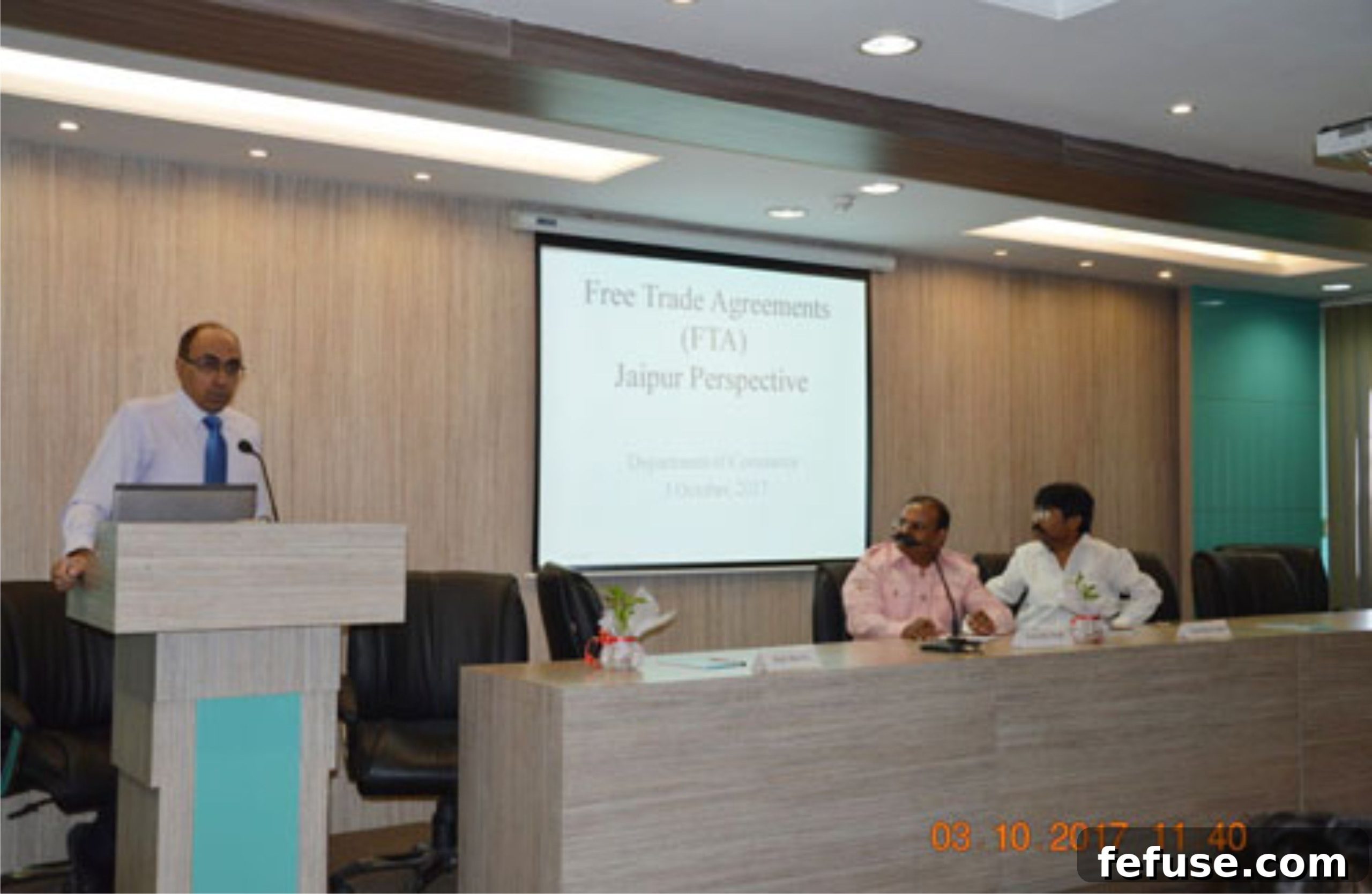
India’s gems and jewellery sector stands as a shining beacon of the nation’s economic prowess, contributing significantly to its foreign exchange earnings and employment. As a global leader in diamond cutting and polishing, and a major hub for gold jewellery manufacturing, the industry constantly seeks avenues to expand its reach and competitiveness in international markets. In this pursuit, Free Trade Agreements (FTAs) have emerged as pivotal instruments, offering Indian exporters unprecedented access and preferential treatment in numerous countries worldwide. Recognizing the critical importance of these agreements, the Gems and Jewellery Export Promotion Council (GJEPC), in a proactive collaboration with the office of the Joint Director General of Foreign Trade (Jt DGFT) Jaipur, organized a landmark seminar to illuminate the vast export opportunities presented by India’s FTAs.
This insightful seminar, held on October 3, 2017, at the GJEPC’s Jaipur Regional Office, served as a crucial platform for Indian exporters to gain a deeper understanding of the mechanisms and benefits inherent in these trade pacts. The event was meticulously designed to empower participants with practical knowledge, enabling them to strategically leverage FTAs for enhanced market penetration and increased profitability. The enthusiastic participation of a significant number of exporters underscored the industry’s keen interest and readiness to explore new global horizons, solidifying its position as a dynamic and forward-thinking contributor to India’s economy and its ambition to become a global trade leader.
Demystifying FTAs: A Strategic Seminar for Exporters
The core objective of the seminar was to demystify the complexities surrounding Free Trade Agreements and to explicitly highlight the tangible advantages they offer to the Indian gems and jewellery export community. Attendees, representing a diverse cross-section of the industry, from established manufacturers to emerging enterprises, gathered to absorb expert insights into navigating the international trade landscape more effectively. The event underscored the government’s unwavering commitment, facilitated by leading organizations like GJEPC and DGFT, to fostering an environment conducive to robust export growth and global competitiveness for Indian businesses. Such initiatives are fundamental in translating national economic policies into actionable strategies for individual exporters.
Key Insights from Distinguished Speakers
The seminar featured an illustrious panel of speakers, whose expertise provided invaluable perspectives on the intricacies of international trade policy. The main presentation was delivered by Shri Bipin Menon, Director, Department of Commerce, Ministry of Commerce & Industry, Government of India. His address was particularly enlightening, offering a comprehensive overview of India’s existing Free Trade Agreements and the strategic rationale behind their formulation. Shri Menon meticulously detailed how these agreements are crafted to provide preferential market access for Indian goods, thereby granting a significant competitive edge to domestic exporters. His deep understanding of trade policy and its practical applications resonated strongly with the audience, providing much-needed clarity on a topic that can often appear daunting to those unfamiliar with international trade law.
Further enriching the discussions, a representative from the New Delhi Joint Director General of Foreign Trade (Jt DGFT) also actively participated, contributing to an engaging Q&A session and offering perspectives from the enforcement and implementation side of trade regulations. The presence of such high-ranking officials from key governmental departments underscored the seriousness and strategic importance the government attaches to boosting India’s exports, particularly within high-value sectors like gems and jewellery. This collaborative effort between industry bodies and governmental agencies exemplifies a unified approach towards achieving ambitious export targets and streamlining processes for businesses.
The Unparalleled Advantage: Concessional and Nil Duties for Gems & Jewellery
A central theme that emerged prominently from the seminar was the extraordinary advantage offered by FTAs in terms of tariff reductions. Shri Menon explicitly highlighted that under these agreements, Indian exporters are entitled to ship a wide array of Gems & Jewellery products to partner countries at significantly concessional duty rates. More impressively, in numerous instances, these meticulously crafted products can even enter foreign markets with nil duty. This preferential tariff treatment directly translates into substantial cost savings for exporters, making Indian gems and jewellery more attractive and highly competitive in the global marketplace compared to goods from non-FTA countries.
The impact of reduced or eliminated duties cannot be overstated for an industry as intricate and globally competitive as gems and jewellery. For businesses where margins can be tight and market dynamics fiercely competitive, any reduction in landed costs provides a critical edge. It empowers Indian manufacturers to offer more competitive pricing, capture larger market shares, and ultimately boost their profitability. This direct financial benefit is a powerful incentive for exporters to understand and actively utilize the provisions of India’s various Free Trade Agreements. It effectively levels the playing field against international competitors and opens doors to new consumer bases previously deterred by prohibitive import tariffs, fostering true global reach for Indian craftsmanship.
India’s Global Footprint: The Strategic Importance of FTAs
India has been strategically forging Free Trade Agreements with key economies and regional blocs around the world as a cornerstone of its foreign trade policy. These agreements are not merely about reducing tariffs; they are comprehensive pacts designed to facilitate trade across various dimensions, including services, investment, intellectual property rights, and customs procedures. For the gems and jewellery sector, these agreements are transformative, enabling easier access to crucial raw materials, ensuring smoother cross-border movement of finished goods, and enhancing investor confidence both domestically and internationally. They represent a commitment to economic integration and mutual growth.
Current and evolving FTAs, such as those with ASEAN, Japan, South Korea, and more recently, the UAE and Australia, represent vast consumer markets and significant trading partners. Each agreement offers specific advantages tailored to the economic relationship between India and its partners. Understanding the nuances of each FTA, including precise rules of origin, product-specific rules, and dispute resolution mechanisms, is paramount for exporters looking to maximize benefits. The GJEPC seminar served precisely this purpose: to distill complex legal frameworks into actionable, understandable insights for the industry, ensuring practical applicability and commercial advantage.
Expanding Market Access and Diversification for Indian Exporters
One of the most significant benefits of FTAs is the expansion of market access. By systematically reducing trade barriers, Indian gems and jewellery products can reach a wider and more diverse consumer base in various geographical regions. This diversification is crucial for mitigating risks associated with over-reliance on a few major markets. For instance, an FTA with a specific region can unlock demand for particular types of jewellery or gemstones that might not be as popular in traditional export destinations. This allows Indian manufacturers to innovate, tailor their product offerings, and explore new design trends to cater to varied international tastes and preferences, fostering creativity and responsiveness within the sector.
Moreover, market diversification fostered by FTAs significantly enhances the resilience of the Indian gems and jewellery industry against global economic fluctuations or geopolitical shifts affecting specific markets. By having a robust presence and diversified export portfolio across multiple FTA partner countries, exporters can better absorb economic shocks and maintain stable growth trajectories, ensuring the long-term sustainability and vibrancy of the sector. This strategic spread of risk is vital for an industry heavily reliant on global consumer confidence and demand.
The GJEPC’s Pivotal Role in Fostering Export Growth
The Gems and Jewellery Export Promotion Council (GJEPC) plays an indispensable and multifaceted role in promoting, protecting, and facilitating the sustained growth of India’s gems and jewellery exports. Established by the Ministry of Commerce & Industry, Government of India, the GJEPC acts as the apex body for the industry, undertaking numerous initiatives to support its members. These critical functions include comprehensive market research, leading trade delegations to international events, organizing and participating in global exhibitions, implementing skill development programs, and orchestrating crucial knowledge-sharing seminars like the one held in Jaipur, which are designed to empower and inform the industry.
The Council’s efforts extend beyond mere promotion; it actively engages with policymakers and government bodies to advocate for industry-friendly policies, including the negotiation and effective implementation of new Free Trade Agreements and the refinement of existing ones. By regularly organizing seminars, workshops, and training sessions, GJEPC empowers exporters with the necessary tools, up-to-date information, and strategic insights to navigate the complexities of international trade and effectively capitalize on preferential trade agreements. Their proactive, member-centric approach ensures that Indian exporters are well-equipped to compete on a global scale and to uphold India’s revered reputation as a reliable, innovative, and high-quality supplier of exquisite gems and jewellery.
Practical Steps for Exporters: Leveraging FTA Benefits Effectively
For exporters looking to leverage the significant benefits of Free Trade Agreements, understanding the practical steps involved is crucial for seamless operations and maximum advantage. The primary requirement is often obtaining a Certificate of Origin (COO), a vital document which authentically certifies that the goods being exported originate from India and thus qualify for preferential tariff treatment under a specific FTA. This essential document, typically issued by authorized bodies like the Directorate General of Foreign Trade (DGFT) or the GJEPC, is indispensable for swift and efficient customs clearance in the importing partner country, ensuring the goods receive their entitled duty benefits.
Beyond the COO, exporters must also be meticulously well-versed in the intricate ‘Rules of Origin’ specific to each individual FTA. These rules rigorously define the criteria for determining the national origin of a product, a particularly important aspect for goods that involve materials or processing from multiple countries. Compliance with these precise rules ensures that products genuinely qualify for reduced or nil duties. Ignorance of these intricate details can unfortunately lead to delays, penalties, increased costs, or even outright denial of preferential treatment at customs. Therefore, continuous education and readily accessible expert guidance, precisely what the GJEPC seminar aimed to provide, are invaluable resources for the discerning export community, fostering compliance and sustained success.
Looking Ahead: India’s Vision for Global Trade Leadership
The seminar in Jaipur, though held in 2017, remains profoundly relevant as India continues its aggressive pursuit of a more robust global trade footprint and economic dominance. The government’s ‘Make in India’ and ‘Vocal for Local’ initiatives are intrinsically linked to boosting exports and enhancing domestic manufacturing capabilities across all sectors. Free Trade Agreements serve as a vital mechanism to translate these overarching national objectives into tangible economic benefits. By securing preferential market access, India not only promotes its finished products on the global stage but also strategically attracts foreign investment into its burgeoning manufacturing sector, creating a virtuous cycle of sustained growth and employment opportunities across the nation.
As India confidently aspires to become a five-trillion-dollar economy in the near future, the indispensable role of exports, particularly from high-value sectors like gems and jewellery, will be paramount. Continued engagement, constructive dialogue, and robust capacity-building initiatives, similar to the highly successful one organized by GJEPC and Jt DGFT Jaipur, will be essential to keep the entire export community informed, agile, and thoroughly prepared for the continuously evolving global trade landscape. The proactive dissemination of timely information on new FTAs and amendments to existing ones will ensure that Indian exporters remain dynamic and competitive, ready to seize every emerging opportunity that comes their way.
Conclusion: A Bright Future for India’s Gems & Jewellery Exports
The seminar organized by GJEPC and Jt DGFT Jaipur was a powerful testament to the collaborative spirit and strategic vision driving India’s export ambitions. By shedding clear light on the immense potential and tangible advantages offered by Free Trade Agreements, the event provided critical impetus and much-needed clarity to the vibrant gems and jewellery export community. The overarching message was unequivocal: FTAs are not just bureaucratic documents but powerful, dynamic tools specifically designed to significantly enhance the competitiveness, market reach, and overall profitability of Indian products in diverse international markets.
As India continues to strengthen its formidable position as a global leader in the gems and jewellery sector, strategic initiatives like this seminar are absolutely vital. They empower exporters with the comprehensive knowledge and practical skills necessary to confidently navigate global trade complexities, substantially reduce costs, and effectively access vast new markets. The unwavering commitment from both leading industry bodies and responsive government agencies ensures a bright, prosperous, and globally dominant future for India’s radiant gems and meticulously crafted jewellery on the world stage, truly unlocking boundless global opportunities for this iconic Indian industry and its countless artisans.
News Source: gjepc.org