
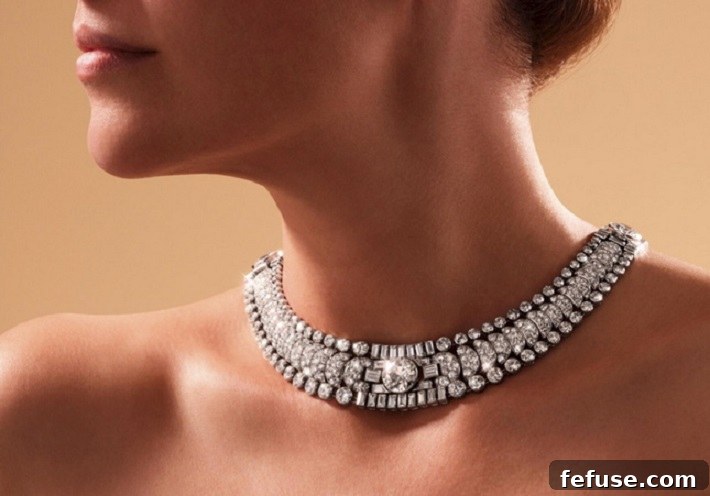
An extraordinary piece of high jewelry history, a 1929 diamond and platinum “tie-necklace” crafted by the legendary house of Van Cleef & Arpels, recently captivated the luxury world, selling for an astonishing $3.6 million at Sotheby’s New York. This remarkable sum far exceeded its pre-sale expectations, fetching three times its high estimate and solidifying its place as one of the most significant and sought-after jewels to cross the auction block in recent memory. Hailing from a distinguished American collection, this unique creation was the undisputed highlight of Sotheby’s prestigious Magnificent Jewels auction, showcasing both unparalleled craftsmanship and the enduring allure of Art Deco design.
The auction itself was a testament to the robust market for exceptional vintage jewelry. Carrying an initial estimate of $800,000 to $1.2 million, the Van Cleef & Arpels tie-necklace not only met but spectacularly surpassed these figures, drawing intense bidding from collectors worldwide. Its final hammer price made it the highest-selling lot of the entire auction, narrowly edging out another formidable contender: a magnificent, loose, pear-shaped D-color, internally flawless (IF) diamond weighing an impressive 53.04 carats, which itself commanded $3.48 million against an estimate of $3 million to $5 million. The fact that the intricate design and historical provenance of the tie-necklace outweighed the sheer size and perfection of a singular large diamond speaks volumes about its unique appeal and perceived value in the eyes of connoisseurs.
The Genesis of a Gem: Van Cleef & Arpels and the Art Deco Era
Van Cleef & Arpels has long been synonymous with innovation, elegance, and exceptional savoir-faire in the realm of high jewelry. Founded in Paris in 1906, the maison quickly established a reputation for creating groundbreaking designs that pushed the boundaries of traditional jewelry. The late 1920s, when this tie-necklace was conceived, was a period dominated by the Art Deco movement—an aesthetic defined by its geometric forms, streamlined silhouettes, and a penchant for luxurious materials. This era encouraged bold experimentation in fashion and jewelry, reflecting a modern woman who was increasingly independent and sought designs that complemented her evolving lifestyle and wardrobe.
The 1929 tie-necklace is a quintessential example of Van Cleef & Arpels’ ingenuity during this vibrant period. Its conception reflects a deep understanding of contemporary fashion and a desire to create pieces that were not just adornments but statements. The design, with its novel and elaborate structure, offered versatility—a key element for the modern woman. It could be worn at the front of a dress, cascading like a sophisticated cravat, or elegantly draped over one shoulder, adding a touch of drama and sparkle to an evening gown. This adaptability made it a truly progressive piece for its time, embodying the spirit of elegance, freedom, and innovation that defined the Art Deco age.
A Dazzling Display: The Anatomy of the Tie-Necklace
Crafted in the luxurious and durable metal of platinum, the tie-necklace is a breathtaking composition of diamonds, meticulously set to maximize their brilliance. The choice of platinum was deliberate; its strength allowed for intricate settings with minimal metal visible, letting the diamonds take center stage, and its silvery-white hue perfectly complemented the cool fire of the diamonds. The sheer volume and quality of the gemstones incorporated into this single piece are astounding, totaling approximately 149.15 carats.
The Heart of the Necklace: Major Diamonds
At the core of this magnificent creation are three principal diamonds, each of substantial size and character, forming the central focus of the cascading design. These impressive stones weigh approximately 8.15 carats, 8.05 carats, and 7.40 carats, respectively. Their color is assessed as approximately I-K, which signifies a near-colorless to faint yellow tint, a common and highly valued range for vintage diamonds that often possess a unique warmth and depth. The clarity of these main stones is approximately SI-I (Slightly Included to Included), meaning they have minor to noticeable inclusions, though these characteristics typically do not detract from the overall beauty and sparkle of such large, well-cut diamonds from this era, especially when viewed with the naked eye.
The Accenting Brilliance: Supporting Gemstones
Complementing these three substantial diamonds is a dazzling array of accenting diamonds, which collectively weigh an approximate total of 125.55 carats. These smaller, yet equally crucial, stones are predominantly G-I color, indicating they are in the near-colorless range—a highly desirable trait that ensures a bright, icy white appearance. Their clarity is rated as VS-I (Very Slightly Included to Included), meaning they have very minor inclusions that are difficult to see under 10x magnification, contributing to the necklace’s overall exceptional sparkle and visual purity. The meticulous arrangement of these hundreds of diamonds creates a fluid, radiant tapestry that shimmers with every movement, truly bringing the tie-necklace to life.
A Fleeting Fashion: The Rarity and Legacy of the Tie-Necklace
The opulent nature of tie-necklaces like this Van Cleef & Arpels masterpiece meant that their production was incredibly limited. These were not pieces for mass consumption; they were bespoke creations for an elite clientele, custom-made to exacting standards. The intricate design, the astronomical quantity of high-quality diamonds, and the skilled labor required for their fabrication meant that only a mere handful of examples were ever brought into existence. Each one represented a pinnacle of high jewelry artistry and an investment of considerable resources.
Despite their breathtaking beauty and innovative design, the tie-necklace proved to be a relatively short-lived fashion trend. Its heyday coincided with the vibrant, post-World War I era of the Roaring Twenties, where extravagance and new forms of expression flourished. However, the global economic downturn of the Great Depression, which began in late 1929, significantly impacted the demand for such lavish and non-essential items. As societal tastes evolved and economic realities shifted, the intricate and somewhat formal style of the tie-necklace gradually fell out of favor. The last recorded example of this distinctive jewelry type was produced in 1935, marking the end of an intriguing chapter in high jewelry design.
Today, the extreme rarity of these pieces only enhances their desirability and historical significance. A Van Cleef & Arpels tie-necklace from this specific period is not just a piece of jewelry; it is a tangible artifact of an iconic brand’s creative peak, a symbol of Art Deco glamour, and a testament to a bygone era of unparalleled luxury. Its provenance, combined with its exquisite condition and the universal recognition of its creator, makes it an irresistible acquisition for serious collectors and institutions alike. The record-breaking sale at Sotheby’s underscores that exceptional quality, unique design, and historical importance will always command premium prices, ensuring that this magnificent tie-necklace will continue to be admired and celebrated for generations to come.