
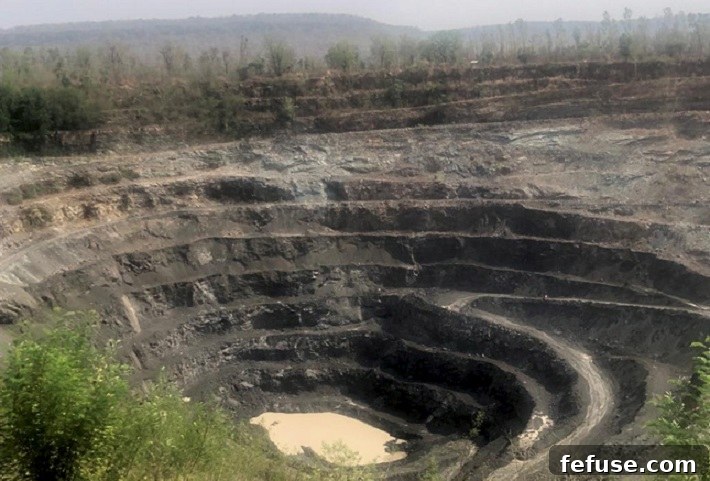
Resurrection of a Gem: India’s Majhgawan Diamond Mine Springs Back to Life
A significant development in India’s mineral landscape has captured global attention: work has officially resumed at the Majhgawan mine, the nation’s sole mechanized diamond extraction facility. Located in the picturesque Panna district of Madhya Pradesh, this mine holds immense strategic importance for India’s domestic diamond supply chain and its broader mining sector. After facing a series of operational halts and environmental challenges, the restart signals renewed hope for boosting indigenous diamond production and cementing India’s position not only as a global leader in diamond cutting and polishing but also as a growing player in raw diamond extraction.
The Road to Extraction: Overcoming Geological Hurdles
The path to reaching the valuable diamond-bearing kimberlite ore at Majhgawan is an extensive and painstaking one. Experts estimate that it could take up to a full year to meticulously remove the vast quantities of overlying soil and stone, commonly known as overburden. This crucial initial phase involves large-scale earthmoving operations to expose the mineralized rock layers beneath. The overburden, composed of various geological strata accumulated over millennia, must be systematically excavated and transported away from the main mining pit. This process, while time-consuming and capital-intensive, is fundamental to ensuring safe and efficient access to the primary diamond reserves. The scale of this preparatory work underscores the commitment required to reactivate a mine of this magnitude and highlights the complex engineering involved in modern mechanized mining operations.
National Mineral Development Corporation (NMDC), India’s largest iron ore merchant miner and a prominent public sector undertaking, is at the helm of this ambitious project. NMDC harbours optimistic projections for the mine’s future, aiming for an annual production target of 40,000 carats. This figure represents a substantial increase over past performances and reflects the company’s confidence in the Majhgawan deposit’s potential and its enhanced operational strategies following the resumption of activities. Achieving this target would significantly contribute to India’s domestic gem market and potentially reduce reliance on imported rough diamonds, thereby bolstering the nation’s economic self-reliance in this critical sector.
A Storied History: The Panna Diamond Mining Project
The Panna Diamond Mining Project, situated approximately 15 kilometres from the historic town of Panna, boasts a rich and often tumultuous history. Its commercial production commenced in 1971, marking a pivotal moment for organized diamond mining in India. For several decades, until 2017, the mine was operated by Rio Tinto, a global mining giant with extensive experience in diamond extraction worldwide. Rio Tinto’s involvement brought international standards and advanced technologies to the Panna region, laying much of the foundational infrastructure and expertise that continues to serve the mine today. The transition of operators and subsequent challenges have shaped the mine’s trajectory, making its current revival even more noteworthy.
Throughout its operational history, the Majhgawan mine has experienced multiple periods of cessation. These halts have often been triggered by a confluence of factors, including regulatory complexities, market fluctuations, and increasingly, environmental concerns. One of the most significant interruptions occurred in December 2020 when critical environmental clearances lapsed. This specific issue arose due to concerns voiced by conservationists and authorities regarding the mine’s proximity to the ecologically sensitive Panna Tiger Reserve, a vital habitat for one of India’s most iconic species. Balancing the economic imperative of mineral extraction with the urgent need for environmental protection has been, and continues to be, a delicate tightrope walk for the operators and regulatory bodies.
Production Dynamics and the Impact of Halts
The recent production figures vividly illustrate the challenges faced by the Majhgawan mine in the years leading up to its current restart. For the fiscal year 2021 (FY2021), the mine managed to produce 13,681 carats, a modest figure reflective of the operational constraints and impending environmental clearance issues. Subsequently, FY22 witnessed a complete halt in production. Despite the absence of new extraction, NMDC successfully sold 25,219 carats from existing stockpiles during FY22, generating revenues valued at approximately $7.5 million. This sale underscored the market demand for Panna diamonds even during non-production periods, demonstrating the inherent value of the reserve.
The subsequent fiscal years, FY23 and the first eleven months of FY24, also saw no production activity. This extended hiatus underscores the severity of the regulatory and operational hurdles that needed to be resolved before work could safely and legally resume. The prolonged period without new diamond output has had ripple effects, not only on NMDC’s balance sheets but also on the local economy of the Panna region, which heavily relies on the mine for employment and ancillary business opportunities. The return to production, therefore, carries significant economic weight for the local communities and stakeholders.
India’s Diamond Landscape: Mechanized vs. Artisanal Mining
India’s diamond mining sector presents a unique dichotomy. While the Majhgawan mine stands as the country’s sole mechanized operation, employing large-scale machinery and advanced geological techniques for extraction, the broader landscape is dominated by a multitude of smaller-scale operations. There are over 1,000 licensed artisanal mines scattered across various regions, particularly within the Panna belt itself. These artisanal miners, often working with traditional methods and limited equipment, play a crucial role in providing livelihoods for countless families and contributing to local economies.
The contrast between mechanized and artisanal mining is stark. Mechanized operations like Majhgawan involve significant capital investment, detailed geological surveys, environmental impact assessments, and strict regulatory compliance. They are designed for large-scale, long-term extraction from deeper kimberlite pipes. Artisanal mining, conversely, typically focuses on shallow alluvial deposits, is labour-intensive, and often operates with fewer resources and more localized permits. While both contribute to India’s diamond supply, Majhgawan’s mechanized nature signifies a level of industrialization and output potential unmatched by its smaller counterparts, making its continued operation paramount for strategic resource management.
Environmental Stewardship and Sustainable Mining Practices
The renewed environmental clearances for the Majhgawan mine highlight a critical shift towards more stringent and sustainable mining practices. The Panna Tiger Reserve, a sprawling protected area adjacent to the mining site, is a biodiversity hotspot and a conservation success story for India’s tiger population. The concerns raised in 2020 emphasized the potential impact of mining activities—such as noise, dust, vibration, water pollution, and habitat fragmentation—on the delicate ecosystem of the reserve. NMDC’s current operations are now under enhanced scrutiny to ensure minimal ecological footprint.
Modern mining operations are increasingly integrating environmental management plans, including measures for reforestation, water recycling, waste management, and wildlife protection corridors. For the Majhgawan mine, this might involve adopting advanced dust suppression techniques, installing water treatment plants, carefully monitoring noise levels, and implementing strict protocols to prevent any encroachment or disturbance to the tiger reserve’s boundaries. The balancing act between extracting valuable resources and preserving irreplaceable natural heritage is a complex global challenge, and the Panna project serves as a key example of India’s commitment to finding viable solutions through responsible mining and rigorous environmental compliance.
Economic Impact and Future Prospects for India’s Diamond Sector
The successful and sustained operation of the Majhgawan diamond mine holds substantial economic promise for India. Achieving the 40,000-carat annual target would not only inject significant revenue into the state and national exchequers but also create direct and indirect employment opportunities for thousands of people in the Panna region. These jobs range from skilled mining engineers and geologists to equipment operators, administrative staff, and various support services. Furthermore, increased domestic supply of rough diamonds could bolster India’s world-renowned diamond cutting and polishing industry, which currently processes a vast majority of the world’s rough diamonds, predominantly imported.
Looking ahead, the Majhgawan mine’s successful revival could also pave the way for further exploration and development of other potential diamond-bearing kimberlite pipes in the Panna region and beyond. India’s geological surveys have identified other prospective areas, and the success of this flagship project could attract more investment into the country’s mineral exploration sector. With global demand for diamonds remaining robust, driven by both jewellery and industrial applications, Majhgawan’s consistent output will strengthen India’s position in the global diamond supply chain, contributing to its economic growth and mineral security. The journey ahead will undoubtedly require continuous innovation, adherence to best practices in sustainability, and collaborative efforts between government, industry, and local communities to ensure a prosperous and environmentally responsible future for India’s diamond mining industry.