
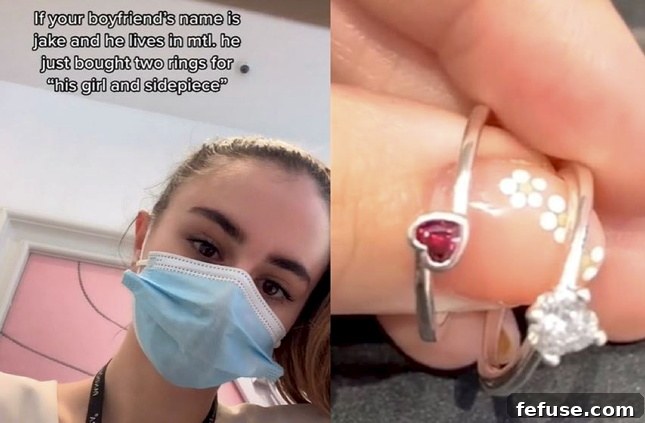
A shocking incident at a popular jewelry store, brought to light by a former employee, has ignited a fierce online debate about customer privacy, employee ethics, and the complex dynamics of modern relationships. The saga began when a TikTok video posted by a former Pandora worker went viral, exposing a customer who allegedly purchased two rings: one intended for his girlfriend and another for his “sidepiece.” This compelling narrative quickly captured global attention, underscoring the powerful reach of social media in uncovering personal dramas and sparking widespread discussion.
Pandora Worker Exposes Cheating Boyfriend in Viral TikTok: A Deep Dive into Digital Accountability and Ethical Dilemmas
In an age where personal lives often intersect with public platforms, the boundaries of privacy and disclosure are constantly being redefined. This story, originating from a humble jewelry store transaction, has become a powerful example of how digital transparency can unravel secrets and trigger profound conversations about honesty, loyalty, and the responsibilities of individuals in both their personal and professional capacities.
The Unfolding Scandal: A Simple Purchase, A Complex Revelation
The incident began as seemingly any other retail transaction at a Pandora store. A customer approached the counter, seeking to purchase two rings. However, the seemingly innocuous nature of the purchase quickly shifted when an observant and ethically driven employee, identified as Eli from Montreal, Canada, became involved. Eli, whose TikTok handle is @ferreiroroche, recounted the pivotal moment that led to her controversial revelation.
According to Eli, the customer was purchasing two distinct silver and cubic zirconia rings, priced at $45 and $50 respectively. A standard part of the sales process involves inquiring about receipt preferences. Eli’s simple question – whether the customer desired one receipt or two – inadvertently became the catalyst for a startling confession. Faced with the choice, the customer reportedly “came clean,” admitting that one ring was for his primary partner and the other for an individual he referred to as his “sidepiece.” This admission instantly transformed a routine retail interaction into a morally charged encounter, placing Eli in an unexpected ethical quandary.
The worker’s account paints a vivid picture of the internal conflict she must have faced. On one hand, there’s the professional obligation to maintain customer confidentiality. On the other, a strong sense of solidarity and justice, often dubbed “girl code,” propelled her towards action. The choice she made ultimately led to a viral sensation and an intense online discussion, highlighting the growing power of social media as a platform for moral policing and personal accountability.
From Sales Counter to Global Sensation: The TikTok Phenomenon
Eli decided to take her experience to TikTok, a platform renowned for its ability to transform everyday events into viral content. Her video quickly amassed an astonishing 2.6 million views within just ten days, demonstrating the immense appetite for real-life drama and ethical dilemmas among online audiences. In the clip, Eli directly addressed the situation, stating, “If your boyfriend’s name is Jake and he lives in MTL, he just bought two rings for his ‘girl and his sidepiece.’” She concluded her message with a blunt and empathetic warning: “You deserve better.”
The video’s caption, “Gotta support my girls,” further underscored Eli’s motivation: a desire to protect and inform other women. This sentiment resonated deeply with millions, leading to an explosion of shares, likes, and comments. The rapid virality of the content can be attributed to several factors: the dramatic nature of infidelity, the perceived justice of exposure, and the collective desire to uphold certain moral standards, particularly among women. TikTok, with its short-form video format and highly engaged community, proved to be the perfect conduit for this explosive narrative, allowing it to transcend local boundaries and become a topic of global conversation.
Ethical Crossroads: Privacy, Professionalism, and Public Shaming
The incident immediately ignited a passionate debate about the ethics involved. From a professional standpoint, employees are generally bound by policies that safeguard customer privacy. Disclosing personal details, even concerning morally questionable behavior, can potentially lead to repercussions for the employee and legal challenges for the company. While Eli is a “former” worker, the initial act of filming and posting occurred in the context of her knowledge gained as an employee, raising questions about the appropriate boundaries for retail staff.
However, many online commenters fervently defended Eli’s actions, citing a higher moral imperative. They argued that exposing infidelity, especially when it involves deceit and disrespect, outweighs the customer’s right to privacy. This perspective often leans on the concept of “girl code” – an unwritten rule among women to support each other and prevent harm from deceptive partners. The sentiment is that while privacy is important, it should not be a shield for unethical behavior that directly impacts another person’s well-being and trust.
The debate extends to the efficacy and ethics of public shaming in the digital age. Is it a legitimate tool for accountability, or does it cross a line into vigilantism? In this case, the customer had confessed, lending credibility to the accusation. Yet, the broader implications of publicly identifying individuals for personal transgressions remain a contentious issue, prompting discussions about due process, potential for misidentification, and the lasting impact on those exposed to online scrutiny.
The Power of Collective Investigation and Digital Solidarity
The online community’s response to Eli’s video was swift and decisive. The call to identify “Jake from MTL” quickly became a focal point. True to the nature of viral phenomena, it wasn’t long before at least one commenter claimed to know Jake’s identity. This showcases the incredible power of crowdsourced investigation and digital solidarity, where thousands of individuals collectively work to uncover information, often with surprising speed and accuracy.
This collective effort highlights a growing trend where social media users take on roles traditionally associated with investigative journalism or community policing. While this can be a force for good, bringing accountability to situations that might otherwise remain hidden, it also carries inherent risks, including the potential for wrongful accusations, digital vigilantism, and the erosion of individual privacy without due process. The “Jake” incident serves as a stark reminder of how quickly personal transgressions can become public spectacles, with consequences that extend far beyond the original parties involved.
Implications for Relationships and Trust in the Digital Age
Beyond the immediate drama, this viral story delves into deeper societal issues concerning relationships, trust, and fidelity in the digital era. Infidelity has always been a painful aspect of human relationships, but the advent of social media has amplified its visibility and consequences. The ability for a personal secret to explode into a global headline fundamentally alters the landscape of accountability.
For individuals in relationships, the “Jake” saga serves as a cautionary tale. It underscores that actions taken in what might be perceived as private moments can easily be exposed, often with severe repercussions for all parties involved – the deceived partner, the “sidepiece,” and the perpetrator of the infidelity. The story implicitly asks us to consider the value of honesty and transparency in relationships, particularly when the potential for digital exposure looms large.
Moreover, the incident explores the emotional fallout that such revelations can cause. The girlfriend, who likely had no idea of the deception, faces public humiliation and heartbreak. The “sidepiece” is also thrust into an unwelcome spotlight. And Jake himself, despite his confession, is now a globally recognized figure of infidelity, his reputation potentially irrevocably damaged. The digital realm leaves little room for quiet resolution; instead, it often magnifies pain and conflict, drawing countless strangers into intimate personal battles.
Lessons Learned: Navigating a Hyper-Transparent World
The Pandora worker’s viral video is more than just a fleeting internet sensation; it’s a potent commentary on the evolving norms of privacy, ethics, and accountability in our hyper-connected world. It raises critical questions for individuals, businesses, and society at large:
- For Employees: Where do professional duties end and personal moral obligations begin? What are the boundaries of confidentiality, especially when faced with perceived injustice?
- For Businesses: How do companies navigate situations where employees use social media to expose customer behavior? What policies need to be in place to balance employee rights with customer privacy and brand reputation?
- For Individuals: What is the true cost of deceit in an age of digital transparency? How do we balance the desire for justice with the potential for public shaming?
- For Society: Are we moving towards a world where personal accountability is increasingly enforced by collective online action, and what are the long-term implications of such a shift?
The story of Jake and the two rings from Pandora will undoubtedly continue to spark conversations long after the TikTok views cease to climb. It serves as a stark reminder that in our digitally intertwined lives, actions can have far-reaching consequences, often extending beyond the immediate individuals involved. As technology continues to blur the lines between private and public, the ethical dilemmas presented by stories like Eli’s will only become more frequent and complex, challenging us all to reconsider our understanding of privacy, trust, and justice in the modern age.
Conclusion: A Digital Mirror Reflecting Our Values
The viral narrative of the Pandora worker exposing a cheating customer serves as a powerful digital mirror, reflecting contemporary societal values and anxieties regarding fidelity, transparency, and personal accountability. It underscores how individual actions, once confined to private spaces, can now ignite global conversations, challenge corporate policies, and redefine the ethical frameworks within which we operate. As we continue to navigate this increasingly interconnected world, the “Jake from MTL” saga stands as a compelling testament to the unpredictable, yet undeniably influential, power of social media to expose truths, demand justice, and spark essential dialogues about the human condition in the digital age.