
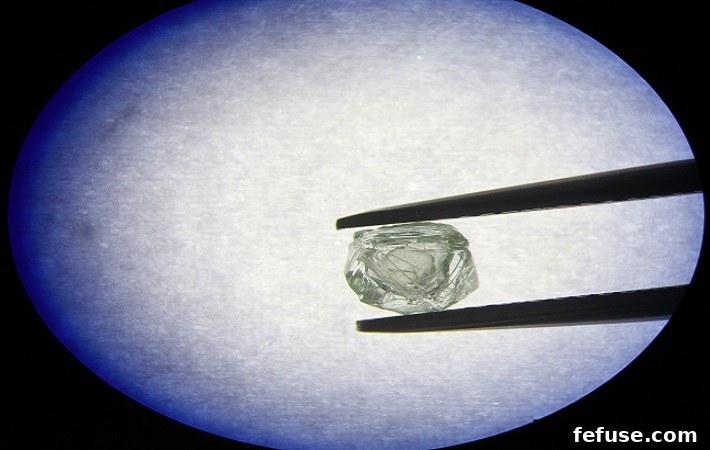
The Unprecedented Matryoshka Diamond: A Geological Marvel from Yakutia
In a discovery that has sent ripples of excitement through the gemological and scientific communities, an utterly extraordinary diamond has been unearthed in the remote and mineral-rich region of Yakutia, Russia. Mined by ALROSA, the world’s leading diamond producer by volume, this one-of-a-kind gemstone holds a smaller, distinct diamond moving freely within its core, much like the iconic Russian Matryoshka nesting dolls. This unprecedented find, originating from ALROSA’s Nyurba mining and processing division, marks a monumental moment in the history of global diamond mining, representing the first such phenomenon ever recorded.
The allure of this “Matryoshka diamond” lies not only in its stunning visual analogy but also in the profound scientific questions it raises. While inclusions within diamonds are relatively common, finding a perfectly formed, distinct, and freely moving diamond encased within another is an absolute rarity. This discovery pushes the boundaries of our understanding of diamond formation, challenging long-held theories and opening new avenues for research into the Earth’s deep mantle processes. It is a testament to nature’s boundless capacity for creation and surprise, particularly in environments as extreme as the planet’s interior.
A Glimpse into Deep Time: The Diamond’s Ancient Origins
Scientists estimate this remarkable diamond to be incredibly ancient, dating back over 800 million years. This immense age underscores the slow, powerful geological timescales involved in its creation, deep beneath the Earth’s surface. Despite its intricate internal structure and the profound scientific interest it generates, the entire stone is surprisingly modest in size. It weighs a mere 0.62 carats, equivalent to approximately 0.124 grams, making it a truly miniature marvel.
Its maximum external dimensions are a compact 4.8 x 4.9 x 2.8 mm. To put this into perspective, it’s smaller than a pea, yet it encapsulates a geological mystery millions of years in the making. The small size, however, does not diminish its significance; rather, it amplifies the wonder of how such a complex and stable structure could have formed and survived deep within the Earth’s mantle and subsequent journey to the surface.
Unveiling the Matryoshka’s Inner World: Detailed Characteristics
The true marvel of the Matryoshka diamond lies within its internal architecture. Researchers have meticulously measured its components, revealing a fascinating interplay of solid crystal and empty space:
- External Diamond Dimensions: The outer diamond measures a maximum of 4.8 x 4.9 x 2.8 mm, providing a protective shell for its unique inhabitant.
- Total Weight: The entire composite stone weighs 0.62 carats (0.124 grams), a testament to its density despite its internal void.
- Internal Cavity Volume: Approximately 6 cubic millimeters. This “air space” or void is the critical element that allows the inner diamond its freedom of movement, a feature unparalleled in previous diamond discoveries.
- Inner Diamond Volume: The encapsulated crystal occupies approximately 1.6 cubic millimeters.
- Inner Diamond Estimated Weight: The inner diamond itself is exceptionally tiny, weighing around 0.02 carats (0.004 grams).
- Inner Diamond Characteristics: It possesses a distinct tabular shape, with precise dimensions of 1.9 x 2.1 x 0.6 mm. The ability of this smaller, perfectly formed diamond to move freely within its host creates the mesmerizing Matryoshka effect, setting it apart from typical static inclusions and making it a true geological anomaly.
These precise measurements underscore the delicate balance and extraordinary conditions of geological forces that must have converged to create such a unique structure. The very existence of a stable void, rather than a solid inclusion, is what elevates this diamond to a truly unprecedented specimen of natural artistry and scientific intrigue.
From the Depths of Yakutia: ALROSA’s Role in Discovery
The journey of this exceptional gemstone highlights the rigorous and meticulous processes employed by ALROSA, a company synonymous with global diamond production. The Matryoshka diamond began its ascent to fame from the Nyurba mining and processing division in the Sakha Republic (Yakutia), a region globally recognized for some of the world’s most significant diamond finds. Yakutia, located in the vast and remote Siberian expanse, is renowned for its prolific kimberlite pipes, which are the primary geological conduits that bring gem-quality diamonds from the Earth’s mantle to its surface. ALROSA, operating several major mines across this region, stands at the forefront of global diamond production, consistently unearthing stones that range from industrial-grade to exceptionally rare and scientifically invaluable specimens.
The diamond was initially identified during a routine sorting process at the Yakutsk Diamond Trade Enterprise. This critical stage, where raw diamonds are carefully evaluated and categorized based on size, shape, and quality, relies on the keen eyes and expertise of highly trained specialists. Upon recognizing the highly unusual nature of this particular stone – a characteristic that would easily set it apart from typical rough diamonds – the specialists promptly forwarded it for further, in-depth examination. This quick recognition allowed the stone to bypass standard processing and be preserved for scientific scrutiny. The gem was then transferred to ALROSA’s Research and Development Geological Enterprise, the scientific arm dedicated to studying geological anomalies and pushing the boundaries of diamond research and understanding.
Advanced Scientific Scrutiny: Unlocking Formation Secrets with Cutting-Edge Technology
At ALROSA’s R&D Geological Enterprise, a battery of advanced analytical techniques was deployed to understand the Matryoshka diamond’s unique structure and unravel the mysteries of its formation. These state-of-the-art methods allowed scientists to peer into the diamond’s internal world without causing any damage to the incredibly rare and precious specimen:
- Raman Spectroscopy: This non-destructive technique uses the inelastic scattering of monochromatic light to analyze vibrational modes in a material. It provides highly detailed information about the chemical composition, crystal structure, and molecular interactions within the diamond itself and any potential inclusions. For the Matryoshka diamond, Raman spectroscopy was crucial for confirming the diamond nature of both the inner and outer crystals and identifying any other mineral traces.
- Infrared Spectroscopy: Complementary to Raman, infrared spectroscopy reveals the presence of specific chemical bonds and functional groups within the material. It can detect trace elements, water, and structural defects, offering critical insights into the diamond’s growth environment and any post-formation alterations it may have undergone millions of years ago.
- X-ray Microtomography: This technique was arguably the most vital for a complex, multi-layered structure like the Matryoshka diamond. X-ray microtomography is a non-destructive imaging method that creates highly detailed three-dimensional images of the internal structure of an object. It allowed researchers to accurately visualize the size, shape, and precise position of the inner diamond and, crucially, the surrounding cavity. It was through this sophisticated method that the free movement of the inner stone was definitively confirmed and its exact dimensions meticulously mapped, providing undeniable proof of its unique “nesting doll” characteristic.
Based on the comprehensive data gathered from these sophisticated analyses, scientists began to formulate hypotheses regarding the diamond’s extraordinary genesis. The initial prevailing theory suggested a sequential growth pattern: the inner diamond crystallized first, deep within the Earth’s mantle, and the external diamond subsequently grew around it, encapsulating the smaller gem in a multi-stage crystallization process.
The Enigma of the Empty Space: Hypothesizing Formation in Earth’s Depths
While the sequential growth hypothesis provided a foundational understanding for the presence of two diamonds, the truly perplexing aspect for researchers was the formation of the “air space” – the internal cavity that allows the inner diamond to move freely. Oleg Kovalchuk, Deputy Director for innovations at ALROSA’s Research and Development Geological Enterprise, aptly notes, “Nature does not like emptiness.” Typically, when minerals are replaced or altered in geological processes, new minerals fill the void, or the original structure collapses. The presence of a stable, empty cavity, particularly within a diamond, is what makes the Matryoshka diamond such a profound geological anomaly. Kovalchuk and his team developed two primary hypotheses to explain this unique phenomenon, each offering a fascinating glimpse into the dynamic processes of Earth’s deep interior:
Hypothesis 1: The Dissolution of a Captured Mantle Mineral
The first hypothesis posits that during the growth of the outer diamond, deep within the Earth’s mantle, a different mantle mineral was captured. This could have been a common inclusion mineral such as olivine, pyroxene, or garnet, which are frequently found within diamonds. Crucially, this captured mantle mineral would have encased the already formed inner diamond. As geological processes continued over millions of years, and potentially as the composite diamond ascended closer to the Earth’s surface through kimberlite pipes, this captured mantle mineral may have been subjected to specific geochemical conditions that caused its dissolution. This dissolution, which selectively removed the intermediate mineral without affecting the robust diamond structures, would have left behind the void, encapsulating the inner diamond within the outer one and creating the necessary space for it to move freely. This theory suggests a complex, multi-stage process involving precise geochemical conditions that facilitated the selective removal of one mineral phase.
Hypothesis 2: Ultra-Fast Growth and Subsequent Dissolution of a Porous Layer
The second, and perhaps even more intriguing, hypothesis involves a phenomenon of ultra-fast diamond growth. According to this theory, the initial diamond (which would become the inner Matryoshka) experienced a period of extremely rapid crystallization. This rapid growth could have led to the formation of a layer of porous polycrystalline diamond substance around it. Polycrystalline diamonds are aggregates of many smaller diamond crystals, and a porous structure within this layer would imply a less dense, more permeable material compared to a single-crystal diamond. Subsequently, this porous layer was subjected to aggressive mantle processes. These processes, which could involve high temperatures, immense pressures, or interaction with highly reactive fluids (such as molten silicates or carbonatitic melts), selectively dissolved the weaker, porous polycrystalline diamond layer. Crucially, the solid, well-formed inner diamond and the robust outer diamond remained intact. The dissolution of this intermediate porous layer would then create the void, enabling the inner diamond to rattle freely within its larger counterpart. This scenario highlights the dynamic and often violent geological conditions under which diamonds form and evolve, demonstrating nature’s capacity for creating unique structures under extreme stress.
The Enduring Significance of an Unrivaled Discovery
The Matryoshka diamond is far more than a mere curiosity; it represents a significant leap in our understanding of diamond genesis and the complex geological processes occurring deep within the Earth’s mantle. As Oleg Kovalchuk emphatically stated, “As far as we know, there were no such diamonds in the history of global diamond mining yet. This is really a unique creation of nature.” Its discovery underscores the continuous potential for groundbreaking finds in well-established mining regions like Yakutia and reinforces ALROSA’s position at the forefront of both diamond extraction and cutting-edge scientific research.
This unprecedented gem will undoubtedly become a focal point for gemologists, mineralogists, and geophysicists worldwide for years to come. It offers invaluable insights into the specific conditions of diamond growth, the interaction of various minerals in extreme high-pressure and high-temperature environments, and the dynamic nature of Earth’s mantle over eons. Each hypothesis regarding its formation presents a fascinating glimpse into the possibilities of natural processes, reminding us that even in the most studied fields, nature continues to surprise and challenge our perceptions. The Matryoshka diamond stands as a magnificent testament to the Earth’s hidden wonders and the endless mysteries that still await discovery beneath our feet, a true symbol of nature’s ingenuity.