Moscow, February 12, 2019 – ALROSA, the world’s leading diamond mining company, today announced its sales performance for January 2019, providing crucial insights into the evolving dynamics of the global diamond market. As a titan in the industry, ALROSA’s sales figures serve as a significant barometer for the health and trends within the diamond supply chain, from rough extraction to polished retail, reflecting the broader economic landscape and consumer sentiment.
ALROSA Reports January 2019 Diamond Sales: Navigating Market Fluctuations and Cyclical Trends
In January 2019, ALROSA Group recorded total sales of rough and polished diamonds amounting to $281.5 million. This figure represents a notable decrease of 44% compared to the same period last year (Year-over-Year). A detailed breakdown reveals that rough diamond sales constituted the vast majority, reaching $278.2 million, while polished diamond sales accounted for a smaller but significant $3.4 million. These figures come amidst an environment where market participants keenly observe signs of stability and growth, particularly after a period of intense activity in the preceding months. The substantial year-over-year adjustment prompts a closer examination of the underlying market forces at play.
Understanding the Sales Decline: A Deeper Dive into Market Activity and Midstream Dynamics
The reported year-over-year decline in January’s sales, while appearing substantial at first glance, is framed by ALROSA as an anticipated market correction within the industry’s natural rhythm. Yury Okoemov, ALROSA Deputy CEO, provided valuable context for these numbers. He noted, “In January, market activity was lower than usual. After active restocking at the midstream in December 2018 (our December sales were up 20% quarter-over-quarter and up 46% year-over-year), our January sales came lower.” This statement highlights the intricate relationship between different segments of the diamond pipeline and the inherent cyclicality of the industry.
The “midstream” segment of the diamond industry, comprising cutters, polishers, and traders, plays a pivotal role in the global supply chain. Their purchasing decisions are heavily influenced by current inventory levels, consumer demand forecasts for upcoming seasons, and prevailing economic conditions. The robust sales experienced by ALROSA in December 2018—a remarkable 20% increase quarter-over-quarter and an even more impressive 46% surge year-over-year—suggest a strong restocking phase. This surge was likely driven by anticipatory demand for the holiday season and the replenishment of inventories depleted by earlier robust sales. Such strong preceding months often lead to a natural slowdown as the midstream processes its newly acquired stock and adjusts its levels, thus impacting subsequent rough diamond purchases.
The Cyclical Nature of Diamond Sales: An Expected Market Correction After Peak Periods
Okoemov further elaborated on the long-term perspective, stating, “Sales in the diamond market are always cyclical, and apparently, we are seeing the expected correction after the peak values in previous periods.” This perspective is crucial for understanding the broader narrative beyond immediate monthly fluctuations. The diamond industry has historically been characterized by predictable periods of strong demand followed by phases of consolidation or moderation. These cycles are influenced by a multitude of factors, including global economic growth trends, shifts in consumer confidence, seasonality tied to major festive periods and gift-giving occasions, and even evolving fashion and luxury trends.
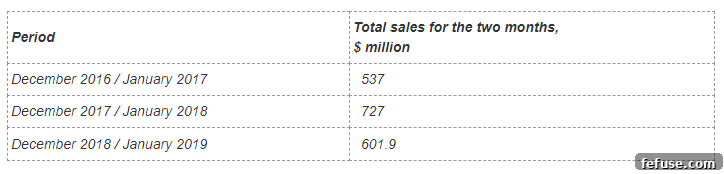
The combined sales for December 2018 and January 2019 reached a total of $601.9 million, aligning closely with the three-year average for this specific two-month period. This consistency, despite the stark month-to-month and year-over-year variations, underscores the underlying stability when viewed over a slightly longer timeframe. It suggests that while individual months can be volatile, the overall trend and demand for diamonds remain relatively steady, reflecting a healthy, albeit mature, market. This average figure provides a reassuring benchmark for investors and stakeholders, indicating that the market is behaving within its historical norms and expectations.
The market’s cyclicality is a well-known phenomenon among diamond industry professionals, where strong buying periods are often followed by quieter ones as inventories are processed, and new demand gradually builds. December’s high sales, driven by robust midstream restocking, logically led to a more subdued January as the cutting and polishing centers focused on transforming the newly acquired rough diamonds into polished gems, rather than immediately buying more rough. This operational rhythm is a fundamental aspect of the diamond supply chain and is consistently factored into the strategic planning of major players like ALROSA, ensuring a disciplined approach to sales and inventory management.
The Broader Global Diamond Industry Landscape in Early 2019
The beginning of 2019 found the global diamond industry grappling with a complex mix of opportunities and challenges. While demand for natural diamonds remained strong in key consumer markets, particularly for engagement rings and celebratory occasions, concerns lingered regarding broader macroeconomic factors. These included geopolitical tensions, potential economic slowdowns in major consumer economies like China, India, and Europe, and the ongoing emergence of lab-grown diamonds (LGDs) as a competitive alternative. ALROSA, as the world’s largest diamond miner by volume, stands at the forefront of these dynamics, requiring a flexible and responsive sales strategy to maintain its market leadership.
The overall sentiment in the early part of the year often sets the tone for the subsequent quarters. A cautious approach from buyers in January, as observed by ALROSA, can be a symptom of broader market uncertainties or simply a period of introspection and adjustment after the year-end rush. Miners, as the primary source of rough diamonds, carefully monitor these signals to adjust their production and sales schedules, ensuring market balance and price stability across the value chain.
Moreover, the supply-demand balance for rough diamonds is a delicate one. An over-supply can depress prices and erode margins, while an under-supply can stifle the midstream and retail segments. ALROSA’s strategic management of its sales, choosing to sometimes hold back supply during periods of weak demand, is a testament to its commitment to long-term market health and sustainable pricing. The company’s ability to navigate these complexities is crucial not only for its own profitability but also for the stability and prosperity of the entire diamond value chain, from mine to consumer.
Key Factors Influencing Global Diamond Sales and Consumer Demand
Several interconnected factors consistently influence global diamond sales and consumer purchasing behavior. Economic health is paramount; robust GDP growth, increasing disposable incomes, and strong consumer confidence typically translate into higher spending on luxury items, including diamonds. Major festive seasons and cultural traditions, such as weddings, anniversaries, birthdays, and holidays like Christmas, Diwali, and Valentine’s Day, are powerful drivers of demand. Strategic marketing efforts by the industry, historically epitomized by iconic campaigns like “A Diamond Is Forever,” also play a significant role in shaping consumer desires and perceptions of value and rarity.
Inventory levels across the entire pipeline—from miners’ stockpiles to manufacturers’ rough holdings and retailers’ polished inventories—are critical determinants of buying patterns. When inventories are high at the midstream or retail level, demand for new rough diamonds naturally softens as the focus shifts to clearing existing stock. Conversely, low inventories spur renewed buying activity. This cyclical ebb and flow creates the inherent pattern of demand and supply that ALROSA’s Deputy CEO referenced, requiring careful management at every stage.
The competitive landscape, particularly the rise of lab-grown diamonds (LGDs), has introduced a new dimension to the market. While natural diamonds continue to command a premium and are valued for their rarity, heritage, and unique geological origins, LGDs offer an alternative at a lower price point. This necessitates continuous differentiation and emphasis on the unique value proposition of natural diamonds, an area where ALROSA and other major miners actively invest through marketing, provenance initiatives, and responsible sourcing programs to reinforce consumer trust and preference.
ALROSA’s Strategic Approach and Operational Resilience in a Dynamic Market
As the world’s largest diamond producer by volume, ALROSA’s operational footprint spans various diamond-rich regions, predominantly in Russia, utilizing advanced mining technologies. The company’s robust mining operations, combined with its strategic sales approach, enable it to manage market fluctuations effectively. ALROSA’s unwavering commitment to responsible mining practices, transparency, and ethical sourcing further strengthens its brand and appeal in an increasingly socially conscious global market. These foundational strengths provide a crucial cushion during softer market periods and strategically position the company for accelerated growth when demand inevitably rebounds.
The company employs a flexible sales system, offering various purchasing options and long-term supply agreements to its key clients, which allows for adaptive responses to prevailing market conditions. This flexibility helps to smooth out the peaks and troughs of demand, ensuring a more consistent flow of rough diamonds through the pipeline while striving to maintain stable prices and foster enduring relationships. By fostering strong, collaborative relationships with its clients, ALROSA can better understand evolving market needs and adjust its offerings accordingly, contributing to overall market stability.
Moreover, ALROSA’s continuous investment in geological exploration and technological advancements ensures the long-term sustainability of its resource base and enhances operational efficiency across its mines. The long-term nature of diamond mining requires foresight and meticulous strategic planning, looking well beyond short-term market shifts to maintain a strong and competitive position for decades to come. This inherent resilience and forward-thinking strategy are key to navigating the intrinsic volatility of a luxury goods market that remains highly sensitive to global economic trends and consumer preferences.
Outlook and Conclusion: A Balanced Perspective on the Diamond Market
Looking ahead from early 2019, ALROSA’s January sales figures, when understood within the broader context of market cyclicality and strategic restocking activities, suggest a healthy, albeit adjusting, market. The substantial sales in December 2018 acted as a strong precursor, setting the stage for a quieter January as the midstream assimilated its new inventory. The combined two-month average being in line with historical trends provides a reassuring signal of market equilibrium and stability, indicating that the market is functioning within its anticipated patterns.
The diamond industry, much like any other luxury sector, is dynamic and inherently responsive to global economic currents, shifting consumer sentiment, and evolving geopolitical landscapes. ALROSA, with its strategic prowess, deep market understanding, and leading position in rough diamond supply, is exceptionally well-equipped to navigate these complexities. While monthly figures can offer a valuable snapshot, a comprehensive understanding requires evaluating longer-term trends and the underlying structural integrity of the diamond supply chain, which remains robust.
As the year progresses, market watchers will continue to observe ALROSA’s performance, alongside other key players, to gauge the overall health and future direction of the diamond industry. The delicate balance between supply and demand, the impact of evolving retail trends, and the broader macroeconomic environment will all play a crucial role in shaping the trajectory for natural diamonds. ALROSA’s transparent reporting and insightful analytical perspectives remain invaluable for understanding this intricate and globally interconnected market.
Total rough and polished diamond sales for the two months (December and January) during the last three years