
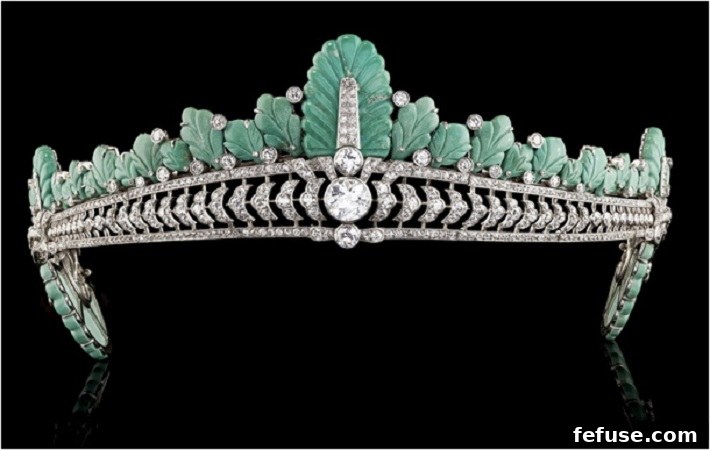
Nancy Astor’s Historic Cartier Tiara Sells for Record $1.1 Million: A Gem of History and Design
A remarkable piece of British political and design history recently captivated collectors and enthusiasts alike, as a truly rare Cartier turquoise and diamond tiara, once the cherished possession of Nancy, Viscountess Astor, achieved an astonishing sum at auction. This dazzling Art Deco masterpiece went under the hammer at Bonhams in London, fetching an impressive $1.1 million (£889,400). This phenomenal sale figure was more than double its high estimate of $434,000 (£350,000), underscoring the immense historical and artistic value attributed to this exceptional jewel.
The Tiara: An Art Deco Masterpiece with Global Influences
The tiara itself is a breathtaking example of Art Deco elegance, a style that dominated the world of art and design in the early 20th century, characterized by its geometric shapes, rich colors, and opulent materials. At its heart lies a magnificent old brilliant-cut diamond, surrounded by a constellation of smaller, yet equally brilliant, old brilliant, rose, and single-cut diamonds, meticulously set to enhance their sparkle. However, what truly distinguishes this Cartier creation are its three strikingly beautiful fluted turquoise plumes. These vibrant, sky-blue elements rise gracefully from diamond-set stems, creating a visually captivating effect that immediately draws the eye.
The choice of turquoise and the distinctive plume motif were no accident; they are a direct nod to the powerful Eastern design influences—specifically Egyptian, Persian, and Indian aesthetics—that profoundly captivated Cartier’s creative vision during the 1920s and 1930s. This period was marked by a global fascination with ancient cultures and exotic lands, spurred by archaeological discoveries (such as Tutankhamun’s tomb) and increased international travel. Cartier, renowned for its innovative designs and keen eye for emerging trends, masterfully integrated these elements, transforming them into sophisticated pieces of Western haute joaillerie. The tiara thus stands as a testament to this cross-cultural exchange, blending the precision of French craftsmanship with the mystique of the East, making it a truly unique representation of its era.
A Commission from Cartier London’s Golden Era
Dating back to circa 1930, this exquisite tiara was originally commissioned by Lord Astor from Cartier London. At the time of its creation, Cartier London was widely considered to be at the absolute zenith of its artistic prowess and global influence. The early 20th century represented a golden age for the renowned jewelry house, known for its unparalleled craftsmanship, innovative designs, and an exclusive clientele that included royalty, aristocracy, and prominent figures from society and industry across the globe. Bespoke commissions like this tiara were a hallmark of Cartier’s prestige, allowing the master jewelers to fully express their artistry and meet the exacting standards of their distinguished patrons. For nearly a century, this significant piece of jewelry had remained largely out of the public eye, its beauty and history known only to a select few, until its grand re-emergence at Bonhams, reigniting interest in its storied past.
Nancy Astor: A Trailblazer in British Politics and Society
The historical resonance of the tiara is profoundly amplified by its original owner, Nancy Astor (1879–1964). Born Nancy Witcher Langhorne in Virginia, USA, she immigrated to England and became a towering figure in British public life. She holds a truly unique and indelible place in British political history as the first woman to successfully take a seat in the House of Commons. Her groundbreaking election in 1919 marked a pivotal moment, shattering centuries of male-dominated parliamentary tradition and paving the way for future generations of women in politics. Her victory, achieved in the Plymouth Sutton by-election, was not merely a personal triumph but a symbolic victory for women’s suffrage and representation across the nation, making her a global icon for female empowerment.
From American Socialite to Parliamentary Pioneer
Nancy Astor’s journey to becoming a political pioneer was far from conventional. An American-born socialite, she arrived in Britain with charisma, intelligence, and a formidable will. Upon marrying Waldorf Astor, the 2nd Viscount Astor, she was thrust into the heart of British aristocratic and political circles. When her husband inherited his peerage and moved to the House of Lords, it created a vacancy in the House of Commons. Against prevailing societal norms and considerable opposition, Nancy Astor courageously decided to contest the seat, effectively becoming the first woman to successfully campaign and win an election for Parliament. Her victory on 28 November 1919 was a seismic event, not just in Britain but globally, inspiring women around the world to seek political office and challenging deeply entrenched patriarchal structures.
A Distinct Voice in Westminster
During her tenure in Parliament, Nancy Astor was far from a silent figure. She was known for her outspoken nature, her sharp wit, and her unwavering commitment to social reform. She championed causes that were often considered radical for her time, including advocating for women’s rights, child welfare, and temperance. She famously worked to raise the legal drinking age and tirelessly campaigned for expanded women’s suffrage, pushing for greater equality and opportunities for women in all spheres of life. Her presence in the House of Commons was transformative, forcing male colleagues to re-evaluate their perceptions of women’s capabilities in public service. She held her seat for 26 years, until 1945, leaving an indelible mark on British legislation and political culture, proving that a woman’s voice belonged at the highest levels of governance.
Cliveden: The Epicentre of Astor’s Influence
Beyond her parliamentary duties, Nancy Astor was equally renowned for her vibrant presence as a hostess at Cliveden, the magnificent Astor family estate in Buckinghamshire. Cliveden was not merely a grand home; it was a celebrated salon, a crucible where Britain’s elite—politicians, intellectuals, artists, and royalty—converged. Here, amidst opulent surroundings, significant political discussions were held, alliances were forged, and social trends were set. Astor’s legendary parties and gatherings made Cliveden a powerful hub of influence, allowing her to network, persuade, and subtly shape public opinion, further cementing her status as a formidable force both inside and outside the halls of Westminster. The estate became synonymous with social influence and served as a reflection of her unique position in British society.
The Auction: A Testament to Enduring Value and Provenance
The dramatic sale result of Nancy Astor’s Cartier tiara at Bonhams speaks volumes about the current appetite for truly exceptional pieces of jewelry. The market for historic jewels with impeccable provenance, especially those inextricably linked to iconic women and storied eras, is experiencing a significant boom. Collectors worldwide are increasingly drawn to items that not only boast exquisite craftsmanship but also carry a rich narrative, connecting them to pivotal moments in history and the lives of extraordinary individuals. This tiara perfectly embodies that allure, intertwining the glamour of Art Deco design with the groundbreaking legacy of Nancy Astor, making it an irresistible acquisition for discerning collectors.
Commenting on the profound significance of the sale, Jean Ghika, Bonhams’ Global Head of Jewellery, eloquently summarized the tiara’s multifaceted importance:
“This tiara represents a remarkable convergence of history, craftsmanship, and cultural exchange. Its turquoise plumes and diamond detailing embody Cartier London’s golden era—when global influences were seamlessly woven into fine jewellery. That it belonged to a trailblazing woman like Nancy Astor only adds to its legacy, making it an object of immense desirability and historical weight.”
The Enduring Allure of Historic Jewels
The phenomenal price achieved for Nancy Astor’s tiara is a clear indicator of a robust and growing demand for items that offer more than just aesthetic beauty. Modern collectors, whether private individuals or institutions, are increasingly seeking out artifacts that tell a compelling story, offering a tangible link to the past. This trend extends beyond jewelry, encompassing art, furniture, and historical documents, reflecting a broader societal appreciation for heritage and authenticity. The tiara, with its exquisite design and its connection to a woman who literally changed the face of British politics, perfectly satisfies this demand, making it not just a jewel, but a historical artifact of significant cultural importance that transcends mere monetary value.
Ultimately, the sale of the Cartier turquoise and diamond tiara is more than just an auction headline; it’s a celebration of exceptional artistry, a tribute to a pioneering spirit, and a vivid reminder of how objects can encapsulate entire chapters of history. Its journey from a prestigious commission for a political luminary to a record-breaking auction item cements its place as one of the most significant pieces of jewelry to come to market in recent times, promising to inspire awe and fascination for generations to come and serve as a brilliant beacon of an extraordinary past.