
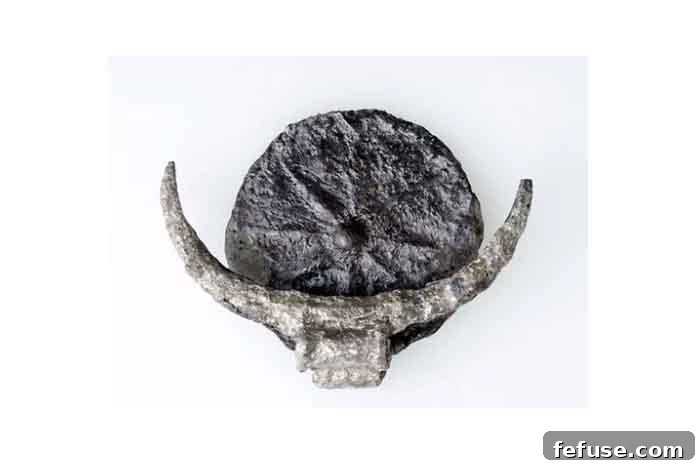
Unveiling Ancient Secrets: Exquisite Treasures Unearthed Beneath an Ancient Home at Tel Gezer
In a remarkable testament to the enduring mysteries hidden beneath the earth, archaeologists from the Israel Antiquities Authority (IAA) and the Israel Nature and Parks Authority (INPA) have announced a captivating discovery at the Tel Gezer National Park in Israel. This significant find includes a collection of exquisite gold and silver objects, primarily ancient jewelry, unearthed from a meticulously preserved context.
The discovery offers a rare glimpse into the spiritual beliefs and daily lives of people who inhabited this strategically important site thousands of years ago. Found directly beneath the foundations of an ancient house, these artifacts represent a special category of archaeological finds known as a “foundation deposit” – a practice steeped in ancient religious ritual and superstition.
The Sacred Practice of Foundation Deposits
Dr. Dan Warner, a prominent scholar from the New Orleans Baptist Theological Seminary, shed light on the cultural significance of this unique discovery. “This is a foundation deposit; we found it underneath the house,” Dr. Warner explained to the Tazpit Press Service (TPS). He elaborated on the purpose of such offerings: “They placed it there to appease the gods so that their house would still stand.” This tradition, prevalent across many ancient civilizations, involved interring valuable objects, often jewelry or other precious items, within the foundational layers of a new building. The act was believed to invoke divine protection, ensuring the stability and longevity of the structure and the prosperity of its inhabitants. Such deposits serve as powerful archaeological markers, not only indicating the presence of ancient settlements but also illuminating the complex spiritual worlds of their builders.
The context of this particular find further amplifies its importance. Dr. Warner highlighted the exceptional state of preservation at the site, noting, “These are the tallest preserved walls from this time period anywhere in Israel.” The remarkable structural integrity of the ancient dwelling provides an invaluable opportunity for researchers to understand the architectural techniques and domestic environments of the period, alongside the intimate details revealed by the foundation deposit.
Treasures from the Depths: A Closer Look at the Artifacts
The collection of items unearthed from Tel Gezer is diverse and aesthetically striking, offering insights into ancient craftsmanship, artistic tastes, and religious iconography. The archaeological site, nestled in the Judean foothills northwest of Jerusalem, has yielded several key pieces:
The Ishtar Pendant: A Glimpse into Ancient Deities
Among the most captivating items is a distinct pendant featuring an eight-point star engraved on a disc, accompanied by a crescent moon. This symbol carries profound religious significance in the ancient Near East. Archaeologist Dr. Irit Ziffer identified this powerful emblem as representing Ishtar, the revered Mesopotamian East Semitic goddess. Ishtar was a multifaceted and immensely powerful deity, encompassing the domains of fertility, love, war, sex, and political power. Her worship was widespread throughout Mesopotamia and the Levant, making her a central figure in the religious pantheon of many ancient cultures in the region. The eight-pointed star is her most characteristic symbol, often depicted alongside the moon and sun to denote cosmic power.
The presence of the crescent alongside the eight-point star further deepens the symbolic narrative. In Mesopotamian cultures, the crescent moon was strongly associated with the moon god, Sin (or Nanna in Sumerian), a deity of immense importance, often linked to wisdom, illumination, and the nocturnal heavens. The juxtaposition of Ishtar’s star and the moon god’s crescent on a single artifact suggests a sophisticated understanding of divine pantheons and possibly a desire to invoke the combined protective and beneficent powers of both celestial deities for the dwelling and its occupants. This pendant, therefore, is not merely a piece of jewelry but a profound religious artifact, echoing the deeply embedded spiritual beliefs of its time.
The Golden-Banded Scarab: A Symbol of Rebirth and Protection
Another significant find is a golden-banded scarab. Scarabs, beetle-shaped amulets, were ubiquitous in ancient Egypt and widely adopted across the Levant, including Canaan. They were intricately carved, often bearing inscriptions or symbols on their flat undersides, and were primarily used as seals, amulets, or funerary ornaments. The scarab beetle’s habit of rolling dung into a ball and burying it was associated with the sun god Ra’s daily journey and rebirth, making the scarab a potent symbol of regeneration, new life, and protection against evil. A golden-banded scarab would have been a particularly valuable and prestigious item, signifying wealth and the owner’s desire for potent protective magic or status.
Further Personal Adornments and Offerings
The collection also includes a delicate silver chain, an elegant earring, and an intriguing arrow-shaped pendant. These items, though perhaps less overtly symbolic than the Ishtar pendant or the scarab, provide valuable data on the personal adornment, craftsmanship, and material culture of the period. The presence of both gold and silver highlights the precious nature of these offerings and the affluence of the individuals who lived in the house. An arrow-shaped pendant could symbolize protection, hunting prowess, or even a deity associated with warfare, adding another layer of meaning to the ensemble.
Tel Gezer: A Crossroads of Ancient Civilizations
The site of Tel Gezer itself holds immense historical and archaeological significance. Located strategically at the intersection of the international coastal highway (Via Maris) and a major road leading to Jerusalem and Jericho, Gezer was a formidable Canaanite city-state during the Bronze Age, later becoming an important Israelite city. Its strategic position meant it was frequently at the nexus of regional power struggles, experiencing occupations by Egyptians, Philistines, Israelites, and Assyrians over millennia. This rich history has left behind layers of archaeological evidence, each telling a piece of Gezer’s storied past.
Gezer is mentioned in numerous ancient texts, including the Amarna Letters and the Hebrew Bible, underscoring its pivotal role in the geopolitical landscape of the ancient Near East. Previous excavations at Gezer have revealed monumental gates, a sophisticated water system, and large public buildings, indicating a highly organized and powerful urban center. The discovery of this foundation deposit within a domestic setting adds a crucial human dimension to our understanding of Gezer, bringing to life the personal beliefs and protective rituals practiced by its inhabitants.
The Collaborative Effort and Future Implications
The collaborative efforts of the Israel Antiquities Authority and the Israel Nature and Parks Authority are crucial for such discoveries. Their meticulous work ensures that these precious remnants of history are uncovered, preserved, and studied with the highest standards of archaeological practice. The findings from Tel Gezer contribute significantly to our broader understanding of Bronze Age Canaanite culture, religious practices, and socio-economic structures in the southern Levant.
Each artifact, from the symbolic Ishtar pendant to the protective scarab, offers invaluable clues that help piece together the intricate mosaic of ancient life. These discoveries not only enrich our historical knowledge but also resonate with contemporary interest in ancient civilizations and their enduring legacies. As archaeological investigations continue at Tel Gezer, there is no doubt that more secrets of this ancient crossroads will be brought to light, further illuminating the vibrant past of Israel.
(Photo by Kiara Amit, courtesy of Israel Antiquities Authority)
News Source: JCKOnline.com