
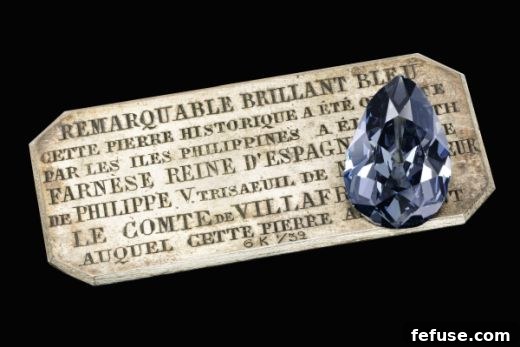
The Farnese Blue Diamond: A Royal Legacy Unveiled at Sotheby’s
A diamond steeped in three centuries of European royal history, the magnificent Farnese Blue diamond is poised to make its highly anticipated market debut. Sotheby’s is set to offer this extraordinarily rare gem at its prestigious Geneva sale in May, marking the very first time this historical treasure has been available for public acquisition. Its emergence from the depths of private royal collections signals a landmark event in the world of fine jewels and historical artifacts.
A Glimpse into Royalty: The Diamond’s Origins and Characteristics
The Farnese Blue is a breathtaking pear-shaped diamond, weighing a significant 6.16 carats. Its captivating hue, classified as “fancy dark grey-blue,” is exceptionally rare and contributes immensely to its allure. This unique color profile, combined with its exquisite cut, sets it apart from other precious stones. The diamond’s illustrious journey began in 1714, when it was presented as a wedding gift to Queen Elisabeth Farnese of Spain following her marriage to King Philip V. From that momentous occasion, the diamond embarked on a remarkable 300-year odyssey, carefully guarded within the private collections of Europe’s most prominent royal families.
This precious gem will finally go under the hammer at the much-anticipated Magnificent Jewels and Noble Jewels auction on May 15th. Experts at Sotheby’s have placed its estimated value between a substantial $3.7 million and $5.3 million, a testament to its unparalleled rarity, historical significance, and intrinsic beauty. Originating from the legendary Golconda mines of India, a source renowned for producing some of the world’s most famous and magnificent diamonds, the Farnese Blue has traveled an incredible path, traversing from Spain to France, then to Italy, and finally settling in Austria over the course of the last three centuries. Each stop along its journey has added another rich layer to its captivating narrative.
Three Centuries of Secrecy: The Diamond’s Hidden Existence
For centuries, the Farnese Blue diamond remained a closely guarded secret, a magnificent enigma known only to a select few. The royal family kept the diamond carefully concealed within a secret royal casket, its existence a mystery to all but family members and their most trusted royal jewelers. This extraordinary period of secrecy has only amplified the diamond’s mystique and allure, making its public appearance an even more compelling event. The idea that such a historically significant and beautiful object could remain hidden for so long speaks volumes about the discretion and tradition upheld by these noble houses.
Reflecting on its profound significance, Philipp Herzog von Württemberg, chairman of Sotheby’s Europe and managing director of Sotheby’s Germany, aptly remarked, “With its incredible pedigree, the Farnese Blue ranks among the most important historic diamonds in the world.” This statement underscores not only its rarity and beauty but also its irreplaceable role as a tangible link to European history and royalty. Its provenance is not merely a list of previous owners but a vibrant tapestry of generations, political shifts, and personal stories that have shaped a continent.
A Legacy Through Generations: Tracing the Farnese Blue’s Royal Lineage
The journey of the Farnese Blue through various royal hands is a testament to its enduring value and the deep personal attachment it held for its owners. Queen Elisabeth Farnese, its original royal recipient, eventually passed the diamond to her son, Philip, Duke of Parma. This act initiated a remarkable succession through the ducal line, ensuring the diamond remained a cherished heirloom within the family. Philip’s son, Ferdinand, subsequently inherited the esteemed jewel, cementing its place within the Parma dukedom.
The diamond then passed from Ferdinand to his son, Louis I, who ascended to the throne as King of Etruria. This transfer highlights the diamond’s movement through different royal titles and territories, reflecting the complex interconnections of European aristocracy. Louis’s grandson, Charles II, Duke of Lucca, later became its custodian. As the generations progressed, the Farnese Blue continued its noble trajectory, moving from Charles II to his grandson, Robert I, who holds the distinction of being the last ruling Duke of Parma. It was Robert I who undertook the significant act of moving the precious stone from Italy to Austria, further diversifying its geographical history.
In Austria, Robert I chose to mount the diamond onto a resplendent diadem that had previously belonged to his mother, Louise Marie Thérèse of Artois. This act of integrating the Farnese Blue into another significant piece of royal jewelry demonstrates the continuous tradition of repurposing and cherishing these family treasures. Following the death of Robert I, the diamond passed into the possession of his son, Elias of Bourbon, Duke of Parma. It was Elias’s wife, Maria Anna von Habsburg, who took on the crucial task of meticulously recording the stone’s comprehensive history before her passing in 1940. Her dedicated efforts have provided invaluable insights into the diamond’s intricate lineage, offering a clear and detailed account of its extraordinary journey through three centuries of European royalty.
The Golconda Connection: Birthplace of Legends
The fact that the Farnese Blue diamond originated from the Golconda mines in India adds another layer of profound importance to its narrative. The Golconda region, situated in what is now Andhra Pradesh, India, was historically the sole source of diamonds for the global market for many centuries, particularly between the 16th and 19th centuries. These mines are legendary, having yielded some of the most celebrated and iconic diamonds in history, including the Hope Diamond, the Koh-i-Noor, the Regent Diamond, and the Great Mogul Diamond.
Diamonds from Golconda are renowned for their exceptional quality, often possessing a rare type IIa classification, which means they are almost entirely devoid of nitrogen impurities, resulting in an extraordinary level of optical transparency and brilliance. The unique geological conditions of the region contributed to the formation of diamonds with a distinct character, often exhibiting a fascinating play of light and an inner fire that sets them apart. To trace the Farnese Blue’s origins back to this fabled source instantly elevates its status, placing it within an elite group of stones that have shaped our understanding of beauty, wealth, and power across civilizations. Its journey from the ancient earth of India to the opulent courts of Europe is a story in itself, mirroring the historical trade routes and cultural exchanges that characterized the early modern world.
Sotheby’s Global Exhibition and Auction Event
Before its grand debut at the Geneva auction, the Farnese Blue diamond will embark on an exclusive global exhibition tour, allowing enthusiasts and potential bidders from around the world to marvel at its splendor. This tour includes prestigious stops in major international cities: Hong Kong, London, New York, Singapore, and Taipei. Such an extensive showcase highlights the diamond’s universal appeal and its status as a significant global cultural artifact, transcending mere monetary value.
The purpose of this extensive pre-sale exhibition is multifaceted. It not only generates immense interest and excitement but also allows prospective buyers to physically examine the diamond, appreciate its unique color, cut, and clarity firsthand, and connect with its tangible history. For Sotheby’s, a leading auction house with a storied reputation for handling the world’s most valuable art and jewels, presenting the Farnese Blue is a moment of significant prestige. The Magnificent Jewels and Noble Jewels auction in Geneva is one of the most anticipated events in the calendar for serious collectors and connoisseurs. This particular sale is renowned for featuring pieces with exceptional rarity, historical provenance, and artistic significance, making it the perfect platform for the Farnese Blue to find its next custodian.
The estimated price range of $3.7 million to $5.3 million reflects the myriad factors that contribute to the diamond’s immense value. This includes its unparalleled royal provenance, its astonishing three-century history of private ownership, its rare “fancy dark grey-blue” color, its respectable 6.16-carat weight, and its impeccable condition. Furthermore, the inherent romance and intrigue associated with objects that have graced the hands of queens and kings add an immeasurable premium, transforming the diamond from a mere gemstone into a living piece of history that offers a unique connection to Europe’s storied past. Acquiring the Farnese Blue is not just about owning a beautiful diamond; it’s about becoming a part of its ongoing, illustrious history.
The Farnese Blue diamond represents more than just a magnificent jewel; it is a tangible piece of European history, a silent witness to centuries of royal marriages, political shifts, and dynastic legacies. Its emergence onto the open market offers a once-in-a-lifetime opportunity for a private collector or institution to acquire a treasure of immense historical and aesthetic value. Sotheby’s Geneva auction is set to be a momentous occasion, bringing this long-hidden gem into the spotlight it so rightfully deserves, ensuring its story continues to captivate for generations to come.