
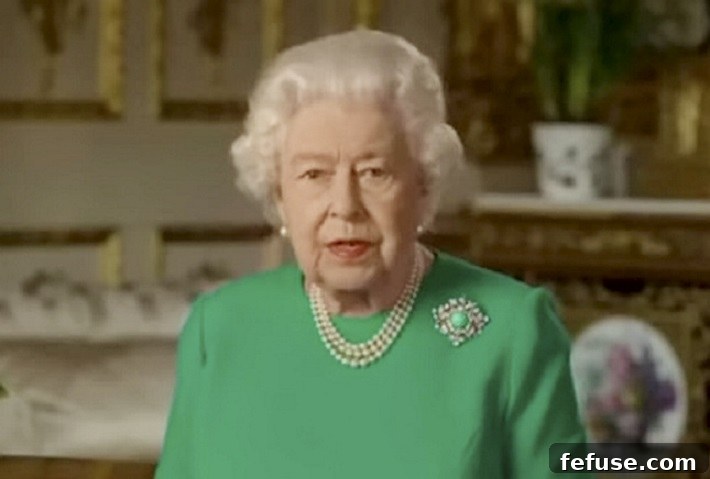
Queen Elizabeth II’s Symbolic Brooch: A Beacon of Hope Amidst Crisis
When Queen Elizabeth II delivered her historic televised address to the United Kingdom and the Commonwealth during the unprecedented coronavirus crisis, her message of hope and resilience resonated deeply. Yet, beyond her powerful words, a subtle detail captivated royal observers and garnered almost as much attention: her choice of jewelry. The specific piece, a stunning turquoise and diamond brooch, was not just an adornment; it was a carefully selected symbol, imbued with history and meaning, signaling continuity and calm in a moment of global uncertainty.
The Queen’s public addresses are rare and momentous occasions, typically reserved for events of profound national significance. This particular address, only the fifth of her remarkable 68-year reign outside of her annual Christmas broadcast, underscored the gravity of the pandemic. In times of national anxiety, the British monarch often serves as a unifying figure, and her appearance, including her attire and accessories, is meticulously scrutinized for underlying messages. The choice of the rarely seen turquoise and diamond brooch was no exception, immediately sparking widespread discussion and interpretation among royal commentators and the public alike.
The Turquoise and Diamond Brooch: A Royal Heirloom’s Moment
The brooch itself is a magnificent example of royal craftsmanship and heritage. Inherited by Queen Elizabeth II in 1953 from her beloved grandmother, Queen Mary, the widow of King George V, it boasts a rich history. Queen Mary was renowned for her expansive and exquisite jewelry collection, meticulously cataloged and often redesigned to suit evolving tastes and to incorporate new acquisitions. Her passion for precious stones and historical pieces ensured that many significant royal jewels were preserved and passed down through generations of the British Royal Family.
The turquoise and diamond brooch was a significant gift to Princess Mary of Teck (later Queen Mary) on her wedding day in 1893, presented by her new in-laws, the future King Edward VII and Queen Alexandra. This makes the brooch over a century old, steeped in the history of the monarchy. Its design elegantly combines the serene blue-green hues of turquoise with the dazzling brilliance of diamonds, set in what is believed to be a timeless platinum or silver setting. Despite its venerable age and inherent beauty, the brooch was not a frequent fixture in Queen Elizabeth II’s public appearances.
Indeed, before her 2020 coronavirus address, the brooch had only been seen publicly on a handful of occasions. Its first known public outing by Queen Elizabeth II was not until 2014, more than half a century after it came into her possession. This rarity made its reappearance during such a critical national moment even more striking and intentional. Royal watchers, with their keen eye for detail, were quick to identify the piece and delve into its provenance, recognizing that the Queen’s jewelry choices are rarely accidental but rather deliberate statements.
Decoding the Royal Choice: Symbolism and Message
The intentionality behind Queen Elizabeth II’s jewelry selection is a well-documented aspect of her reign. Every brooch, necklace, or tiara chosen for a public engagement or significant address carries a weight of symbolism, often linked to the event, the location, or the people being met. In the context of the COVID-19 pandemic, the turquoise and diamond brooch was seen as a poignant and powerful emblem of hope, healing, and resilience.
Turquoise, a gemstone revered across many cultures for millennia, is widely associated with protection, wisdom, and serenity. It is believed to bring good fortune, calm the mind, and offer comfort during times of distress. Historically, turquoise has been used as a talisman against illness and misfortune, making its selection during a global health crisis particularly apt and reassuring. Diamonds, on the other hand, symbolize eternity, strength, and invincibility, reinforcing a message of enduring stability and unwavering resolve.
By choosing this particular brooch, Queen Elizabeth II subtly communicated a deeper layer of meaning beyond her spoken words. It was a visual affirmation of her message of hope and healing, a tangible link to a past era of royal continuity, and a silent promise of future endurance. In a world grappling with unprecedented uncertainty, the Queen’s unwavering presence, underscored by such a thoughtfully chosen symbol, provided a much-needed sense of reassurance and solidarity to millions.
The Historic Address: A Nation Turns to its Monarch
The address itself was a truly historic event. Coming at a time when the United Kingdom, and indeed the world, was grappling with widespread lockdowns, fear, and loss, the Queen’s words were a balm. Her speech acknowledged the challenges, praised frontline workers, and called for national unity and resolve, famously stating, “We will meet again,” echoing Vera Lynn’s wartime song. This carefully crafted message was delivered with her characteristic gravitas and warmth, providing comfort and leadership.
The rarity of such addresses underscores their profound significance. Prior to this, Queen Elizabeth II had only made four other unscheduled televised addresses during her reign: in 1991 during the Gulf War, in 1997 following the death of Diana, Princess of Wales, in 2002 after the death of her mother, Queen Elizabeth The Queen Mother, and in 2012 for her Diamond Jubilee. Each of these occasions marked a moment of profound national or international importance, demonstrating that the Queen’s intervention signaled a deep understanding of the prevailing public mood and a desire to connect directly with her people.
In the context of the COVID-19 pandemic, her address served as a vital moment of national cohesion. It reinforced the notion that despite the unprecedented challenges, the fundamental fabric of society and the enduring spirit of the British people would prevail. Her choice of the turquoise and diamond brooch subtly reinforced this message, linking the present crisis to a long lineage of royal history and the inherent resilience of the nation.
A Glimpse into the Royal Collection: More Than Just Jewels
The Queen’s jewelry collection is arguably one of the most magnificent and historically significant in the world. Far from being mere decorative items, these jewels are living artifacts, each with its own story, often spanning centuries of royal lineage and international diplomacy. The collection includes not only personal acquisitions but also pieces inherited from previous monarchs, gifts from foreign dignitaries, and items with deep symbolic ties to British history.
Beyond the turquoise brooch, other iconic pieces include the Imperial State Crown, worn at the State Opening of Parliament, adorned with some of the world’s most famous diamonds and gemstones; the Girls of Great Britain and Ireland Tiara, a personal favorite often worn at state banquets; and the myriad of brooches, necklaces, and earrings that make up her extensive personal collection. Each piece is chosen with purpose, reflecting a connection to an individual, a nation, or a particular historical event.
Royal jewelry serves multiple functions. It acts as a visual shorthand for the monarchy’s continuity and stability, linking the present monarch to their ancestors. It is also a tool for diplomacy, with gifts of jewels often cementing international relations. Furthermore, it plays a crucial role in perpetuating the ceremonial grandeur and historical narrative associated with the British Royal Family, capturing public imagination and reinforcing the enduring mystique of the crown.
Public Fascination and Media Scrutiny
The Queen’s unexpected choice of the turquoise and diamond brooch for her coronavirus address immediately sparked what the original report termed “furious debate” among observers and on social media. This level of public interest highlights the enduring fascination with the minutiae of royal life and the powerful, albeit often subtle, non-verbal communication employed by the monarchy.
Royal commentators and fashion experts dedicate considerable effort to analyzing the Queen’s outfits and accessories, seeking clues and deeper meanings. Her jewelry selections are particularly ripe for such interpretation, as they often carry a historical weight or a specific symbolic significance. The immediate online discussions, ranging from historical deep-dives into the brooch’s origins to interpretations of its gemstone symbolism, underscored how deeply engaged the public is with these royal signals.
This scrutiny is not merely trivial; it reflects a broader cultural engagement with the monarchy as a symbol of national identity and tradition. In times of crisis, when stability is paramount, every deliberate action and choice made by the head of state takes on heightened importance. The Queen’s ability to communicate messages of hope and resilience not only through her words but also through her carefully curated appearance demonstrates a mastery of soft power and symbolic leadership.
The Enduring Legacy of Royal Adornments
The royal jewelry collection, of which the turquoise and diamond brooch is just one exquisite example, represents an invaluable part of British heritage. These pieces are more than just valuable assets; they are historical documents, tangible links to centuries of monarchy, embodying the stories of queens and kings, triumphs and tribulations, and the evolving relationship between the crown and its people.
The tradition of passing down these treasures through generations ensures that the legacy of the monarchy remains visible and vibrant. Each new monarch inherits not only a crown but also a wealth of personal and symbolic adornments that have witnessed and participated in history. This continuity is a cornerstone of the monarchy’s appeal, offering a constant thread through the tapestry of national life.
The public’s enduring fascination with royal jewels is a testament to their unique blend of artistry, history, and symbolism. From the grandest tiara to the most modest brooch, each piece tells a story, captivating audiences and reinforcing the narrative of a living history that continues to unfold.
Conclusion: The Power of a Deliberate Choice
Queen Elizabeth II’s decision to wear the rarely seen turquoise and diamond brooch during her historic coronavirus address was far from coincidental. It was a deliberate, powerful, and deeply symbolic choice that resonated with millions. In a moment of unprecedented global anxiety, the brooch served as a silent yet potent beacon of hope, healing, and continuity, reinforcing her verbal message with layers of historical and spiritual significance.
This single piece of jewelry, with its rich history dating back to Queen Mary and its inherent symbolism of protection and serenity, became a focal point of public attention, demonstrating the profound impact of the Queen’s non-verbal communication. Her ability to harness the power of royal heirlooms to convey reassurance and leadership underscores her unparalleled understanding of her role and the expectations placed upon the monarchy. The turquoise and diamond brooch, in its quiet elegance, stands as a testament to the enduring power of royal symbolism in unifying a nation during its most challenging times, proving that sometimes, the smallest details carry the greatest weight.