
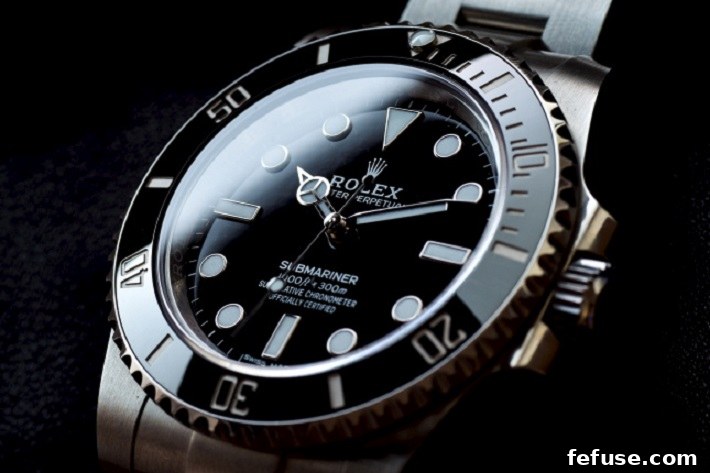
Rolex: Unrivaled King of the Swiss Watch Market, Solidifying a Legacy of Dominance
In the intricate world of haute horlogerie, one name consistently shines brighter than all others: Rolex. A recent comprehensive report compiled by investment banking giant Morgan Stanley and consulting firm LuxeConsult unequivocally confirms Rolex’s formidable position, revealing that the iconic brand commanded over a 30 percent share of the entire Swiss watch market in 2023. This remarkable figure not only underscores Rolex’s enduring appeal but also highlights an unprecedented level of market leadership within the luxury sector, setting a benchmark that few, if any, other premium brands in their respective industries can hope to match.
The findings of this esteemed research paint a clear picture of Rolex’s almost impregnable stronghold. The report’s authors emphatically state, “No other luxury brand can claim such a dominant position in its respective sector.” This assertion resonates deeply within the luxury market, where even the most prestigious names typically contend with much narrower margins of superiority. Rolex’s towering lead is not merely significant; it represents a unique phenomenon, a testament to decades of meticulous brand building, relentless innovation, and an unwavering commitment to quality that has cultivated an unparalleled global demand.
A Crowned Position: Rolex’s Unprecedented Dominance in Numbers
To truly grasp the magnitude of Rolex’s market leadership, one only needs to compare its standing against its closest competitors. The research indicates that Rolex’s market share surpasses that of the next five largest brands combined. These esteemed watchmakers include Cartier (accounting for 8 percent of the market), Omega (7 percent), the highly exclusive Patek Philippe (6 percent), Audemars Piguet (5 percent), and the avant-garde Richard Mille (3 percent). This collective share, totaling 29 percent, still falls short of Rolex’s individual slice of the pie, illustrating a chasm of success that defies conventional industry dynamics.
The financial implications of this dominance are equally staggering. Rolex’s estimated revenue for the year reached an impressive $11.43 billion (CHF 10.1 billion). This colossal figure was achieved through the sale of an estimated 1.24 million watches globally last year, at an average cost of $13,832 (CHF 12,218) per timepiece. To put this into perspective, its closest competitor, Cartier, while selling a respectable 660,000 watches, did so at a significantly lower average cost of $6,467 (CHF 5,712). These numbers not only highlight Rolex’s incredible volume but also its ability to command a premium price point, reflecting the intrinsic value and prestige associated with each watch bearing the iconic crown logo.
The Pillars of Rolex’s Enduring Supremacy
Rolex’s unparalleled success is not a mere fluke or fleeting trend; it is the culmination of a meticulously crafted strategy and an unwavering dedication to core principles. Several foundational elements underpin its enduring supremacy in the luxury watch market.
Heritage and Brand Legacy: A Story Etched in Time
From its inception in 1905 by Hans Wilsdorf, Rolex embarked on a journey to innovate and excel. The brand’s history is punctuated by groundbreaking achievements, including the world’s first waterproof wristwatch, the Oyster, in 1926, and the self-winding Perpetual rotor in 1931. These innovations, coupled with the introduction of iconic models like the Datejust, Submariner, and GMT-Master, established Rolex as a pioneer in functional, reliable, and elegant timepieces. This rich heritage is not just a marketing tool; it’s a living legacy that resonates with consumers, conveying a sense of timelessness and proven performance that few brands can replicate. The narrative of exploration, achievement, and precision is woven into the very fabric of the brand, making it more than just a watch – it’s a piece of history on the wrist.
Uncompromising Quality and Craftsmanship: The Pursuit of Perfection
At the heart of every Rolex watch lies an unwavering commitment to quality and precision engineering. Rolex is one of the few watchmakers that produce virtually all components of its watches in-house, from the casting of its own gold alloys (such as the exclusive Everose gold) to the meticulous assembly of its robust and highly accurate movements. Each movement undergoes rigorous testing, earning the prestigious Swiss Official Chronometer Testing Institute (COSC) certification, a testament to its exceptional precision. Beyond COSC, Rolex imposes its own even stricter Superlative Chronometer certification, guaranteeing accuracy within +2/-2 seconds per day. The robust Oyster cases, crafted from Oystersteel (a highly corrosion-resistant alloy), ceramic bezels, and intricate dials are all testament to a philosophy where no detail is too small, and no compromise on quality is acceptable. This dedication translates into watches that are not only beautiful but also exceptionally durable and reliable, built to last for generations.
Strategic Marketing and Exclusivity: Crafting Desire
Rolex’s marketing strategy is as unique as its watches. Eschewing overt celebrity endorsements (though many celebrities wear Rolex, it’s often an organic choice), the brand opts for subtle yet powerful messaging that focuses on achievement, exploration, and enduring excellence. Its advertisements often feature explorers, athletes, and pioneers, aligning the brand with peak human performance and aspirational lifestyles. Crucially, Rolex expertly manages supply and demand, creating a perception of exclusivity and scarcity that fuels desire. The brand’s authorized dealer network is carefully curated, ensuring a consistent brand experience and fostering long-term relationships with clients. This controlled distribution, combined with a consistently high demand, means that many popular models are difficult to acquire new, further enhancing their mystique and desirability among collectors and enthusiasts alike.
Iconography and Investment Value: More Than Just a Timepiece
Rolex has created a pantheon of iconic models that have transcended mere watch status to become cultural symbols. The Submariner, synonymous with diving and adventure; the Daytona, a legend in motorsport; the GMT-Master, a quintessential pilot’s watch; and the elegant Datejust, a symbol of everyday luxury – each model boasts a distinct identity and a loyal following. These watches are not just tools for telling time; they are statements, achievements, and often, investments. The strong resale market for Rolex watches is well-documented, with many models not only retaining their value but appreciating significantly over time, particularly for sought-after references or vintage pieces. This investment potential further bolsters Rolex’s appeal, positioning it not just as a luxury purchase but as a tangible asset that can provide both aesthetic pleasure and financial returns.
The Broader Swiss Watch Landscape: Recovery and Resilience
The overall health of the Swiss watch industry provides an important context for understanding Rolex’s success. Last year marked a significant milestone for the sector, with total sales returning to pre-Covid levels. The industry experienced a robust 7.6 percent year-on-year growth, reaching an impressive $30.23 billion (CHF 26.7 billion). This recovery highlights the enduring global demand for luxury goods and the resilience of high-end mechanical watches in an increasingly digital world.
Several factors contributed to this resurgence. The global rise in affluence, particularly in emerging markets, has created a broader base of discerning consumers willing to invest in luxury items. Furthermore, the perceived stability and tangible value of luxury watches, especially from reputable brands like Rolex, Patek Philippe, and Audemars Piguet, have attracted collectors and investors looking to diversify their portfolios. While smartwatches have carved out a niche in the mass market, they have largely failed to diminish the allure of traditional mechanical timepieces, which are valued for their craftsmanship, heritage, and emotional connection rather than just their technological utility.
Within this thriving ecosystem, other major players carve out their distinct niches. Cartier, for instance, leverages its broader luxury goods empire, offering elegant and often jewel-focused timepieces that appeal to a fashion-conscious clientele. Omega, with its strong historical ties to space exploration and sports timing, combines technical prowess with accessible luxury. Patek Philippe and Audemars Piguet represent the pinnacle of ultra-luxury, focusing on exquisite complications and extreme exclusivity, catering to an elite segment of collectors. Richard Mille pushes the boundaries of contemporary watchmaking with avant-garde designs and high-tech materials. Each brand possesses unique strengths and a dedicated following, but none has managed to achieve the sheer scale and widespread appeal that defines Rolex’s market dominance.
What Makes a Luxury Watch an Investment?
The concept of a luxury watch as an investment has gained significant traction, especially for brands like Rolex. This isn’t just about speculation; it’s rooted in several key attributes. Firstly, **scarcity and demand**: As mentioned, Rolex meticulously controls its supply, ensuring that demand often outstrips availability for popular models. This artificial scarcity drives up secondary market prices. Secondly, **brand strength and reputation**: Rolex’s consistent quality, global recognition, and strong brand narrative create a robust foundation for value retention. Thirdly, **historical significance and provenance**: Limited editions, watches with unique stories, or those owned by notable figures often command higher premiums. Fourthly, **durability and serviceability**: High-end mechanical watches are designed to last for decades, often centuries, with proper maintenance. Rolex’s extensive service network ensures that older models can be restored and kept in excellent working order, preserving their value. Lastly, **tangible asset**: In an increasingly digital world, a physical, finely crafted object like a luxury watch offers a sense of permanence and an alternative store of value, particularly appealing during periods of economic uncertainty.
Looking Ahead: The Future of Luxury Timekeeping
As the Swiss watch industry moves forward, it faces both opportunities and challenges. Sustainability, ethical sourcing, and transparency are becoming increasingly important for discerning consumers. Brands like Rolex are actively working to address these concerns, focusing on responsible practices throughout their supply chains. Engaging with younger demographics, who may have grown up in a digital-first world, will also be crucial. While smartwatches continue to evolve, the intrinsic value of mechanical watchmaking – the artistry, the engineering, the heritage – remains largely untouched. The future will likely see a continued emphasis on innovation within traditional watchmaking, alongside a reinforced focus on the emotional and cultural significance of owning a finely crafted timepiece. Rolex, with its established legacy and unwavering market leadership, is exceptionally well-positioned to navigate these trends, continuing to set the standard for excellence in the luxury watch sector.
In conclusion, the data from Morgan Stanley and LuxeConsult firmly entrenches Rolex’s status as the undisputed leader of the Swiss watch market. Its remarkable 30 percent-plus market share is not merely a number; it is a profound testament to a legacy built on innovation, uncompromising quality, strategic brand management, and the creation of products that transcend utility to become symbols of aspiration and enduring value. As the global luxury market continues to evolve, Rolex’s unique formula for success ensures its crown remains firmly in place, solidifying its position as an icon not just in horology, but across the entire luxury landscape.