
The Donnersmarck Diamonds: A Timeless Tale of Rarity, Royalty, and Rags-to-Riches Glamour at Sotheby’s
In the illustrious world of historic jewels, few pieces command as much attention, fascination, and sheer beauty as the Donnersmarck Diamonds. These exceptional gemstones, steeped in a rich tapestry of history, romance, and unparalleled luxury, are set to captivate collectors and enthusiasts alike as they go under the hammer at Sotheby’s Geneva next month. More than just dazzling stones, they represent a tangible link to one of the most intriguing figures of 19th-century Parisian high society.
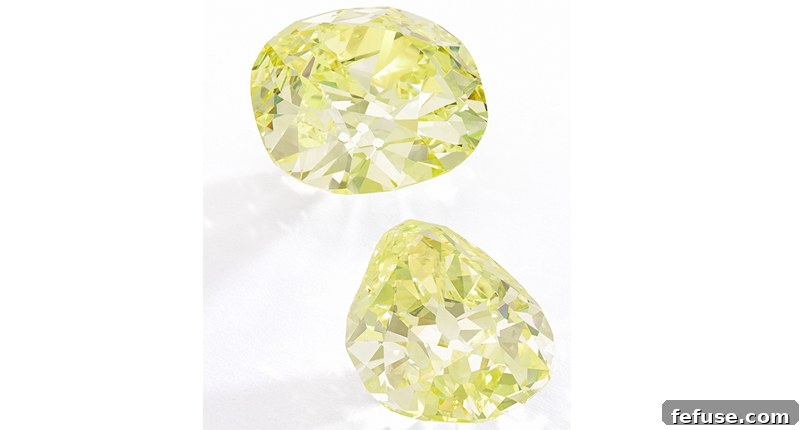
Scheduled to be a highlight of Sotheby’s prestigious Magnificent Jewels and Noble Jewels sale on November 15, this exquisite pair of “fancy intense yellow” diamonds consists of a breathtaking 102.54-carat cushion-shaped stone and an equally stunning 82.47-carat pear-shaped diamond. Their combined carat weight and vibrant hue make them an extraordinarily rare find, and they are expected to fetch a staggering sum between $9 and $14 million. This estimate reflects not only their inherent gemological value but also the profound historical provenance that elevates them far beyond mere adornments.
A Legacy Forged in Scandal and Splendor: The Story of La Païva
The allure of the Donnersmarck Diamonds is inextricably linked to their original owner, Thérèse Lachmann, better known to history as Countess Henckel von Donnersmarck, or simply “La Païva.” Born into modest circumstances in Moscow in 1819, her journey from a humble Russian Jewish girl to arguably the most famous and successful courtesan of 19th-century France is a testament to her extraordinary ambition, intellect, and seductive charm. La Païva was not merely a courtesan; she was a self-made woman who skillfully navigated the complex social hierarchies of her era, leveraging her beauty and sharp mind to ascend to the very pinnacle of European aristocracy.
Her life story reads like a captivating novel, beginning with an early, ill-fated marriage to a tailor in Moscow, which produced a son. However, the constraints of this life proved too stifling for the spirited young Esther. By the tender age of 18, she had decisively abandoned her conventional existence, leaving her husband and son behind to seek a new destiny in the vibrant, opportunity-filled metropolis of Paris. It was here that she truly began to transform, shedding her past and embracing a future defined by luxury, influence, and the patronage of the era’s most powerful men.
The Rise of a Parisian Icon: From Muse to Magnate’s Wife
Upon her arrival in Paris, La Païva quickly found her footing, thanks in no small part to her natural charisma and intellect. She was soon drawn into the city’s glittering cultural and artistic circles, primarily through her romantic involvement with Henri Herz, a celebrated piano composer and pianist. This relationship proved to be a pivotal stepping stone, opening doors to a world populated by luminaries of art and literature. Through Herz, she cultivated friendships with titans of culture such as Richard Wagner, Hans von Bülow, Théophile Gautier, and Emile de Girardin, establishing herself not just as a beauty, but as a woman of considerable wit and intellectual depth, capable of holding her own among the era’s great minds.
La Païva’s journey through Parisian society saw her through several significant relationships, each contributing to her rising status. In the late 1840s, she encountered Marquis Albino Francisco de Araújo de Païva, an heir to substantial fortunes in Macao. Their marriage in 1851, though famously lasting only a single day, was strategically significant, as it bestowed upon her the aristocratic title and the enduring nickname “La Païva,” which she would carry for the rest of her celebrated life. This title, even fleeting, cemented her position within a society obsessed with lineage and status, proving her adeptness at leveraging every opportunity.
Her ultimate ascent came with her third husband, Count Guido Henckel von Donnersmarck. A formidable figure, the Count was a Peruvian industrialist and mining magnate, and at just 22 years old, already one of the wealthiest men in Europe. Sotheby’s historical accounts vividly describe his immediate and profound captivation by La Païva’s “seductive charms, extraordinary mind, and exceptional business acumen.” This was not merely a union of passion but a formidable partnership between two individuals of immense drive and ambition. Their relationship became the subject of intense gossip and fascination within Paris high society, culminating in their marriage in 1871.
The Donnersmarck Diamonds: Symbols of Love and Lavishness
The Count’s devotion to La Païva was boundless, and he spared no expense in adorning his beloved wife and furnishing their life together with unimaginable splendor. La Païva, already a connoisseur of exquisite jewels and with a notable collection pre-dating her marriage to the Count, found her desires for opulence fully realized through his vast resources. He was instrumental in building her jewelry collection into one that was truly without equal, a dazzling array of precious stones that showcased both their wealth and her impeccable taste. Among the most magnificent gifts he bestowed upon her were the two extraordinary yellow diamonds that would forever bear his family’s name: the Donnersmarck Diamonds.
These majestic stones, with their intense golden fire, were more than just jewels; they were a testament to their unique bond and a symbol of their extravagant lifestyle. It is believed that the Count acquired these diamonds as a special gift, recognizing their rarity and beauty as fitting for a woman of La Païva’s stature. The brilliance and vivid hue of these “fancy intense yellow” diamonds are naturally occurring, making them incredibly desirable and adding to their prestige. They are a true marvel of nature, expertly cut to maximize their captivating sparkle and deep, warm color.
Beyond the jewels, Count Donnersmarck’s patronage extended to funding one of Paris’s most iconic private residences. He provided the vast sums necessary for La Païva to acquire a prime plot on the prestigious Champs Elysées, where she would realize her vision for a grand architectural masterpiece: “L’Hôtel de La Païva.” This mansion was designed to be a living testament to their combined wealth and aesthetic sensibilities, a lavish abode that would stand as a monument to their unique place in society.
L’Hôtel de La Païva: An Architectural Gem
L’Hôtel de La Païva was not merely a house; it was an opulent palace designed to host the most exclusive gatherings and display an unparalleled level of luxury. Constructed on one of the city’s most famous avenues, it quickly became renowned for its extraordinary features. One of its most striking elements was a grand central staircase crafted from Algerian yellow marble – a deliberate and stunning architectural detail chosen to perfectly complement and echo the distinctive vibrant yellow of the Donnersmarck Diamonds. This thoughtful integration of the diamonds’ color into the very fabric of their home underscored the couple’s profound appreciation for aesthetics and their desire to infuse every aspect of their lives with beauty and grandeur.
The mansion itself was a marvel of 19th-century design and craftsmanship, boasting sumptuous interiors filled with exquisite art, custom-designed furniture, and luxurious textiles. Its legendary onyx bathroom, featuring silver taps and a bathing tub carved from a single block of yellow onyx, further exemplified the couple’s commitment to unparalleled indulgence. For decades, it remained a symbol of Parisian high society and extravagant living, attracting guests from across Europe’s elite. The building underwent a significant restoration in 2010, ensuring its preservation as a historical and architectural landmark, continuing to tell the story of its remarkable original owners.
The Enduring Legacy and Return to Auction
La Païva passed away in 1884, but her legend and the dazzling jewels she cherished continued their journey. After her death, Count Donnersmarck remarried, taking a Russian aristocrat as his second wife. Crucially, the Donnersmarck Diamonds remained within the family’s esteemed collection for more than a century, passing down through generations, their historical significance and breathtaking beauty carefully preserved.
The world had another chance to marvel at these magnificent stones in 2007 when they made a triumphant return to the auction block at Sotheby’s. This particular sale was noteworthy as it marked the inauguration of Sotheby’s new initiative dedicated solely to jewels with aristocratic or royal provenance, further cementing the Donnersmarck Diamonds’ status as pieces of immense historical importance. At that time, these two extraordinary diamonds commanded nearly $8 million, a testament to their enduring appeal and rarity. Since then, they have resided within an undisclosed private collection, adding another layer of mystique to their already fabled history.
Now, after more than a decade, the Donnersmarck Diamonds are once again poised to make headlines. Their return to Sotheby’s auction block in Geneva on November 15 represents a rare opportunity for collectors to acquire not just diamonds of exceptional size and color, but tangible pieces of European history. These jewels carry with them the echoes of lavish balls, whispered secrets, and the indomitable spirit of a woman who defied societal norms to carve her own path to power and prestige.
Why These Diamonds Matter: Beyond Carats and Color
The significance of the Donnersmarck Diamonds extends far beyond their impressive carat weight or their striking fancy intense yellow hue. They are emblematic of an entire era—the Second French Empire—a period characterized by extravagance, rapid social change, and the rise of powerful, self-made individuals like La Païva. Owning these diamonds is not just an investment in precious stones; it is an acquisition of a piece of cultural heritage, a direct connection to a world of unparalleled glamour and intrigue.
For gemologists, the diamonds offer a pristine example of natural colored diamonds, a category that continues to see robust demand and appreciation. Their “fancy intense yellow” designation places them among the most coveted color grades, indicating a rich, saturated color without any brown or green modifiers. For historians and connoisseurs of luxury, their provenance is paramount. The narrative surrounding La Païva, her ambition, her relationships with some of the most influential figures of her time, and the breathtaking mansion built to complement their brilliance, imbues these diamonds with an almost living history.
As the auction date approaches, anticipation builds for what is sure to be one of the most talked-about events in the world of high jewelry. The Donnersmarck Diamonds are more than just jewels; they are storytellers, chronicling a saga of love, power, and the pursuit of beauty that continues to fascinate and inspire. Their sale at Sotheby’s Geneva is not just an auction; it is a celebration of enduring legacy and the timeless allure of truly magnificent jewels.
News Source: nationaljeweler.com