
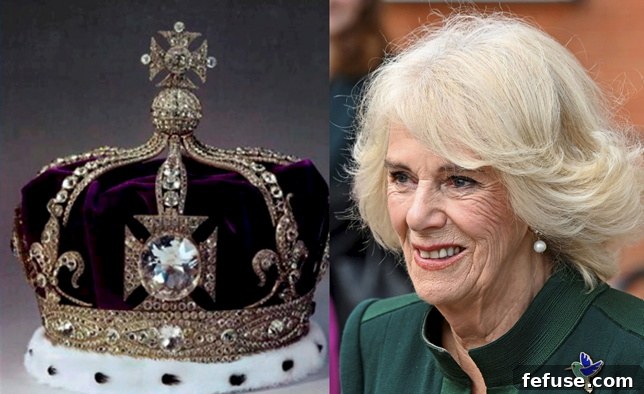
Queen Camilla to Wear Historic Crown, Sidestepping Koh-i-Noor Diamond Controversy at King Charles III’s Coronation
Buckingham Palace has formally announced that Queen Camilla, the Queen Consort, will not adorn her coronation ensemble with the immensely controversial 105-carat Koh-i-Noor diamond during the upcoming coronation of her husband, King Charles III. This pivotal decision, revealed today, marks a significant moment for the British monarchy, balancing tradition with contemporary geopolitical sensitivities.
Instead of the contentious jewel, Her Majesty will wear a thoughtfully modified version of Queen Mary’s Crown. This historic crown, originally crafted by Garrard for Queen Mary’s own coronation in 1911, will be elegantly reset with the exquisite Cullinan III, IV, and V diamonds. This choice not only offers a visually stunning alternative but also strategically navigates a long-standing international dispute.
The Unspoken Diplomacy: Averted Conflict and Royal Strategy
While the Palace’s announcement does not claim to resolve the deeply entrenched ownership dispute over the Koh-i-Noor diamond – a gem vigorously claimed by India, Pakistan, Iran, and Afghanistan – it unequivocally prevents what would have been an inevitable and widespread escalation of diplomatic and public outcry had Queen Camilla chosen to wear it. The diamond has long been a potent symbol of colonial legacy, and its display at such a high-profile global event would undoubtedly have reignited calls for its repatriation.
In an official statement, Buckingham Palace underscored the rationale behind this historic choice: “The selection of Queen Mary’s Crown by Her Majesty is the first instance in recent history that an existing crown will be utilized for the coronation of a consort, rather than commissioning a new piece. This decision was made in the paramount interests of sustainability and efficiency.” This commitment to existing regalia rather than new commissions reflects a modern approach, aligning the monarchy with contemporary values of environmental consciousness and responsible resource management. It also subtly signals an acknowledgement of the economic climate, projecting a more modest and pragmatic image.
In preparation for the grand coronation ceremony scheduled for May 6th, Queen Mary’s Crown was temporarily removed from its public exhibition at the Tower of London, where it is a prominent part of the Crown Jewels display, to undergo the necessary modifications and fittings for the Queen Consort.
Intriguingly, reports from the Daily Mail shortly before Queen Elizabeth II’s passing suggested that the late monarch had expressed a personal wish for Camilla to wear a crown incorporating the Koh-i-Noor. This recent decision, therefore, represents a considered shift from what might have been an earlier intention, illustrating the evolving considerations and advice that inform major royal decisions in the modern era.
The Fabled Koh-i-Noor: A Diamond Shrouded in History and Controversy
The Koh-i-Noor, meaning “Mountain of Light” in Persian, is far more than just a magnificent gemstone; it is a repository of tumultuous history, imperial power, and colonial conquest. Originating from the ancient Golconda mines in India, renowned for producing some of the world’s most famous diamonds, this extraordinary gem boasts a pedigree tracing back to the 14th century. Classified as a Type IIa D-color diamond, it signifies its exceptional purity and lack of color, placing it among the most prized diamonds globally. Its original form was a massive 186-carat gem, a true wonder of the ancient world.
The diamond’s journey is a saga of empires. It passed through the hands of various Indian, Persian, and Afghan rulers, each claiming it as a symbol of their dominion and power. From the Kakatiya dynasty to the Mughals, and later to Persian conqueror Nader Shah and Afghan rulers, the Koh-i-Noor’s ownership mirrored the rise and fall of powerful dynasties across South Asia and Persia. Its final acquisition by the British came in 1849, following the conclusion of the Anglo-Sikh War. The then-Maharaja of Lahore, Duleep Singh, a child at the time, was compelled to present the diamond to Queen Victoria as part of the Treaty of Lahore in 1847, a transfer widely viewed as an act of colonial seizure rather than a voluntary gift.
Upon its arrival in Britain, the diamond underwent a significant transformation. It was controversially re-cut from its original, larger form into a significantly smaller, brilliant oval weighing 105.6 carats, in an attempt to enhance its brilliance according to European tastes. Since this modification, the Koh-i-Noor has remained an integral, albeit controversial, part of the British Crown Jewels, traditionally worn by Queen Consorts in their crowns.
Queen Mary’s Crown: A Symbol of Continuity and New Beginnings
The choice of Queen Mary’s Crown, in contrast to the Koh-i-Noor, provides a narrative of continuity and adaptability for the modern monarchy. This crown itself holds a rich history, having been created specifically for Queen Mary of Teck – King George V’s consort – for her coronation alongside him in 1911. Its design and previous use make it a fitting emblem of the enduring traditions of the British royal family.
The modification of this existing crown aligns with contemporary calls for sustainability and reducing waste, a message that resonates positively with a global audience. The use of existing heritage rather than commissioning an entirely new piece underscores a desire to present a more responsible and frugal image of the monarchy in the 21st century.
Crucially, the crown will be adorned with several magnificent diamonds from the legendary Cullinan collection. The Cullinan Diamond, discovered in South Africa in 1905, was the largest gem-quality rough diamond ever found, weighing an astonishing 3,106 carats. It was subsequently cut into nine major stones and 96 smaller brilliants. The most famous pieces, Cullinan I (the Great Star of Africa) and Cullinan II (the Lesser Star of Africa), are integral parts of the Sovereign’s Sceptre with Cross and the Imperial State Crown, respectively. For Queen Camilla’s crown, the Cullinan III (a 94.4-carat pear-cut diamond), Cullinan IV (a 63.6-carat cushion-cut diamond), and Cullinan V (an 18.8-carat heart-shaped diamond) will be incorporated. These diamonds, with their own fascinating history and immense value, offer a dazzling spectacle without the contentious historical baggage associated with the Koh-i-Noor.
The Modern Monarchy: Balancing Tradition with Evolving Global Sensibilities
This decision regarding Queen Camilla’s coronation crown is emblematic of a broader effort by the British monarchy to navigate an increasingly interconnected and scrutinizing world. In an era where colonial histories are being re-evaluated and challenged, particularly by nations once under imperial rule, the symbolic weight of objects like the Koh-i-Noor cannot be underestimated. For many, its presence in the British Crown Jewels is a stark reminder of historical injustices and a continuing symbol of national grievance.
By choosing to forgo the Koh-i-Noor, King Charles III and Queen Camilla signal a willingness to adapt and respond to global sentiments. It demonstrates an understanding that while tradition is important, maintaining relevance and respect in the modern world often requires strategic concessions and a recognition of complex historical narratives. This move, while seemingly small, speaks volumes about the monarchy’s ongoing efforts to modernize its image and secure its future legitimacy on the global stage.
The coronation of King Charles III and Queen Camilla will be a moment of immense national and international spectacle. Every detail, from the ceremonial regalia to the guest list, will be meticulously scrutinized. The choice of Queen Mary’s Crown, adorned with the splendid Cullinan diamonds, allows Queen Camilla to wear a crown of profound historical significance that also projects an image of sensitivity, modernity, and a forward-looking monarchy. It allows the focus to remain on the solemnity and celebration of the coronation itself, rather than being overshadowed by a centuries-old dispute.
Beyond the Jewels: The Broader Dialogue on Repatriation
The Koh-i-Noor diamond is not an isolated case; it is one of many artifacts in Western museums and royal collections whose origins are tied to colonial expansion and historical power imbalances. The ongoing global dialogue surrounding the repatriation of cultural heritage – from the Benin Bronzes to the Elgin Marbles – highlights a growing demand from source nations for the return of items considered integral to their cultural identity and national patrimony. The decision regarding the Koh-i-Noor, while not a repatriation, is a recognition of this broader, potent debate.
The careful handling of the Koh-i-Noor situation sets a precedent, demonstrating that even deeply entrenched symbols can be treated with a degree of diplomatic flexibility. It showcases the monarchy’s evolving role, not just as custodians of tradition, but also as participants in a global conversation about history, ownership, and reconciliation. As the world watches the coronation, this choice will undoubtedly be noted and discussed as a subtle but significant gesture in the ongoing narrative of the British Crown’s engagement with its past and its future.
A Coronation Fit for a New Era
As King Charles III prepares to ascend to the throne, alongside Queen Camilla, the careful consideration given to every aspect of the coronation underscores a deliberate effort to craft an event that is both historically resonant and reflective of contemporary values. The decision regarding the Koh-i-Noor diamond is a clear manifestation of this intent. Queen Camilla’s wearing of Queen Mary’s Crown, reset with the magnificent Cullinan diamonds, not only ensures a breathtaking visual for the coronation but also subtly communicates a message of prudence, sustainability, and a respectful awareness of global sensitivities. It sets the stage for a coronation that acknowledges the past while firmly looking towards the future of the British monarchy.