
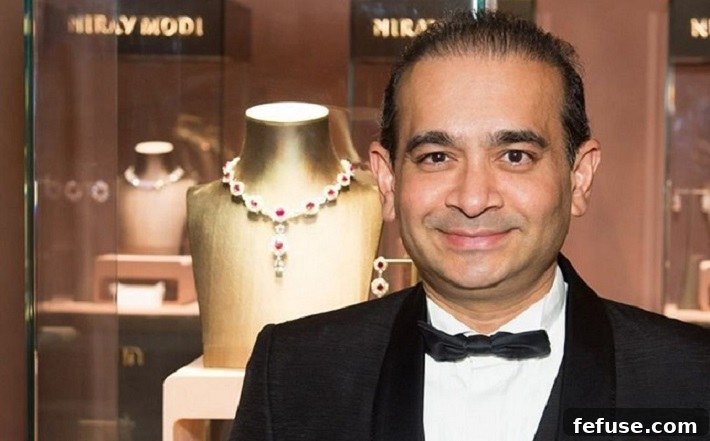
In a significant development underlining India’s relentless pursuit of financial offenders, the Enforcement Directorate (ED) announced a substantial seizure of assets linked to the high-profile diamond merchant, Nirav Modi. The ED’s proactive measures saw the attachment of various valuable properties in Mumbai and Surat, collectively valued at an estimated Rs 147.72 crore (approximately $20 million at the time). This comprehensive seizure included a diverse portfolio of assets: eight luxury cars, essential plant and machinery, consignments of exquisite jewelry, rare paintings, and significant immovable properties. These assets were directly owned by Nirav Modi and his intricate web of group companies, which notably included Firestar Diamond International Private Limited, Firestar International Private Limited, Radheshir Jewelry Company Private Limited, and Rhythm House Private Limited.
Nirav Modi, a name once synonymous with global luxury jewelry, stands accused alongside his uncle, Mehul Choksi, of orchestrating one of India’s largest banking frauds. The duo is implicated in defrauding the state-owned Punjab National Bank (PNB) of over $2 billion, an act that sent shockwaves through the Indian financial system. The ongoing investigation and subsequent actions are being rigorously pursued under the stringent provisions of the Prevention of Money Laundering Act (PMLA), a powerful legislative tool designed to combat economic crimes and reclaim illegally acquired wealth.
The scale and nature of the assets seized paint a vivid picture of the extravagant lifestyle allegedly funded by illicit means. Among the most notable items attached were a Rolls Royce, symbolizing ultimate luxury and status, substantial parcels of real estate, an extensive collection of high-value jewelry, and significant works of art, as reported by leading national dailies like the Hindustan Times. These seizures are part of a broader, sustained effort by the ED to recover public funds. Cumulatively, the ED has reported seizing properties worth an estimated $240 million, both within India and internationally. This figure is further augmented by claims over an additional $68 million worth of precious gold, sparkling diamonds, intricate jewelry, and other valuable items, illustrating the massive scale of the alleged financial malfeasance.
The PNB fraud, which came to light in early 2018, exposed a sophisticated scheme involving the fraudulent issuance of Letters of Undertaking (LoUs) and Foreign Letters of Credit (FLCs) by rogue PNB employees to Modi and Choksi’s companies. These financial instruments were then used to obtain short-term credit from overseas branches of other Indian banks, ostensibly for importing pearls and diamonds. However, these transactions allegedly lacked the necessary collateral and were not recorded in PNB’s core banking system, allowing the fraud to go undetected for years. The intricate web of shell companies and fraudulent documentation allowed the scam to spiral into an unprecedented financial crisis for the bank and a national embarrassment for the country’s banking oversight.
The accused, Nirav Modi and Mehul Choksi, are currently not residing in India, having fled the country before the full extent of the fraud became public. Mehul Choksi strategically acquired citizenship in Antigua and Barbuda, a Caribbean nation, raising complex jurisdictional challenges for Indian authorities seeking his extradition. Nirav Modi, on the other hand, is believed to have taken refuge in the United Kingdom, where he was subsequently arrested in March 2019. His ongoing legal battle against extradition to India has been a protracted and high-profile affair, drawing significant international attention to India’s commitment to bringing financial fugitives to justice. The UK courts have largely ruled in favor of his extradition, citing prima facie evidence of fraud and money laundering, but the appeals process continues, delaying his return.
The Enforcement Directorate’s role in this case is pivotal. As India’s premier agency investigating economic crimes and enforcing the PMLA, the ED is tasked with tracing, attaching, and confiscating properties derived from or involved in money laundering. The PMLA empowers the agency to provisionally attach properties for 180 days, which can then be confirmed by the Adjudicating Authority, making them legally recoverable by the state. This proactive approach by the ED ensures that the proceeds of crime, which often fuel illegal activities and destabilize the economy, are identified and brought under government control, eventually paving the way for their realization to compensate the defrauded entities.
The financial irregularities unearthed in the PNB scam highlighted significant vulnerabilities within the Indian banking system, particularly in the realm of internal controls and oversight mechanisms. The incident prompted a comprehensive review of operational protocols, risk management frameworks, and interbank communication systems to prevent similar occurrences in the future. The Reserve Bank of India (RBI) and the government have since introduced stricter regulations and enhanced surveillance measures to bolster the resilience of public sector banks against sophisticated financial frauds. The PNB fraud served as a stark reminder of the critical importance of robust compliance, transparency, and accountability in financial institutions.
The global hunt for Nirav Modi and Mehul Choksi also underscores India’s evolving strategy in dealing with fugitive economic offenders. The Indian government has demonstrated unwavering resolve in pursuing these individuals across international borders, utilizing diplomatic channels, legal instruments, and bilateral agreements. The enactment of the Fugitive Economic Offenders Act (FEOA) in 2018 further strengthened the government’s hand, allowing for the confiscation of properties of individuals who have fled the country to avoid prosecution for specific economic offenses. This legislative framework aims to deter such flights and ensure that justice is served, irrespective of the perpetrator’s location.
The implications of the Nirav Modi-Mehul Choksi saga extend beyond the financial realm, touching upon issues of public trust, corporate governance, and the rule of law. The meticulous efforts by the ED, the Central Bureau of Investigation (CBI), and other investigative agencies reflect a concerted national commitment to combat white-collar crime and restore faith in the integrity of India’s financial ecosystem. Each asset seizure and every step taken towards extradition sends a clear message that no one is above the law, and those who seek to enrich themselves through fraudulent means will face severe consequences.
As the legal proceedings continue in both India and abroad, the focus remains on the complete recovery of the defrauded amount and ensuring that the perpetrators are held accountable for their alleged crimes. The case has become a landmark example of India’s determination to crackdown on financial fraud, protect its banking system, and uphold the principles of justice. The ongoing efforts to attach more assets, both domestically and internationally, will further solidify the ED’s position and demonstrate the government’s resolve in combating money laundering and bringing economic offenders to book. The outcome of these complex legal battles will undoubtedly set precedents for future cases involving high-profile financial fugitives, reinforcing the message that crime does not pay.