
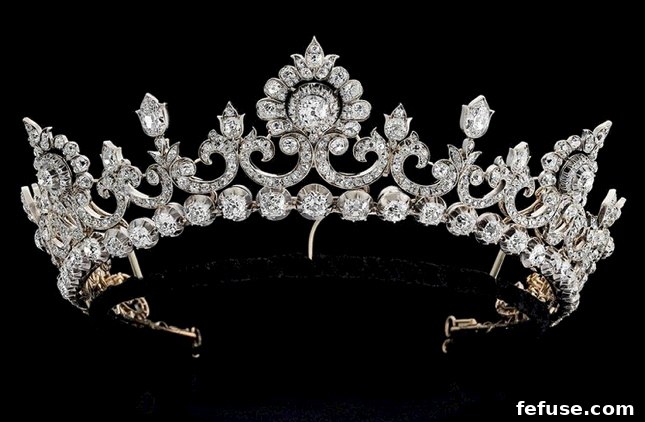
The Marquess of Anglesey Diamond Tiara: A Royal Heirloom Returns to the Market
An unparalleled piece of British aristocratic history and magnificent craftsmanship is poised to captivate the world of luxury jewelry. A breathtaking diamond tiara, boasting over 100 carats of dazzling stones and a lineage tracing back to one of Britain’s most infamous and flamboyant aristocrats, the 5th Marquess of Anglesey, is now being offered for sale. This extraordinary heirloom, which remarkably survived the spectacular financial ruin of its original owner, carries with it tales of grandeur, extravagance, and a fascinating journey through generations, culminating in its esteemed presence at two royal coronations.
A Legacy of Opulence and Extravagance: The 5th Marquess of Anglesey
At the very core of this tiara’s compelling narrative lies Henry Paget, the 5th Marquess of Anglesey (1875 – 1905). Famously known as “The Dancing Marquess” or “The Butterfly Marquess” due to his theatrical proclivities and flamboyant style, Paget inherited an immense fortune. This inheritance, valued at an astonishing $75 million in today’s money, included vast family estates spanning picturesque regions such as Staffordshire, Dorset, Anglesey, and Derbyshire. Born into the highest echelons of privilege, he was destined to live a life of immense luxury, yet his story became a cautionary tale of unchecked indulgence and rapid financial demise, leaving an indelible mark on his family’s legacy and the broader tapestry of British high society.
Within a mere five years of inheriting his ancestral wealth, the 5th Marquess managed to squander every penny. His lavish spending habits were legendary and truly unprecedented, even for the upper echelons of Edwardian England. He indulged in an astonishing array of luxuries: an unparalleled collection of “outrageous clothes” and exquisite furs—many of which he wore himself, often adorned with additional jewels. His profound passion for elaborate theatrical productions led him to convert the chapel at Plas Newydd, his ancestral home in Anglesey, into a lavishly decorated private theatre. Here, he would perform his self-penned plays, famously including the “Butterfly Dance,” where he captivated (and often shocked) audiences in jewel-encrusted costumes.
Paget’s life was, in essence, a continuous, dramatic spectacle of self-expression, meticulously funded by an ever-dwindling inheritance. His expenditures extended to an astonishing array of precious jewels, cutting-edge motor cars, and other symbols of extravagant wealth. This relentless pursuit of pleasure, self-adornment, and theatrical display ultimately led to his catastrophic financial downfall. He was declared bankrupt in 1904, necessitating the widespread sale of his estates and possessions to repay an astronomical debt. Tragically, he died penniless of tuberculosis in Monte Carlo at the tender age of 29, just a year after his bankruptcy, leaving behind a legacy of financial ruin but also a unique, unforgettable place in aristocratic folklore.
The Tiara That Defied Ruin: A Story of Survival and Succession
Amidst the widespread liquidation of the 5th Marquess’s assets, a remarkable twist of fate ensured the survival of this particular diamond tiara. Crafted with exquisite precision in 1890, this magnificent piece was, against all odds, one of the very few possessions that miraculously escaped the auctioneer’s hammer and the relentless grasp of creditors. Its survival speaks volumes about its inherent value, both monetary and sentimental, or perhaps it was simply a fortunate oversight during the chaotic period of asset sales following his bankruptcy.
Following the untimely death of Henry Paget, the tiara was justly inherited by his cousin, Charles Paget, who subsequently became the 6th Marquess of Anglesey. This act of succession not only preserved the tiara within the esteemed family lineage but also allowed it to continue its distinguished journey through history. The transition from the famously flamboyant 5th Marquess to his more conventional cousin likely underscored its return to a more traditional and cherished role within the family’s collection, safeguarding it for future generations and preserving its unique historical narrative.
Guy Burton, director at Hancocks London, eloquently expressed the tiara’s unique journey: “What’s interesting is that this tiara was one of the very few possessions not sold off to pay debts following the death of the fifth Marquess. Instead, it was retained by the sixth Marquess and Marchioness of Anglesey and clearly held a special place in the family’s heart.” This sentiment highlights its exceptional status as a familial heirloom, cherished despite (or perhaps because of) its connection to such a dramatic past.
A Crown Jewel for Royal Occasions: Two Coronations, One Tiara
The tiara’s story takes an even more distinguished turn with its appearances at two monumental events in British royal history: the coronations of King George VI in 1937 and Queen Elizabeth II in 1953. To be worn at such hallowed, internationally significant ceremonies is a profound testament to its inherent prestige, timeless elegance, and the esteemed social status of its owners. Its presence at these pivotal events firmly embeds it within the rich fabric of British royal and aristocratic tradition, lending it an unparalleled provenance that few other pieces of jewelry can claim.
Imagine the grandeur of the spectacle: Westminster Abbey, a hallowed sanctuary, filled to capacity with dignitaries, royalty, and esteemed guests, as the pomp and circumstance of the monarchy unfolded. Among the glittering assembly, this very tiara would have adorned a Marchioness of Anglesey, radiating brilliance and history. These public appearances elevate the tiara beyond a mere piece of jewelry, transforming it into a living historical artifact, a silent witness to pivotal moments in the nation’s life and the continuity of the British crown. Each facet of its over 100 carats of diamonds carries the echo of pomp, solemnity, and national celebration, adding immeasurably to its historical and cultural significance.
Hancocks London Presents: A Rare Opportunity for Collectors
This exceptional piece of historical jewelry is currently on display at the prestigious London jeweler Hancocks, renowned globally for its unparalleled expertise in antique, rare, and fine jewelry. Its exhibition ahead of the Queen’s Platinum Jubilee celebrations is particularly poignant, drawing a direct line between a piece of profound history and the ongoing narrative of the British monarchy. The timing offers a unique and celebratory opportunity for enthusiasts, collectors, and potential buyers to appreciate its remarkable beauty, intricate craftsmanship, and immense historical weight within an atmosphere of national celebration.
Hancocks is not merely facilitating a sale; they are offering a tangible link to a captivating and extraordinary past. Guy Burton further elaborated on the tiara’s exceptional quality and allure: “As tiaras go, this one truly is magnificent and has to be one of if not the best in class we’ve ever seen and we’re delighted to offer it for sale. It really is a jewel with amazing provenance given its rich history along with the fact that it was worn for not one but two royal coronations.” Such an emphatic endorsement from a respected expert underscores the tiara’s extraordinary craftsmanship, the purity and brilliance of its over 100 carats of diamonds, and its unique, distinguished place in the echelons of fine jewelry worldwide.
The market for such historically significant and exquisitely crafted pieces is highly specialized, attracting discerning collectors, prominent museums, and private individuals who seek not just beauty and intrinsic value, but also a rich, compelling narrative. This tiara offers an unmatched blend of design excellence, significant diamond weight, and an unforgettable story that spans generations and royal events. Its impending sale represents a rare and momentous occasion in the world of luxury, promising to be a highlight for any connoisseur of aristocratic and royal history, seeking to own a piece of living heritage.
The Enduring Allure of Historic Diamond Tiaras
The profound allure of a diamond tiara, particularly one imbued with such a captivating and storied history, transcends mere aesthetic appeal. It embodies an era of unparalleled craftsmanship, where master jewelers painstakingly fashioned intricate designs meant to convey status, elegance, and enduring beauty. Tiaras are far more than simple accessories; they are powerful statements of identity, cherished heirlooms meticulously passed down through generations, and often, silent chroniclers of pivotal historical moments.
This particular tiara, with its 1890 crafting date, likely reflects the sophisticated design sensibilities of the late Victorian or early Belle Époque periods. These eras were characterized by delicate settings, often incorporating intricate scrolls, garlands, or natural motifs, all designed to maximize the brilliance and sparkle of the diamonds. While the original content doesn’t specify its exact artistic style, its “magnificent” description and high carat weight strongly suggest a significant, statement-making piece, designed to impress and dazzle. The undisputed fact that it was chosen to be worn at two monumental royal coronations further attests to its timeless design, unparalleled grandeur, and its capability to hold its own amongst the very finest and most important jewels in Britain.
For discerning collectors, the provenance of a piece is often as crucial, if not more so, than its intrinsic value. The captivating story of the 5th Marquess, his dramatic rise and spectacular downfall, and the tiara’s miraculous survival from the auction block, coupled with its verifiable royal connections, creates an unparalleled narrative that significantly enhances its desirability and historical importance. It is far more than just a collection of diamonds; it is a tangible piece of social history, a precious fragment of the British aristocracy’s golden age and its subsequent evolution. This blend of personal drama, historical continuity, and exquisite artistry makes it an exceptionally rare and coveted treasure.
Conclusion: A Legacy Reimagined
The imminent sale of the Marquess of Anglesey diamond tiara is far more than a simple transaction in the luxury market; it is an extraordinary opportunity to acquire a legendary piece of British heritage. It represents a poignant blend of human folly and enduring beauty, a powerful testament to the fact that while immense fortunes can be squandered and personal tragedies may unfold, true artistry, historical significance, and exquisite craftsmanship possess an enduring quality that transcends time and circumstances.
As this magnificent jewel prepares for its next chapter, it stands as a glittering reminder of an era of grand balls, extravagant theatrical performances, and the unwavering, timeless allure of diamonds. For its future owner, it will not just be a breathtaking adornment to be admired; it will be a profound and intimate link to a vibrant past, a tangible piece of history that has graced both notoriously extravagant aristocratic parties and solemn, globally significant royal ceremonies. This tiara is, without doubt, a true masterpiece, waiting to continue its storied journey with a new, fortunate custodian, ready to add its next chapter to its already rich narrative.