
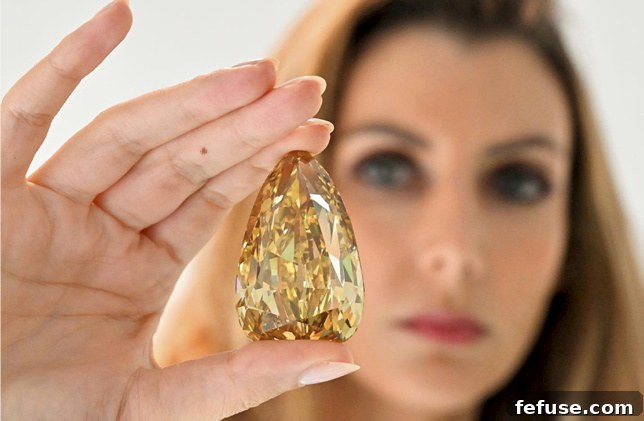
The Golden Canary Diamond: A Resplendent Jewel’s Journey to Record-Breaking Auction
A truly exceptional gem, the Golden Canary diamond, recently captivated the world of high jewelry, achieving a remarkable $12.4 million at Sotheby’s New York. This internally flawless, 303.1-carat fancy deep brownish-yellow stone stands as a testament to nature’s artistry and human ingenuity, securing its place among the most valuable yellow diamonds ever sold at auction. Its journey from a discarded rough in the Democratic Republic of Congo to a polished masterpiece is nothing short of extraordinary.
An Unrivaled Gem Takes Center Stage
The auction world was abuzz as the Golden Canary, heralded as the world’s largest internally flawless diamond, made its grand appearance at Sotheby’s New York. This magnificent jewel, weighing an impressive 303.1 carats, boasts a rare and captivating fancy deep brownish-yellow hue. Its sale yesterday for $12.4 million marked a significant moment in gemological history, solidifying its status as the third most valuable yellow diamond ever to grace an auction block. While the final hammer price fell slightly below its high estimate of $15 million, Sotheby’s aptly characterized the realized figure as “strong,” underscoring the enduring demand and prestige associated with such a unique natural wonder.
Quig Bruning, the esteemed head of jewelry for Sotheby’s Americas, articulated the profound significance of the sale, declaring that the Golden Canary was now taking its “rightful place among the pantheon of superlative stones to be sold at auction by Sotheby’s.” This sentiment perfectly encapsulates the diamond’s unparalleled rarity, exceptional quality, and the meticulous craftsmanship involved in its journey from raw material to a gleaming masterpiece.
The Diamond’s Exquisite Characteristics: A Deep Dive
What makes the Golden Canary truly exceptional? Its allure lies in a combination of factors that are extraordinarily rare in the diamond world:
- Weight (303.1 Carats): To possess a polished diamond exceeding 300 carats is an achievement of immense proportions. Such large stones are incredibly scarce, representing only a minuscule fraction of all diamonds ever discovered. The sheer size of the Golden Canary allows for an awe-inspiring presence and a remarkable display of its inherent beauty.
- Clarity (Internally Flawless): This is perhaps one of its most defining attributes. “Internally flawless” means that the diamond has absolutely no inclusions (internal imperfections) visible under 10x magnification. This level of purity is exceedingly rare, especially in a stone of this magnitude, contributing significantly to its value and desirability. It speaks to the pristine conditions under which it formed deep within the Earth.
- Color (Fancy Deep Brownish-Yellow): While white diamonds are graded on a scale from D (colorless) to Z (light yellow), colored diamonds are classified on a separate “fancy” scale. “Fancy deep brownish-yellow” signifies a rich, intense saturation of color, a complex blend that results in a mesmerizing hue. This specific combination is unique, setting it apart from more common yellow diamonds and giving it a distinct character and warmth. The “fancy deep” designation indicates a strong, concentrated color that is highly prized by collectors.
- Cut (Pear Shape): The elegant pear shape, with its single point and rounded end, is renowned for maximizing a diamond’s brilliance and fire while offering a flattering and timeless aesthetic. This specific cut was a deliberate choice during the re-cutting process, transforming the diamond from its previous form into one that optimizes its sparkle and visual appeal.
From Unnoticed Rubble to International Treasure: The Golden Canary’s Genesis
The story of the Golden Canary begins not in a glamorous vault, but in the rugged terrain of the Democratic Republic of Congo (formerly Zaire) in the 1980s. Miners, accustomed to sifting through tons of earth for precious gems, initially overlooked what would become this legendary stone. The original rough gem, an astounding 890-carat monster, was dismissed as mere rubble and discarded. It was an astonishing oversight that would become a tale for the ages.
The diamond’s true potential was “rescued” from obscurity by a stroke of serendipity: a young girl playing with her friends stumbled upon the massive, seemingly unremarkable stone. Her innocent discovery set in motion a chain of events that would eventually lead to the creation of one of the world’s most talked-about diamonds. This origin story adds an almost mythical quality to the Golden Canary, highlighting the unpredictable nature of discovery and the hidden treasures that lie beneath our feet.
A Metamorphosis: The Diamond’s Transformative Journey
The path from a massive, crude rough to a polished, internally flawless masterpiece is a testament to extraordinary skill and vision. The 890-carat rough diamond underwent a meticulous and daring transformation, first being cut into the 407-carat “Incomparable Diamond.” This initial cutting resulted in a distinctive shield shape, a bold choice that maximized its initial weight and showcased its impressive size.
However, the journey didn’t end there. Recognizing the potential for even greater beauty and market appeal, the Incomparable Diamond was subsequently re-cut. This decision, involving the sacrifice of significant carat weight, is always a monumental undertaking for master diamond cutters. It requires immense precision, expertise, and a deep understanding of the stone’s internal structure to unlock its maximum brilliance, fire, and a more universally desirable form. The result was the breathtaking 303.1-carat pear-shaped Golden Canary. This re-cutting process transformed a truly magnificent stone into a paragon of perfection, optimizing its optical properties and enhancing its aesthetic appeal dramatically.
The Art of Diamond Cutting: A Risky Endeavor
The transformation of a rough diamond into a polished gem is one of the most challenging and high-stakes crafts. A single miscalculation can devalue or even shatter the stone. For diamonds of the Golden Canary’s size and importance, cutters spend months, sometimes years, studying the rough, planning cuts that maximize carat weight, clarity, color, and cut quality. The decision to re-cut the Incomparable Diamond into the Golden Canary demonstrates a bold commitment to achieving absolute perfection, even if it meant reducing the overall carat weight. The pear shape, known for its elegant lines, requires exceptional skill to create symmetry and brilliance.
The Auction Strategy: A Dollar to Millions
Sotheby’s employed a highly unusual, yet brilliantly strategic, approach to the Golden Canary’s auction: bidding started at just $1. This deliberate and unconventional move by the renowned auction house was designed to ignite intense competition and generate significant global buzz. The aim was to provoke fierce bidding, drawing in a wider array of potential buyers and spectators who might not typically participate in such high-value sales, thereby creating an electrifying atmosphere.
While the diamond ultimately sold for $12.4 million, falling short of its $15 million high estimate, the strategy undeniably drew massive attention to the lot. The “strong” price achieved, coupled with the global spotlight on the diamond, ensured its prominent place in the annals of auction history, demonstrating the power of innovative marketing even in the most exclusive markets.
The Broader Market for Magnificent Jewels
The sale of the Golden Canary was part of Sotheby’s larger “Magnificent Jewels Sales,” which collectively raised an impressive total of $50 million. The overall success of the event, with 81 percent of lots sold, underscores the robust and resilient demand for rare and exceptional gemstones in the luxury market. Despite economic uncertainties, the allure of unique, historically significant, and intrinsically valuable items like the Golden Canary continues to attract discerning collectors and investors worldwide.
These high-profile auctions serve not only as marketplaces for extraordinary treasures but also as barometers for the health of the ultra-luxury sector. The consistent high percentage of lots sold indicates a vibrant market where provenance, rarity, and impeccable quality command premium prices.
The Enduring Fascination with Yellow Diamonds
Yellow diamonds hold a special place in the world of precious stones. Unlike colorless diamonds, whose value increases with the absence of color, fancy colored diamonds like the Golden Canary are prized for their intense and vibrant hues. The presence of nitrogen atoms within the diamond’s crystal structure absorbs blue light, causing the stone to appear yellow. The more nitrogen and the more concentrated it is, the more intense the yellow color.
Fancy yellow diamonds come in a spectrum of shades, from light fancy yellow to vivid and deep yellow, often with secondary hues like orange or brown, as seen in the Golden Canary’s “fancy deep brownish-yellow.” These natural colored diamonds are significantly rarer than colorless diamonds, with only a small percentage of all mined diamonds exhibiting natural fancy colors. Their rarity, coupled with their unique beauty and the increasing demand from collectors and investors, contributes to their escalating value in the global market.
The Golden Canary, with its exceptional size, internal flawless clarity, and captivating fancy deep brownish-yellow color, represents the pinnacle of natural artistry. It is not merely a gemstone; it is a piece of Earth’s history, a testament to geological wonders, and a symbol of enduring luxury and human endeavor. Its journey from a forgotten rough to a celebrated auction star cements its legacy as one of the world’s truly magnificent jewels, inspiring awe and wonder for generations to come.