
Navigating the Shifting Sands: An In-Depth Look at the Global Natural Diamond Market in Early 2024
The advent of 2024 ushered in a period of considerable recalibration for the global natural diamond industry. Following a holiday selling season characterized by tempered consumer enthusiasm, the market found itself grappling with a complex array of challenges, including persistent price declines and a palpable softening of demand across key regions. While the crucial U.S. holiday market managed to align with the industry’s modest expectations, this localized performance was insufficient to stimulate a broader market upturn. The prevailing sentiment among diamond dealers, manufacturers, and retailers remained one of caution, as stakeholders meticulously assessed economic indicators and the evolving landscape of consumer preferences. This demanding environment necessitated a critical re-evaluation of business strategies throughout the entire diamond value chain, marking a clear pivot towards adaptability in a post-pandemic world shaped by economic headwinds and increasing competition from alternative luxury categories, including lab-grown diamonds.
Diamond Price Dynamics: A Closer Examination of Market Fluctuations
An analysis of natural diamond prices revealed a multifaceted picture. Overall, the start of 2024 saw a continuation of the downward pricing trend that had begun in the latter half of 2023. However, the impact was not uniformly distributed across all segments of the market. Insights from the venerable Rapaport Group highlighted areas of surprising resilience and specific vulnerabilities. Diamonds within the 0.30- to 0.50-carat range, particularly those possessing superior quality attributes such as D to F color grades and IF to VVS2 clarity, demonstrated a slight upward adjustment or maintained greater price stability compared to other categories. This specific segment often appeals to a consistent demand base for engagement rings, anniversary gifts, and everyday fine jewelry, where discerning consumers prioritize quality and accessibility for timeless pieces.
Conversely, the market for larger, fancy-shaped diamonds, particularly those weighing 3 carats and above, exhibited a comparatively stronger performance. This suggests that affluent consumers and collectors continue to drive demand for unique aesthetics and significant carat weights, often viewing these pieces as investment-grade luxury items. Fancy shapes—encompassing popular cuts like oval, pear, emerald, and radiant—have grown considerably in vogue, offering a distinct alternative to the traditional round brilliant and often presenting a larger perceived size for their actual carat weight. The sustained strength in this high-end segment points to a bifurcated market where premium, unique, and high-value pieces retain their allure even amidst broader market softness.
The Pivotal Role of Rapaport’s RAPI™ in Industry Analysis
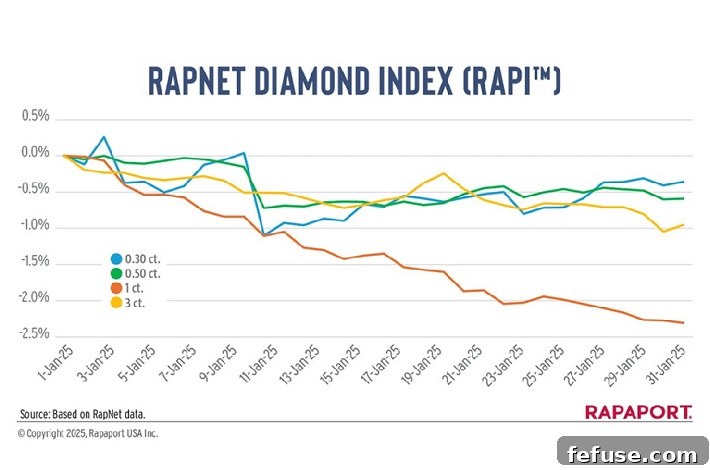
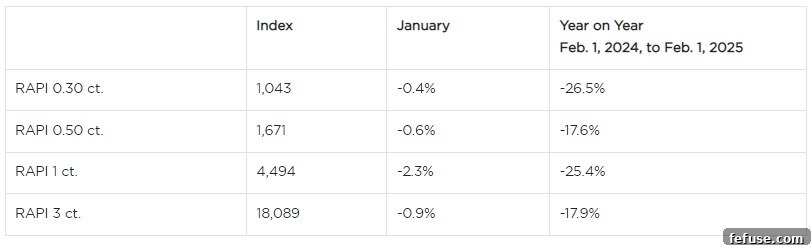
The industry’s leading pricing benchmark, the RapNet Diamond Index (RAPI™) for 1-carat round diamonds (D to H color, IF to VS2 clarity), recorded a notable decline of 2.3% in January. The RAPI™ is an indispensable tool for diamond traders, retailers, and investors, providing a transparent and real-time reflection of wholesale polished diamond prices based on the vast daily listings on the RapNet platform, which stands as one of the world’s largest business-to-business diamond trading networks. A significant drop in this crucial index serves as a clear signal of broad weakening in both demand and pricing power within the most liquid and widely traded segment of the polished diamond market – the archetypal 1-carat round brilliant.
For smaller diamonds, the observed price fluctuations were notably milder, indicating potentially more stable underlying demand or a lower degree of speculative trading. The 0.30-carat category experienced a modest drop of 0.4%, while 0.50-carat stones saw a 0.6% decrease. These sizes are fundamental to the mass-market jewelry sector, including smaller engagement rings, delicate anniversary bands, and fashion-forward pieces. Their relative stability is therefore a positive indicator for broader consumer accessibility and foundational demand. Despite performing generally better than the 1-carat segment, 3-carat stones still recorded a 0.9% decrease in January, underscoring that pricing adjustments were widespread across various carat weights, albeit with differing intensities and market drivers.
RapNet Diamond Index (RAPI™)
Key Strategic Developments: De Beers, Botswana, and the Rough Diamond Market
Beyond the immediate fluctuations in diamond prices, several significant strategic developments unfolded, poised to shape the industry’s future for decades. A landmark agreement was successfully finalized between the global diamond mining titan De Beers and the Government of Botswana, extending the crucial mining licenses for their highly successful joint venture, Debswana, beyond 2029. This historic deal carries immense significance for both parties involved; for Botswana, it unequivocally secures the future of its largest revenue generator and most substantial employer, playing a vital role in the nation’s economic stability and development. For De Beers, the extension guarantees continued access to some of the world’s most prolific and highest-value diamond mines. Debswana, a 50/50 partnership, operates four major diamond mines in Botswana—Jwaneng, Orapa, Letlhakane, and Damtshaa—which collectively account for a substantial portion of the world’s natural diamond production by value. The extended agreement firmly underlines the long-term commitment of both entities to the natural diamond sector, signifying a collaborative and forward-looking approach to navigating future market challenges and capitalizing on emerging opportunities.
A critical component of this extended partnership involves a robust joint commitment to actively promote and safeguard the natural diamond sector. In an era where lab-grown diamonds (LGDs) are increasingly capturing market share, and where consumer education campaigns regarding the inherent value, rarity, and enduring legacy of natural diamonds are more vital than ever, this collaboration is exceptionally timely. De Beers and Botswana are expected to channel significant investments into comprehensive marketing and branding initiatives. These efforts will be meticulously designed to educate consumers about the unique heritage, intrinsic scarcity, and lasting emotional and financial value that truly distinguishes natural diamonds from their mass-produced synthetic counterparts. This strategic move is absolutely essential for reinforcing consumer confidence and ensuring the long-term health, integrity, and desirability of the natural diamond market.
The Rough Diamond Market: De Beers’ Strategic Response to Slowdown
The rough diamond market, which serves as the primary source of uncut stones for manufacturers specializing in cutting and polishing, continued to exhibit sluggish activity. At its inaugural ‘sight’ of the year, De Beers, a preeminent force in the global diamond industry, implemented a calculated strategic approach: it maintained its existing pricing levels for rough diamonds while concurrently effecting a significant reduction in sales volume. A “sight” represents a designated sales period during which De Beers presents carefully curated parcels of rough diamonds to its exclusive roster of accredited buyers, known as sightholders. By deliberately keeping prices stable despite the evident softness in demand, De Beers aimed to preempt a broader collapse in rough diamond values, an event that could trigger detrimental ripple effects throughout the entire diamond supply chain. However, this strategy of reducing sales volume inevitably translated into lower revenues for the mining giant and signaled a cautious outlook regarding immediate demand from diamond cutters and polishers, many of whom were already contending with existing inventories and slower sales of polished diamonds.
This strategic decision by De Beers underscores its prioritization of price stability and long-term market health over short-term sales volume, banking on an eventual market recovery. It also places considerable pressure on sightholders, who must judiciously balance their purchasing commitments with the challenging realities of a subdued polished diamond market. The implications for the midstream sector—comprising diamond cutters and polishers—are profound, as they are compelled to navigate razor-thin margins and the critical need to manage inventory levels with extreme precision, all while patiently awaiting a stronger and more sustained rebound in global consumer demand for finished diamond jewelry.
Evolving Regulatory Landscape and the Global Push for Transparency
The intricate global diamond trade landscape is undergoing a profound transformation driven by significant regulatory changes, particularly those centered on supply chain transparency and the verifiable origin of diamonds. The United States Customs and Border Protection (CBP) recently implemented new, stringent requirements mandating that all importers of polished diamonds meticulously disclose the country of origin for their goods. This pivotal regulation is an extension of a broader international effort to enforce economic sanctions against Russian diamonds, a measure adopted in response to ongoing geopolitical events. The primary objective is to prevent the illicit entry of sanctioned diamonds into key consumer markets and to ensure rigorous compliance with international trade restrictions, thereby maintaining the integrity of the legitimate diamond trade.
Navigating these newly established rules presents considerable challenges for importers, necessitating the implementation of robust traceability systems and the provision of meticulously accurate documentation at every stage of the supply chain. Nevertheless, it is crucial to note that diamonds which demonstrably entered the market prior to the official implementation of sanctions on Russian diamonds may be granted an exemption from these stringent new disclosure requirements. This pragmatic carve-out aims to prevent unnecessary disruption to the flow of legitimate diamonds already in transit or held in existing inventories, while simultaneously underscoring the heightened scrutiny and enhanced due diligence now required for all new diamond imports entering the U.S. market.
Rapaport’s Proactive Initiatives: Setting New Benchmarks for Ethical Sourcing and Traceability
In parallel with governmental regulatory efforts, leading industry players are also stepping up to champion enhanced transparency and ethical practices within the diamond sector. The influential Rapaport Group stands at the forefront of this crucial movement, having introduced its own comprehensive and pioneering standards: the Rapaport Ethical Sourcing Standard (RESS) and the Rapaport Traceability Standard (RTS). The RESS is meticulously designed to establish clear and actionable guidelines for ethical conduct throughout the entire diamond supply chain. This encompasses a broad spectrum of critical areas, including human rights protection, fair labor practices, stringent environmental protection measures, and robust anti-corruption protocols. It provides an authoritative framework for businesses to unequivocally demonstrate their unwavering commitment to responsible sourcing, thereby offering consumers greater assurance that their valuable diamond purchases are not, in any way, linked to unethical or exploitative practices.
The Rapaport Traceability Standard (RTS), on the other hand, is specifically engineered to rigorously document and verify the journey of a diamond from its very origin at the mine to its final destination in the consumer market. In an increasingly intricate global supply chain, the ability to unequivocally prove a diamond’s origin and trace its complete path is paramount for both regulatory compliance and building unshakeable consumer confidence. RTS seeks to implement a verifiable and fully auditable system for tracking individual diamonds, offering a robust and transparent mechanism to confirm the exact country of origin and provide ironclad assurance that stones are entirely free from conflict-related issues or sanction violations. Collectively, RESS and RTS represent a formidable industry-led push towards greater accountability, aiming to significantly bolster the integrity and esteemed reputation of the natural diamond market and cultivate enduring trust with the global consumer base.
Global Market Pulse: Regional Demand and Emerging Trade Tensions
On the global stage, a confluence of diverse regional dynamics continued to exert significant influence over the overall performance of the diamond market. Geopolitical tensions, particularly those escalating between the United States and Canada, introduced the distinct possibility of new tariffs being levied on Canadian diamonds. Should these tariffs be implemented, they possess the potential to profoundly disrupt the long-standing and mutually beneficial trade relationship between the two neighboring nations, inevitably increasing costs for U.S. importers and potentially diminishing the competitive edge of Canadian diamonds in one of their most vital consumer markets. Such protectionist measures could ultimately translate into higher retail prices for consumers or compel considerable adjustments in established supply chains, thereby impacting both Canadian diamond miners and U.S. jewelers and retailers. The looming specter of these trade barriers introduces yet another layer of uncertainty for an industry already navigating a complex web of global challenges.
Key Asian Markets: China and India Offer Contrasting Narratives
In Asia, two of the world’s most significant and influential diamond consumption markets presented markedly differing scenarios at the start of 2024. The highly anticipated Chinese holiday season, traditionally a period characterized by robust consumer spending on luxury goods, regrettably failed to ignite the expected resurgence in diamond demand. This notably subdued performance can be attributed to a combination of factors, including broader economic slowdowns impacting China, discernible shifts in consumer spending behaviors, and perhaps an emergent preference for experiential luxury over tangible goods among certain demographic segments. The absence of a strong post-holiday rebound in China carries substantial implications for global diamond sales, given the sheer size of its market and its formidable purchasing power. Retailers and manufacturers who had diligently stocked up in anticipation of a significant surge in demand consequently found themselves with excess inventory, further contributing to the pervasive cautious sentiment across the industry.
In stark contrast, diamond demand in India displayed remarkable stability throughout this period. India holds a truly unique and multifaceted position within the global diamond market, serving not only as a major consumer base, particularly during its vibrant wedding seasons and cultural festivals, but also as the undisputed world’s leading hub for diamond cutting and polishing. The consistent and unwavering demand emanating from India, deeply rooted in strong cultural traditions associated with diamonds and bolstered by a steadily growing middle class, provides a crucial anchor for the entire industry. While not experiencing a dramatic boom, this inherent stability is absolutely vital, ensuring a consistent and uninterrupted flow of both rough and polished goods through the highly efficient Indian manufacturing pipeline and sustaining a significant portion of the global diamond workforce. This steady performance effectively helps to offset some of the softness observed in other major markets, thereby providing a foundational baseline of demand that supports the intricate and interconnected global diamond supply chain.
Looking Ahead: Enduring Challenges and Emerging Opportunities for the Diamond Industry
The opening months of 2024 served as a poignant and timely reminder of the inherently dynamic and often unpredictable nature of the global natural diamond industry. From persistent price fluctuations and strategic reorientations by major industry titans like De Beers, to the rapid evolution of regulatory landscapes and widely varying regional demand patterns, the sector is unequivocally immersed in a period of profound transformation. The escalating emphasis on verifiable ethical sourcing and comprehensive traceability, driven by both governmental mandates and proactive industry initiatives, underscores a collective and resolute commitment to reinforcing consumer trust and safeguarding the long-term integrity and allure of natural diamonds. As the industry advances, its ultimate success will undoubtedly hinge upon its agility to adapt to shifting consumer behaviors, its shrewdness in navigating complex geopolitical intricacies, and its efficacy in articulately communicating the unparalleled, unique value proposition of natural diamonds within an increasingly competitive luxury market. Sustained innovation, unwavering transparency in practices, and intelligently crafted strategic marketing campaigns will prove absolutely instrumental in ensuring a glittering and prosperous future for this enduring symbol of love, commitment, and timeless beauty.