
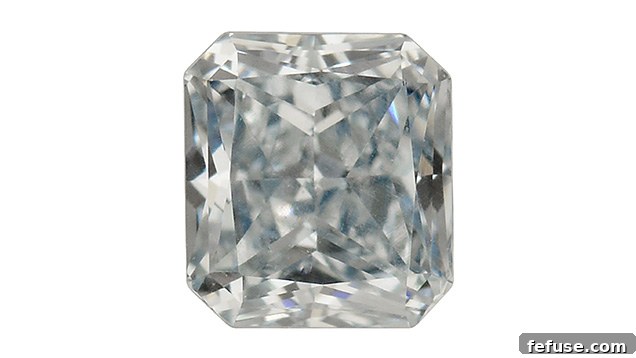
The world of gemology is constantly evolving, presenting new challenges and discoveries that push the boundaries of scientific identification. In a landmark finding, researchers at the Gemological Institute of America (GIA) have reported the unprecedented discovery of a natural diamond enhanced with a synthetic Chemical Vapor Deposition (CVD) overgrowth. This remarkable stone, weighing 0.33 carats and displaying a captivating Fancy blue hue, represents a significant milestone in diamond research, marking the first instance of such a composite diamond encountered by the renowned laboratory. This discovery not only highlights the growing sophistication of synthetic diamond technology but also underscores the critical importance of advanced gemological testing in maintaining transparency and consumer confidence within the diamond industry.
The Emergence of Composite Diamonds: A New Frontier in Gemology
The GIA’s discovery introduces a new category of diamond that blurs the lines between natural and lab-grown. While synthetic diamonds, particularly those produced by CVD methods, have become increasingly common, a composite stone where a natural diamond serves as a substrate for synthetic overgrowth presents unique identification challenges. This 0.33 ct Fancy blue diamond serves as a powerful testament to the ingenuity of modern diamond synthesis techniques, which are capable of mimicking natural processes and characteristics with astonishing accuracy. Understanding the nuances of such composites is paramount for gemologists, graders, and consumers alike, as it directly impacts grading, valuation, and the fundamental definition of a “natural” diamond.
Initial Clues: Unraveling the Mystery of an Unusual Stone
The journey to identifying this extraordinary composite diamond began with an anomaly that immediately piqued the interest of the GIA research team. Upon initial examination, the stone exhibited an unusual co-occurrence of both nitrogen and boron defects – a combination rarely found in a single natural diamond. Natural diamonds typically fall into distinct types based on their impurity profiles: Type Ia diamonds contain aggregated nitrogen, while Type IIb diamonds contain boron, which imparts a blue color and semiconducting properties. The simultaneous presence of both nitrogen (characteristic of Type Ia) and boron (characteristic of Type IIb) within the same crystal structure was a strong indicator that something exceptional, and potentially complex, was at play, prompting the researchers to launch a deeper, more comprehensive investigation using an arsenal of advanced gemological tools.
Advanced Gemological Analysis: Peeling Back the Layers of Deception
To fully comprehend the intricate nature of this Fancy blue diamond, the GIA team employed a suite of cutting-edge analytical techniques. Their meticulous investigation revealed a fascinating array of phenomena, each contributing a vital piece to the puzzle. One of the primary tools utilized was DiamondView imaging, which proved instrumental in visualizing the growth patterns and fluorescence properties of the diamond’s various layers. The images unveiled distinct and unusual characteristics that pointed towards a composite structure. Infrared (IR) spectroscopy further corroborated these suspicions, revealing a mixed type Ia and IIb diamond, confirming the initial observation of combined nitrogen and boron characteristics. This blend of spectral signatures provided compelling evidence that the stone was not a monolithic entity but rather comprised of different diamond types.
Fluorescence and Phosphorescence: Key Differentiators
Fluorescence, the emission of light by a substance when exposed to ultraviolet (UV) radiation, played a crucial role in distinguishing the different layers of the composite diamond. The face-up view of the stone exhibited a yellowish-green fluorescence, while the face-down view displayed a distinct blue fluorescence. More tellingly, a sharp boundary separated a yellowish-green fluorescence zone at the top of the crown from other areas, indicating a clear demarcation between different growth regions. Furthermore, the top layer, later identified as the CVD synthetic overgrowth, also exhibited phosphorescence – a lingering glow after the UV light source is removed. This combination of yellowish-green fluorescence and phosphorescence is often associated with the presence of silicon-vacancy (SiV–) defects, which are characteristic indicators of CVD synthetic diamonds.
Unveiling the Interface: Microscopic Evidence and Strain Patterns
The GIA report meticulously detailed additional compelling evidence that solidified the composite nature of the diamond. Microscopic examination revealed a distinct boundary line along the interface layer on the crown facets, visually separating the two diamond components. Further supporting the evidence of a fusion, a cloud-like inclusion was observed trapped precisely at this interface layer, alongside a dark needle-like inclusion situated at or near the boundary. These physical features provided tangible proof of the junction between two distinct growth events. In contrast, the bottom diamond exhibited characteristics consistent with a natural origin: blue fluorescence but no phosphorescence in DiamondView images, typical of natural Type Ia diamonds. Moreover, a small stress halo and a natural surface feature were observable in the bottom diamond, reinforcing its natural provenance. The strain pattern observed throughout the pavilion of the stone was also entirely consistent with that of a natural Type Ia diamond, further differentiating it from the synthetic overgrowth.
Conclusion: A Rare Composite and a Warning for the Industry
Based on the comprehensive array of gemological evidence, the GIA team conclusively identified this rare stone as having a Type IIb CVD synthetic diamond overgrowth on a Type Ia natural diamond substrate. This finding is not merely an academic curiosity; it carries significant implications for the global diamond industry. The GIA researchers issued a stark warning, emphasizing that “identification of colored diamonds should be performed very carefully by looking for unusual characteristics, such as a straight boundary line associated with an interface plane, and fluorescence zones with sharp edges in DiamondView images.” This guidance is paramount, as the increasing sophistication of synthetic diamond production means that such composites could become more prevalent, potentially making their way into the market unnoticed without rigorous examination. The challenges posed by this fancy-colored composite diamond extend beyond its specific color; the GIA team sagely pointed out that “similar challenges could exist for colorless and near-colorless diamonds,” indicating a broader need for vigilance and advanced detection methods across the entire spectrum of diamond grading.
Implications for Diamond Grading and Consumer Confidence
The discovery of this composite diamond underscores the ongoing “arms race” between synthetic diamond manufacturers and gemological laboratories. As synthesis technologies advance, laboratories like the GIA must continually innovate and refine their identification techniques. For the diamond grading sector, this means a heightened reliance on sophisticated instruments and highly trained gemologists capable of interpreting complex data. The presence of composite stones necessitates an even more thorough examination process, beyond routine screening, to ensure accurate disclosure of a diamond’s origin and characteristics. Crucially, this affects consumer confidence. Ensuring that every diamond bought is accurately represented, whether natural, synthetic, or composite, is vital for maintaining trust in the industry. Full disclosure protects consumers from misrepresentation and ensures the integrity of the diamond market.
The Future of Diamond Identification: GIA’s Pioneering Role
This groundbreaking research reinforces the GIA’s position at the forefront of gemological innovation. The paper detailing this discovery was authored by esteemed GIA researchers Kyaw Soe Moe, Paul Johnson, and Ulrika D’Haenens-Johansson from the GIA’s New York laboratory, alongside Wuyi Wang, GIA’s director of research and development. Their work not only documents a unique specimen but also provides invaluable insights that will guide future research and identification protocols. The continuous investment in scientific research and advanced instrumentation by institutions like the GIA is critical for keeping pace with technological advancements in diamond production and safeguarding the integrity of the diamond supply chain. As the lines between natural and synthetic grow increasingly subtle, the role of independent gemological laboratories in ensuring transparency and ethical practices becomes ever more indispensable.
Their findings serve as a crucial reminder for all stakeholders in the diamond trade about the dynamic nature of gemological science and the unwavering commitment required to uphold authenticity and trust in every single stone that comes to market.
Figure 1. This 0.33 ct Fancy blue diamond was confirmed to be a composite of CVD synthetic type IIb diamond overgrowth on a natural type Ia substrate. Photo by Sood Oil (Judy) Chia; Courtesy GIA