
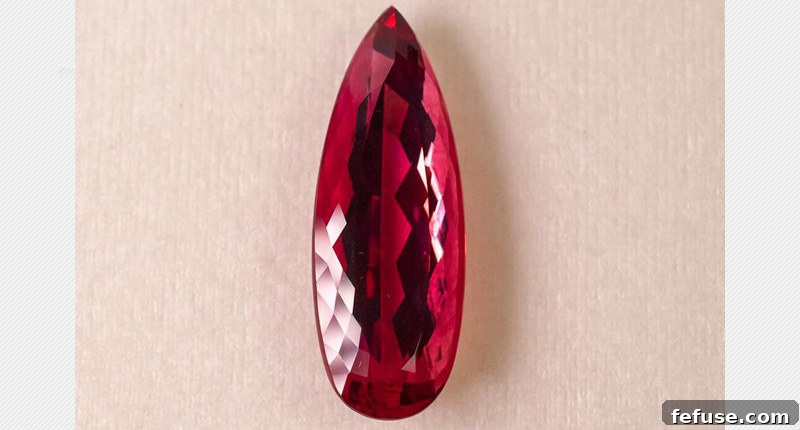
The Whitney Flame Topaz: A Fiery Masterpiece Ignites the Smithsonian’s National Gem Collection
Washington, D.C. has become home to an extraordinary new treasure, captivating gem enthusiasts and the public alike. The esteemed Smithsonian, a global leader in museum collections and research, proudly announces the acquisition of the breathtaking 48.86-carat red “Whitney Flame Topaz.” Hailed by experts as one of the finest topaz specimens ever discovered, this magnificent gemstone now takes its place as a permanent beacon within the illustrious National Gem Collection at the Smithsonian’s National Museum of Natural History.
This remarkable addition promises to draw millions of visitors annually, offering a rare glimpse into the stunning artistry of nature combined with significant human generosity. Its vibrant scarlet glow is unlike any other, immediately distinguishing it as a star among the world’s most prized jewels. The gem is now prominently displayed for public viewing in the prestigious Harry Winston Gallery, a testament to its unparalleled beauty and geological significance.
A Glimmering Masterpiece Joins the Ranks of Legendary Gems
For decades, the Whitney Flame Topaz remained in private hands, a closely guarded secret of unparalleled beauty. Its journey to public display began with the crucial intervention of philanthropist Coralyn Wright Whitney, whose vision and profound generosity facilitated its acquisition as an invaluable gift to the National Gem Collection. This acquisition not only enriches the Smithsonian’s already world-renowned inventory but also ensures that this natural marvel will inspire and educate generations to come.
The gem’s staggering 48.86-carat weight makes it a substantial piece, but it is its intense, fiery red color that truly sets it apart. This mesmerizing hue is a direct result of minute trace quantities of chromium, incorporated into the topaz crystal during its arduous formation deep within the Earth. Such perfect coloration in topaz, particularly in red, is an exceedingly rare phenomenon, making the Whitney Flame a geological anomaly and a collector’s dream.
The Allure of Red Topaz: A Rarity Among Earth’s Treasures
Topaz is a silicate mineral, known for its wide range of colors, including blue, yellow, pink, brown, and colorless varieties. However, red topaz stands out as the rarest and most coveted of all. The conditions required for its formation, specifically the presence of chromium impurities at the precise moment of crystallization, are incredibly specific and seldom met in nature. This scarcity contributes significantly to the gem’s immense value and allure. Unlike some gemstones where color is enhanced through treatment, the Whitney Flame’s captivating red is entirely natural, a pure product of Earth’s intricate processes.
The origin of the Whitney Flame Topaz can be traced to the legendary topaz mines of Ouro Preto, Brazil. This region, nestled in the state of Minas Gerais, has long been revered as a significant source of high-quality gemstones, particularly Imperial Topaz, which typically exhibits golden-orange to pinkish-orange hues. The discovery of a red topaz of such exceptional size and vividness from this already famous locale further solidifies Ouro Preto’s reputation as a treasure trove of geological wonders, cementing Brazil’s status as a premier global source for extraordinary minerals.
Philanthropy’s Brilliance: Coralyn Wright Whitney’s Enduring Legacy
The acquisition of the Whitney Flame Topaz is inextricably linked to the extraordinary benevolence of Coralyn Wright Whitney. Her dedication to the Smithsonian extends far beyond this single magnificent gem, establishing her as one of the institution’s most prominent and impactful supporters. Her contributions span decades, demonstrating a profound commitment to preserving natural history, advancing scientific research, and enriching public education.
A Gift of Unparalleled Generosity and Vision
Mrs. Whitney’s involvement in bringing the Whitney Flame Topaz to the Smithsonian underscores her strategic understanding of how to enhance public collections and scientific endeavors. Her philanthropy is not merely about donations; it’s about investing in the future of knowledge and cultural heritage. The decision to gift a gem of this caliber to a national institution ensures its perpetual accessibility, allowing countless individuals to marvel at its splendor and learn about the geological forces that shaped it.
Her vision recognizes that such natural masterpieces serve as powerful educational tools, sparking curiosity in mineralogy, geology, and environmental sciences. By making such a significant gem available to the public, Mrs. Whitney champions the Smithsonian’s mission to foster an understanding and appreciation for the natural world, inspiring future generations of scientists, artists, and gem enthusiasts.
Beyond the Gem: Endowing the Future of Gemology
The brilliance of Coralyn Wright Whitney’s philanthropy truly shines through her accompanying $5 million gift, which is specifically earmarked to endow the Coralyn W. Whitney Curator of Gems and Minerals position at the museum. This generous endowment provides crucial, long-term financial stability for a pivotal role within the Department of Mineral Sciences. Endowed curatorial positions are vital for institutions like the Smithsonian, ensuring that world-class expertise is continuously available to manage, study, and expand the collections.
A curator of gems and minerals is not just a caretaker; they are a leading scholar, an educator, and a visionary. This endowment guarantees that the Smithsonian can attract and retain top talent in the field, allowing for cutting-edge research, meticulous preservation, and innovative exhibition development. It underscores Mrs. Whitney’s understanding that the longevity and vitality of a collection depend as much on the intellectual capital dedicated to it as on the physical objects themselves. This gift will undoubtedly strengthen the Smithsonian’s standing as a global leader in gemological research and display for decades to come.
Mrs. Whitney’s history of support for the Smithsonian is extensive and impactful. In 2009, she donated another significant piece, the 17-carat Whitney Alexandrite, to the National Gem Collection. Alexandrite, known for its remarkable color-changing properties, is another rare and highly prized gem. Furthermore, she established the Coralyn Wright Whitney Endowment, an enduring fund specifically designed to support research and activities directly related to the collection. This multifaceted support—from individual masterpieces to foundational endowments—demonstrates a comprehensive commitment to the Smithsonian’s mission and its future.
The Smithsonian’s National Gem Collection: A Treasure Trove of Earth’s Wonders
The National Gem Collection at the Smithsonian’s National Museum of Natural History is arguably one of the most prestigious and comprehensive collections of its kind in the world. Home to iconic pieces like the legendary Hope Diamond, the spectacular Star of Asia Sapphire, and the mesmerizing Carmen Lúcia Ruby, it draws millions of visitors annually, each eager to witness Earth’s most stunning mineralogical creations. The addition of the Whitney Flame Topaz only further elevates this already stellar assembly, adding another unique and highly significant piece to its celebrated roster.
Home to Iconic Masterpieces and Scientific Insight
Jeffrey Post, chair of the Department of Mineral Sciences and curator of the National Gem and Mineral Collection, eloquently articulated the significance of this latest acquisition: “The Whitney Flame Topaz is a major addition to the Smithsonian’s collection and will delight and amaze millions of museum visitors. The color and beauty of this gemstone is astounding. You have to see it to believe it. The Whitney Flame is truly one of Earth’s treasures.” His words capture the profound impact such a gem has, not only as an object of beauty but also as a testament to the Earth’s geological processes.
The Department of Mineral Sciences plays a crucial role beyond exhibition. It is a hub for scientific research, where experts study the formation, properties, and origins of minerals and gemstones. Each piece in the collection contributes to our understanding of planetary geology, mineralogy, and the forces that shape our world. The Whitney Flame Topaz will serve as an invaluable specimen for ongoing scientific inquiry, offering insights into the rare conditions required for red topaz formation.
The Educational and Cultural Significance of Gemstones
Museums like the Smithsonian are more than just repositories; they are educational institutions that bridge the gap between scientific discovery and public engagement. Gemstones, with their inherent beauty and fascinating origins, serve as perfect ambassadors for science. They connect visitors to concepts of geology, chemistry, and physics in an accessible and awe-inspiring way. The National Gem Collection, now further enhanced by the Whitney Flame, sparks curiosity, encourages scientific literacy, and inspires a deeper appreciation for the Earth’s natural heritage.
The Magnificence of Topaz: From Earth to Exhibition
Topaz, with a hardness of 8 on the Mohs scale, is a durable and versatile gemstone. Its crystalline structure, typically prismatic, allows for excellent faceting, bringing out its internal fire and brilliance. While colorless topaz is common, various trace elements incorporated during its formation give rise to a spectrum of captivating colors. Iron can produce yellow, brown, and sherry hues, while chromium, as seen in the Whitney Flame, is responsible for the highly prized pink and red varieties. Manganese is often associated with purplish-pink topaz. The understanding of these trace elements is crucial for gemologists and allows for the identification and appreciation of naturally colored stones.
Understanding Topaz: Characteristics and Colors
The vibrant red hue of the Whitney Flame Topaz is not merely aesthetically pleasing; it is a profound scientific indicator. The presence of chromium, even in minuscule amounts, is what transforms the ordinary into the extraordinary in the world of topaz. This process occurs deep within the Earth’s crust, often in pegmatite deposits, where the right chemical elements and thermodynamic conditions align over millions of years to grow such perfect crystals. The clarity and lack of inclusions in the Whitney Flame further amplify its rarity, allowing its natural fire to radiate unimpeded.
Ouro Preto, Brazil: A Cradle of Exquisite Gemstones
The historic town of Ouro Preto, nestled amidst the lush mountains of Minas Gerais, Brazil, is steeped in a rich history of mining and discovery. Originally founded during the Brazilian gold rush in the late 17th century, its name, meaning “Black Gold,” refers to the gold-encrusted black iron ore found there. Over centuries, the region evolved into a world-renowned source for other precious minerals, most notably Imperial Topaz. The geological formations in and around Ouro Preto are uniquely suited for the crystallization of high-quality gemstones, making it a pivotal location for gemologists and collectors worldwide.
Brazil’s contribution to global gemology cannot be overstated. From emeralds and aquamarines to tourmalines and amethysts, the nation’s diverse geological landscape yields an astonishing array of gemstones. The discovery of the Whitney Flame Topaz from this fabled region not only adds to Brazil’s legacy but also underscores the incredible potential for new, unparalleled discoveries that still lie hidden beneath its ancient soils. The gem represents a direct link to the Earth’s powerful formative processes, brought to light through diligent mining and refined through skilled craftsmanship.
A Lasting Spark: The Whitney Flame’s Enduring Impact
The Whitney Flame Topaz is more than just a beautiful stone; it is a symbol of natural wonder, scientific discovery, and profound human generosity. Its acquisition by the Smithsonian’s National Gem Collection ensures its enduring legacy, making it a source of inspiration and education for countless individuals for generations to come. It stands as a powerful reminder of the Earth’s hidden marvels and the critical role of philanthropy in bringing these wonders to the public eye.
Inspiring Future Generations
As visitors gaze upon the Whitney Flame in the Harry Winston Gallery, they will not only witness an object of immense beauty but also connect with the vastness of geological time and the intricate processes that shape our planet. This gem will undoubtedly spark an interest in mineral sciences among young minds, encouraging them to explore careers in geology, gemology, and conservation. It is a testament to the power of a single artifact to inspire and educate, bridging the gap between scientific understanding and aesthetic appreciation.
The combined impact of the Whitney Flame Topaz and Coralyn Wright Whitney’s generous endowment will resonate for years, bolstering the Smithsonian’s capacity for research, exhibition, and public outreach. It reinforces the vital partnership between private donors and public institutions, working together to safeguard and celebrate the planet’s most precious natural heritage.
Planning Your Visit to Witness the Flame
We invite you to experience the unparalleled beauty of the Whitney Flame Topaz firsthand. Plan your visit to the Smithsonian’s National Museum of Natural History in Washington, D.C., and witness this extraordinary gem on permanent display in the Harry Winston Gallery. Prepare to be amazed by its vivid red hue and profound history, a true testament to Earth’s artistic power and human dedication to its preservation.
News Source: nationaljeweler.com