
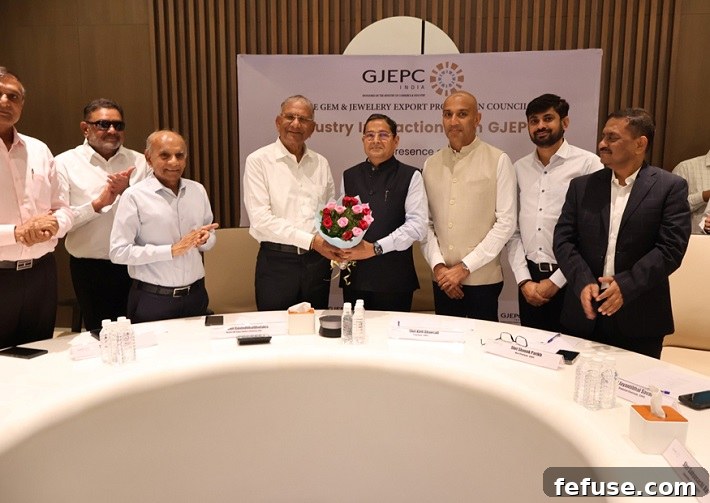
GJEPC Leadership Convening in Surat: Charting a Resilient Future for India’s Gem & Jewellery Exports Amid Global Shifts
In a landmark gathering on April 24, 2025, the apex body of India’s gem and jewellery sector, the Gem & Jewellery Export Promotion Council (GJEPC), orchestrated a high-stakes meeting in Surat. This crucial assembly brought together the GJEPC leadership and the region’s most influential industry stakeholders, reflecting a unified effort to address pressing global trade challenges and proactively forge new pathways for sectoral growth. The high-level interaction, spearheaded by GJEPC Chairman Mr. Kirit Bhansali, underscored the industry’s resolve to navigate the complexities posed by recent US-imposed tariffs and to capitalize on emerging opportunities.
Surat, globally recognized as the diamond hub of the world, served as the ideal backdrop for these critical discussions. Its unparalleled infrastructure, skilled workforce, and deep-rooted legacy in diamond processing make it an indispensable nerve center for India’s gem and jewellery ambitions. The GJEPC’s decision to convene directly in Surat highlighted the council’s commitment to engaging at the grassroots level, ensuring that policy formulation and strategic initiatives are firmly grounded in the realities faced by manufacturers, exporters, and artisans who drive this multi-billion dollar industry.
A Convergence of Industry Leaders and Visionaries
The GJEPC delegation comprised an impressive lineup of figures, signifying the strategic importance of the meeting. Alongside Chairman Mr. Kirit Bhansali, Vice Chairman Mr. Saunak Parikh and Executive Director Mr. Sabyasachi Ray contributed their expertise and insights. Their presence alone signaled the seriousness with which the GJEPC approaches its mandate of fostering export growth and protecting the interests of its members.
The meeting saw a powerful convergence of influential leaders from the Surat region and beyond. Notably present was Rajya Sabha MP and Chairman of the Surat Diamond Bourse (SDB), Mr. Govindbhai Dholakia, whose leadership in establishing the world’s largest diamond trading hub has reshaped the global landscape. Joining him were revered industry veterans such as Mr. Laljibhai Patel, Mr. Nagjibhai Sakariya, and Mr. Vallabh Lakhani, whose decades of experience and wisdom are invaluable to the sector. Their collective insights provided a historical context and a forward-looking perspective, bridging generations of expertise.
Further enriching the dialogue were the heads of key trade associations, representing the diverse facets of the Surat gem and jewellery ecosystem. Leaders from the Surat Diamond Association, the Lab Grown Diamond Association, and the Surat Jewellery Manufacturers Association brought vital perspectives, ensuring that the discussions were holistic and representative of all segments. This broad representation underscored the industry’s collaborative spirit, crucial for addressing complex issues and formulating unified strategies.
Navigating Trade Headwinds: The Impact of US Tariffs and Customs Reforms
A central and critical theme dominating the dialogue was the anticipated ramifications of recent US tariffs on India’s gem and jewellery exports. The United States remains one of India’s largest and most crucial export markets for precious stones and metals. Any shifts in tariff regimes or trade policies from the US can have a significant ripple effect across the Indian industry, impacting everything from manufacturing volumes to employment rates. Recognizing this gravity, Mr. Sabyasachi Ray, GJEPC’s Executive Director, presented a comprehensive analysis, offering data-driven insights into the challenges posed by these tariffs and outlining potential mitigation strategies.
Mr. Ray’s presentation delved into the specifics of how these trade barriers could affect various product categories within India’s export basket, from cut and polished diamonds to intricate gold and silver jewellery. He elaborated on the economic models forecasting potential shifts in demand, pricing structures, and competitive dynamics. The discussion also extended to exploring various strategies, including diversification of export markets, enhancement of value-added products, and potential policy advocacy at both domestic and international levels, to safeguard India’s market share and ensure the continued vibrancy of its export engine.
In a significant development that brought a note of reassurance, Mr. Jayanti Savaliya, Regional Chairman – Gujarat, GJEPC, informed attendees of tangible and proactive progress in resolving long-standing Customs-related bottlenecks. These procedural hurdles, often involving documentation, valuation, and clearances, have historically posed challenges for exporters, leading to delays and increased operational costs. Mr. Savaliya’s update highlighted the GJEPC’s diligent efforts in liaisoning with government agencies to streamline these processes, thereby enhancing the ease of doing business for Indian exporters. Such improvements are vital for maintaining India’s competitive edge in the global market, allowing goods to move more efficiently and predictably across international borders.
Surat: The Undisputed Heart of India’s Gem & Jewellery Industry
Speaking passionately about Surat’s unparalleled global relevance, GJEPC Chairman Mr. Kirit Bhansali articulated the city’s strategic and symbolic role. “Surat is not merely a hub of diamond cutting and polishing—it is the heart of our industry and a beacon of India’s craftsmanship on the world stage,” he stated with conviction. This powerful declaration encapsulated the city’s profound influence, extending far beyond its industrial output to its cultural and economic significance.
Surat’s reputation as the world’s leading center for diamond cutting and polishing is well-deserved, processing an estimated 9 out of 10 diamonds globally. However, Mr. Bhansali’s statement highlighted a deeper truth: Surat represents the confluence of tradition and innovation, where generations of artisans have perfected their craft, transforming rough stones into glittering masterpieces. It is a city that sustains millions of livelihoods directly and indirectly, fueling an entire ecosystem of ancillary industries, from technology and machinery to logistics and education. Its contribution to India’s foreign exchange earnings is immense, making it a critical pillar of the national economy.
The Chairman’s words also resonated with the idea of Surat as a “beacon of India’s craftsmanship.” This refers not only to the technical skill involved in diamond processing but also to the artistry, design capabilities, and commitment to quality that define Indian jewellery. It symbolizes the pride and heritage that Indian artisans bring to their work, ensuring that each piece tells a story of meticulous effort and cultural richness. Promoting this narrative on the world stage is key to elevating India’s brand in the luxury goods sector.
Fostering Trust and Forward-Thinking Collaboration
Echoing this sentiment of mutual respect and collective ambition, Mr. Govindbhai Dholakia, the esteemed Rajya Sabha MP and Chairman of the Surat Diamond Bourse, praised GJEPC’s unwavering efforts. He specifically lauded the council’s crucial role in bridging the gap between policymakers and industry leaders. This unique ability to act as an effective intermediary fosters a culture of mutual trust and forward-thinking collaboration, which is indispensable for the sustainable growth of any major industry. Without such a bridge, industry concerns might remain unheard, and governmental policies might lack the ground-level understanding needed for effective implementation.
Mr. Dholakia emphasized that GJEPC’s advocacy ensures that the voice of the gem and jewellery sector is heard at the highest echelons of government. This collaboration extends to influencing trade policies, addressing regulatory hurdles, promoting skill development initiatives, and advocating for necessary infrastructure investments. By fostering an environment of open communication and shared objectives, the GJEPC empowers the industry to thrive, adapt to dynamic market conditions, and contribute significantly to India’s economic prosperity. This trust is not merely transactional; it is foundational to building a resilient industry capable of navigating global complexities.
Bold Strategies for Future Growth: Rough Diamond Hub and Silver Jewellery’s Ascent
Looking ahead with an astute understanding of current trade dynamics, Vice Chairman Mr. Saunak Parikh proposed several bold strategies aimed at cementing India’s leadership in the global gem and jewellery market. His forward-looking vision encompassed two primary areas of potential exponential growth and strategic enhancement.
Firstly, Mr. Parikh advocated for promoting Surat as a direct hub for rough diamond imports and exports. This initiative represents a significant paradigm shift from the current global supply chain, where major trading hubs like Antwerp and Dubai often act as intermediaries. Establishing Surat as a direct point of origin and destination for rough diamonds would offer numerous advantages. It would streamline logistics, reduce transit times and costs, and enhance India’s control over its diamond pipeline. This move could also attract more international buyers and sellers directly to India, boosting trade volumes, increasing transparency, and further solidifying Surat’s position as the undisputed global diamond capital. It would also empower Indian manufacturers with direct access to a wider variety of rough diamonds, enabling them to respond more swiftly to market demands and foster greater value addition within the country.
Secondly, Mr. Parikh flagged silver jewellery as a promising growth segment, referring to it emphatically as “the next big thing” for the sector. While India has traditionally been renowned for its gold and diamond jewellery, the global market for silver jewellery has been experiencing a significant surge. This segment offers unique opportunities due to its affordability, versatility in design, and appeal to a broader demographic, including younger consumers and those seeking fashionable yet accessible pieces. The potential for mass market penetration, coupled with India’s rich heritage in intricate silver craftsmanship, positions it perfectly to capitalize on this growing demand. GJEPC plans to support this segment through design promotion, skill enhancement programs, and targeted marketing efforts to unlock its full export potential, thereby diversifying India’s jewellery export basket and creating new avenues for growth and employment.
A Unified Vision for a Resilient and Ambitious Future
The conclave concluded on an exceptionally high note, radiating a strong message of unity, resilience, and ambition that permeated every discussion. The collective spirit demonstrated by the GJEPC leadership and the Surat industry stakeholders underscored a shared commitment to overcome challenges and seize opportunities in the dynamic global trade landscape. It was a clear affirmation that India’s gem and jewellery industry, despite external pressures, remains vibrant, innovative, and forward-looking.
As the Indian gem and jewellery industry continues to adapt to ongoing global shifts—be they economic downturns, geopolitical tensions, or evolving consumer preferences—Surat is unequivocally poised to lead the charge. The city, with its deep-rooted legacy of excellence in craftsmanship and its burgeoning infrastructure, is set to reinforce its status as not just a cornerstone of international trade but also as a beacon of innovation and ethical practices. The strategies discussed and the collaborations fostered during this pivotal meeting lay a robust foundation for a future where India’s gem and jewellery exports continue to shine brightly on the world stage, driven by the collective vision and unwavering spirit of its dedicated professionals.