
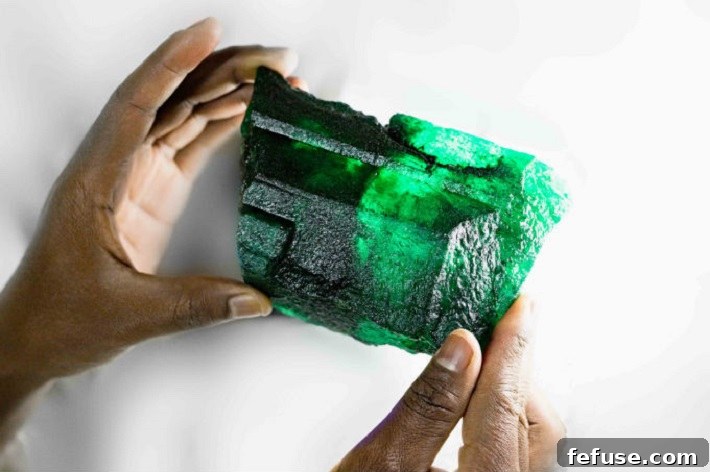
The Kagem Mine in Zambia, a world-renowned source of exceptional emeralds, recently unveiled a truly monumental discovery: a 5,655-carat emerald dubbed the “Lion Emerald.” This colossal gemstone, also affectionately known as “Inkalamu,” which means lion in the local Bemba language, was discovered by Gemfields, the leading global supplier of responsibly sourced colored gemstones. The announcement sent ripples of excitement throughout the gemstone industry, highlighting the enduring allure and geological wonders hidden within the earth.
Inkalamu: A Gemstone of Unparalleled Beauty and Scale
Weighing an astonishing 5,655 carats, the Inkalamu emerald stands as one of the most significant finds in recent history. Its sheer size alone would make it remarkable, but what truly sets the Lion Emerald apart is its extraordinary quality. According to Gemfields’ London-based gemmologist, Elena Basaglia, the stone exhibits a remarkable clarity, an attribute highly prized in emeralds, which are often characterized by natural inclusions. Beyond its transparency, Inkalamu boasts a perfectly balanced golden green hue – a color saturation and tone that speaks volumes about its superior formation and unique mineral composition within the Zambian earth.
Basaglia underscored the immense significance of this discovery, stating, “The discovery of this exceptional gemstone is an important moment for us and the emerald world in general. It’s difficult to estimate how many individual gems will be cut from Inkalamu but the cutting expertise of Gemfields’ auction partners means this gemstone will make its mark in the history books of exceptional gemstones.” Her words encapsulate the excitement and anticipation surrounding how this rough giant will ultimately be transformed into exquisite finished pieces, each carrying a piece of the Lion Emerald’s legacy.
The Fortuitous Discovery: A Testament to Kagem’s Richness
The discovery of Inkalamu was no accident but rather the fruit of meticulous geological exploration and the dedication of experienced miners. The Lion Emerald was unearthed on October 2nd, deep within the eastern section of Kagem’s largest open-pit mine. The discovery team consisted of geologist Debapriya Rakshit and veteran emerald miner Richard Kapeta, whose combined expertise led to this incredible find. This particular area of the Kagem mine has proven to be exceptionally prolific in recent months, yielding several significant crystals. However, none have matched the combined magnitude, vibrant color, and pristine clarity of the Lion Emerald, solidifying its status as a truly once-in-a-lifetime find from a region celebrated for its gemstone bounty.
Kagem Mine: A Pillar of Ethical Emerald Sourcing
The Kagem mine, jointly owned by Gemfields in partnership with the Zambian government, is the world’s single largest producer of emeralds. Its operations are characterized by a commitment to responsible mining practices, ensuring that these precious stones are extracted and brought to market in an ethical and transparent manner. This dedication extends beyond environmental stewardship to include robust community engagement and significant contributions to the Zambian economy. The discovery of the Inkalamu emerald further solidifies Kagem’s reputation as the premier source for some of the finest emeralds known to humanity, reinforcing Zambia’s position at the pinnacle of the global emerald industry.
Gemfields’ overarching mission involves not just the mining and marketing of colored gemstones but also the establishment of clear provenance and ethical sourcing standards. For consumers and collectors alike, knowing that a gemstone like Inkalamu comes from a mine adhering to strict social and environmental protocols adds immeasurable value and peace of mind. The Lion Emerald is not merely a beautiful stone; it represents a commitment to sustainability and positive impact.
The “Lion Emerald”: A Name with Purpose
The naming of the 5,655-carat emerald as “Inkalamu,” or the Lion Emerald, carries a profound significance that extends beyond its majestic presence. Gemfields consciously chose this name to honor and draw attention to the vital conservation work carried out by two of its key conservation partners: the Zambian Carnivore Programme and the Niassa Carnivore Project in Mozambique. These organizations are at the forefront of protecting Africa’s magnificent carnivores, including lions, whose survival is crucial for maintaining ecological balance and biodiversity across the continent.
By linking such an iconic gemstone to these crucial conservation efforts, Gemfields aims to raise awareness and generate support for wildlife protection. This initiative underscores the company’s broader commitment to sustainability and giving back to the regions that provide the world with these natural treasures. The Lion Emerald thus becomes a symbol not only of natural beauty but also of hope for the preservation of Africa’s natural heritage, resonating with a deeper meaning for everyone who encounters its story.
From Mine to Market: The Highly Anticipated Auction
Following its discovery and initial assessment, the Lion Emerald is set to embark on the next phase of its journey: a highly anticipated sale. This extraordinary raw gemstone will be offered for sale at Gemfields’ next private auction in Singapore, scheduled for November. These exclusive auctions are curated events where Gemfields presents its responsibly sourced emeralds to a select group of international buyers, including leading cutters, polishers, and gemstone dealers from around the globe.
The Singapore auction is expected to attract significant attention, given the rarity and monumental size of Inkalamu. Such events are pivotal in establishing market value for exceptional gemstones and are closely watched by industry experts and collectors alike. The competitive bidding environment ensures that the stone realizes its true market potential, reflecting its exceptional qualities and unique provenance.
The Future of Inkalamu: Cutting, Investment, and Legacy
The journey of the Lion Emerald doesn’t end at the auction block; for the buyer, it marks a new beginning filled with immense possibilities. Adrian Banks, Gemfields’ managing director for product and sales, articulated these prospects, stating, “We expect a number of large, fine-quality cut emeralds to be borne of the Inkalamu crystal.” This highlights the primary path for such a magnificent rough stone: to be meticulously studied and then expertly cut into multiple exquisite, finished emeralds. This process requires unparalleled skill and precision from master cutters, who must carefully plan each facet to maximize the beauty, brilliance, and value of the resulting gems.
Each cut emerald derived from Inkalamu will carry a part of its legacy, making them highly desirable additions to the world’s finest jewelry collections. These individual gems, potentially ranging from significant single stones to a collection of matched gems, will undoubtedly command premium prices due to their provenance from such a historically important rough stone.
Beyond cutting, Banks also acknowledged another compelling possibility: “Given this emerald is such a rare find, it is also perfectly conceivable that the buyer will choose to purchase it as an investment.” The market for rare, high-quality gemstones as investment vehicles has grown significantly, with discerning collectors and investors recognizing their tangible value and potential for appreciation over time. The Inkalamu emerald, with its extraordinary size, exceptional clarity, and vibrant color, coupled with its responsible sourcing and compelling backstory, makes it an ideal candidate for such an investment. It’s a physical asset that combines natural beauty with enduring financial value, appealing to those who seek tangible wealth preservation and growth.
Ultimately, whether transformed into a constellation of dazzling jewels or preserved as a singular, monumental rough specimen, the Lion Emerald is destined to leave an indelible mark on the annals of gemstone history. Its discovery is a testament to the Earth’s hidden wonders, the dedication of those who unearth them, and the timeless fascination humanity holds for these precious natural artworks.
News Source: jewellerynet