
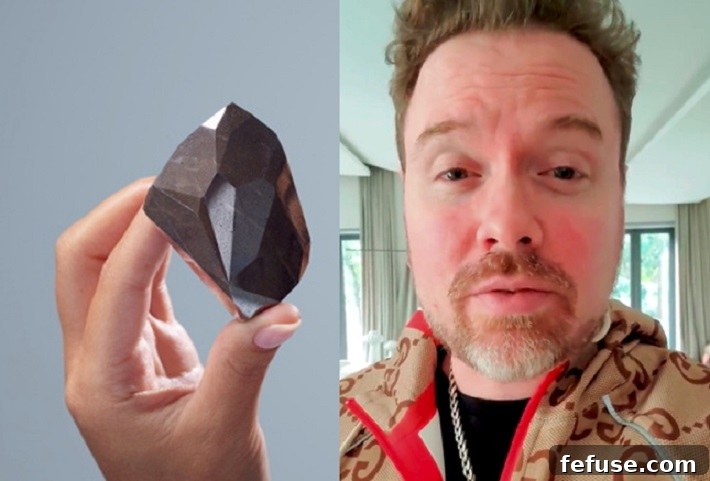
In a dramatic development that has sent ripples through the cryptocurrency world, prominent crypto personality Richard Heart, also known as Richard Schueler, has been formally accused by the U.S. Securities and Exchange Commission (SEC) of engaging in an elaborate scheme of fraud and conducting unregistered securities offerings. These grave allegations claim that Heart, along with his associated crypto entities Hex, PulseChain, and PulseX, collectively raised over an astounding $1 billion from investors. Adding a layer of extraordinary detail to the charges, the SEC specifically alleges that Heart misappropriated at least $12 million of these funds for lavish personal purchases, including a fleet of luxury sports cars, several high-value Rolex watches, and perhaps most notably, ‘The Enigma’ – the world’s largest black natural color diamond, acquired for a staggering $4.3 million.
The SEC’s formal charges, announced on August 31st, paint a picture of significant regulatory breaches and alleged financial misconduct. The core of the accusation centers on the unregistered offerings of asset securities. In the evolving landscape of cryptocurrency, the SEC maintains that many digital assets, when offered to the public, fall under the purview of securities laws, requiring proper registration and disclosure to protect investors. The failure to comply with these regulations is a serious offense, often resulting in significant penalties and legal challenges for the individuals and companies involved. For Heart’s projects – Hex, PulseChain, and PulseX – these charges imply that they allegedly operated outside the established legal framework, potentially exposing investors to undue risk without the transparency and safeguards typically associated with registered securities.
Beyond the unregistered offerings, the SEC has also leveled direct fraud charges against Heart and PulseChain. These allegations focus on the alleged diversion of substantial investor funds for personal enrichment. The list of alleged purchases is striking: expensive McLaren and Ferrari sports cars, a collection of four Rolex watches reportedly valued at over $3 million combined, and the pièce de résistance, ‘The Enigma’ diamond. Such accusations of misappropriation strike at the heart of investor trust, suggesting a profound breach of fiduciary duty and a stark contrast between the purported goals of the crypto projects and the alleged personal expenditures of their founder. This aspect of the case underscores the SEC’s commitment to pursuing individuals who allegedly misuse investor funds for private gain, regardless of the innovative facade of the underlying technology.
The acquisition of ‘The Enigma’ diamond provides a fascinating, almost cinematic, backdrop to the legal proceedings. This monumental gem, a 555.55-carat carbonado, holds the Guinness World Record for the largest cut diamond of its type. It was brought to auction by Sotheby’s in February, sold in a single-lot online auction without reserve. While Sotheby’s did not publicly identify the buyer at the time, Richard Heart, a 42-year-old U.S. tech entrepreneur, wasted no time in revealing himself. He took to Twitter, proudly announcing to his 180,000 followers that he was the successful bidder. His public declaration included his intention to pay for the priceless gem using cryptocurrency and, perhaps more significantly, to rename it the ‘Hex.com diamond,’ a direct nod to the blockchain platform he founded. This public display, now central to the SEC’s fraud allegations, has transformed a unique geological marvel into a symbol entwined with financial controversy and legal scrutiny.
Richard Heart’s projects, Hex, PulseChain, and PulseX, have long been subjects of intense discussion within the crypto community, often lauded by supporters for their innovative approaches and criticized by skeptics for their marketing tactics and economic models. Hex, launched in late 2019, positioned itself as a certificate of deposit on the blockchain, promising high returns for users who “stake” their tokens for predetermined periods. PulseChain, a proposed fork of the Ethereum blockchain, aimed to create a more scalable and cost-effective alternative, while PulseX was envisioned as a decentralized exchange within the PulseChain ecosystem. Heart himself cultivated a distinct public persona, characterized by flamboyant statements and a direct, often provocative, engagement with his audience. This combination of ambitious technological claims, a charismatic leader, and the promise of substantial financial gains attracted a considerable following, ultimately culminating in the massive fundraising efforts now under SEC investigation. The allegations directly challenge the legitimacy of these operations, questioning whether they were genuine entrepreneurial endeavors or elaborate schemes designed to benefit the founder at investors’ expense.
The choice of ‘The Enigma’ as an alleged personal asset acquisition is particularly symbolic. Black diamonds, or carbonados, are among the rarest and most mysterious of all diamonds. Unlike traditional diamonds formed deep within the Earth’s mantle, carbonados are believed to have extraterrestrial origins. Before the auction, Sotheby’s highlighted this extraordinary aspect, noting that the 55-facet polished stone was “thought to have been created either from a meteoric impact or having actually emerged from a diamond-bearing asteroid that collided with Earth.” This otherworldly narrative adds to the diamond’s allure, making it a truly unique specimen. The fact that such a gem, steeped in cosmic mystery and immense geological age, has become a focal point in a modern crypto fraud case creates a compelling and somewhat ironic juxtaposition. It links the cutting edge of digital finance with one of the oldest and most profound natural wonders, underscoring the vast sums of money flowing through the unregulated corners of the crypto market.
Delving deeper into the science, carbonado diamonds are extraordinarily old, with estimates placing their age between 2.6 and 3.8 billion years. To put this in perspective, this predates the formation of most continents on Earth. Their unique composition further supports their extraterrestrial hypothesis. Scientists have found these diamonds contain traces of nitrogen and hydrogen, elements that are abundant in interstellar space. Moreover, they often contain osbornite, a rare mineral that is uniquely present in meteors. These distinct chemical signatures strongly suggest that carbonados did not form through the conventional processes of terrestrial diamond creation. Instead, they likely journeyed through space, perhaps within asteroids, before eventually crashing onto Earth. This makes ‘The Enigma’ not just a large and beautiful gem, but a scientific marvel – a tangible piece of cosmic history that landed squarely in the middle of a high-stakes financial controversy. Its rarity, its age, and its incredible origin story amplify the significance of its alleged purchase with misappropriated funds.
The SEC’s action against Richard Heart and his companies serves as a stark reminder of the ongoing regulatory efforts to bring order and accountability to the fast-evolving cryptocurrency sector. As the crypto market matures, regulatory bodies worldwide are increasingly scrutinizing projects that operate without adhering to existing securities laws, aiming to protect retail investors from potential scams and unregistered offerings. This case, involving substantial alleged illicit gains and a high-profile figure, is likely to have significant implications for how similar projects are viewed and regulated in the future. It reinforces the message that innovation in financial technology, no matter how groundbreaking, does not grant immunity from established legal frameworks designed to ensure transparency, fairness, and investor protection. The outcome of this legal battle could set important precedents for the classification of digital assets and the enforcement powers of regulatory agencies in the digital age.
Furthermore, this high-profile case highlights the critical importance of due diligence for investors in the cryptocurrency space. The allure of quick riches and disruptive technology can sometimes overshadow the fundamental principles of investment safety. The SEC’s allegations against Richard Heart underscore the need for prospective investors to thoroughly research projects, understand the regulatory status of offerings, and critically evaluate the claims made by project founders. While the decentralized nature of blockchain technology offers many benefits, it also presents challenges for oversight and accountability. As legal proceedings unfold, the crypto community will undoubtedly be watching closely, as the resolution of this case could reshape public perception, influence future regulatory strategies, and ultimately contribute to a more defined and potentially safer operating environment for both innovators and investors in the digital asset market.