
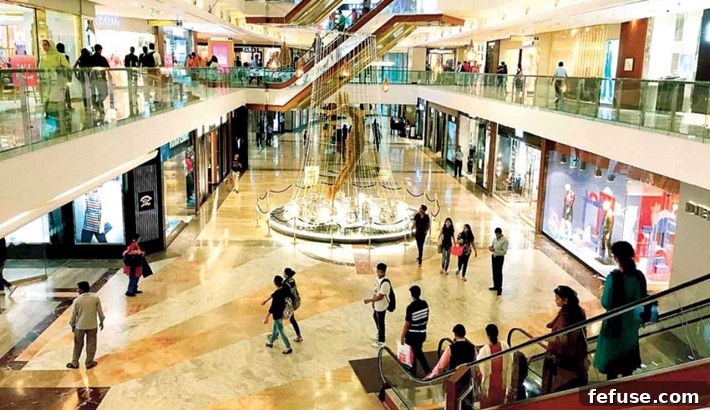
Indian Shopping Centres on the Brink: Urgent Plea for Financial Lifeline Amidst COVID-19 Crisis
Mumbai | Bengaluru: India’s vibrant organized retail sector, a pivotal engine for the nation’s economic growth and employment, finds itself in an unprecedented state of distress. Shopping centre developers and owners are confronting a severe financial downturn, reporting colossal losses and facing the imminent threat of widespread unemployment. In response, a unified appeal has been made to the government and financial institutions, calling for immediate, comprehensive, and sustainable relief measures to avert a complete collapse of this vital industry.
The Devastating Economic Fallout: Billions Lost, Millions of Livelihoods at Risk
The scale of the crisis currently gripping the Indian organized retail industry is staggering. According to the Shopping Centres Association of India (SCAI), the sector has incurred losses exceeding a monumental ₹90,000 crore (approximately $12 billion USD) over just the past two months. This profound financial hemorrhage is a direct consequence of the prolonged lockdowns, stringent restrictions, and reduced consumer footfall brought about by the COVID-19 pandemic. With commercial operations severely curtailed or completely halted for extended periods, many businesses within this ecosystem are teetering on the precipice of insolvency.
Beyond the stark financial figures, the human cost is equally alarming. The industry warns that large-scale unemployment is no longer a distant possibility but a stark reality rapidly approaching, unless substantial financial relief and robust governmental support are swiftly deployed. Millions of jobs, ranging from retail associates and store managers to security personnel, maintenance staff, and supply chain workers, depend directly and indirectly on the health of shopping centres. Their future hangs precariously in the balance.
Amitabh Taneja, Chairman of SCAI, articulated the gravity of the situation, stating, “The organized retail industry is in distress and has not earned anything since the lockdown, and our survival is at stake. While the extension of the loan moratorium talks about some relief on repayment, it won’t help the industry in liquidity. A long-term beneficial plan from the government is much required to revive the second biggest contributor to our country’s GDP.” His words highlight the critical need for solutions that go beyond mere deferrals, emphasizing a sustainable, long-term vision to safeguard an industry that plays a crucial role in India’s Gross Domestic Product.
Key Demands: A Blueprint for Survival and Recovery
In light of the escalating crisis, shopping centre developers and owners have presented a comprehensive set of demands to both the government and financial institutions. These requests are not simply stop-gap measures but are designed to provide the necessary framework for immediate survival and to lay the groundwork for eventual recovery in a post-pandemic landscape. The industry believes these interventions are non-negotiable for preserving infrastructure, employment, and the overall economic contribution of organized retail.
1. Extended Moratorium on Loan Repayments
A central plea from mall owners is for financial institutions to significantly extend the penalty-free moratorium period for loan repayments. The industry is specifically requesting this crucial relief measure be prolonged until at least March 31, 2021. While initial moratoriums offered some temporary respite, the persistent nature of the crisis and the slow pace of economic recovery mean that businesses are still struggling to generate sufficient revenue to meet their financial obligations. An extended moratorium would provide essential breathing room, enabling operators to conserve vital cash flow, manage critical operational expenses, and navigate a period of drastically reduced or non-existent income. However, as SCAI Chairman Amitabh Taneja pointed out, while deferring payments is helpful, it does not solve the fundamental liquidity crisis, merely postponing the problem if incomes do not recover.
2. One-Time Loan Restructuring for Shopping Centres
Beyond temporary deferrals, the industry is advocating for a comprehensive, one-time loan restructuring facility specifically tailored for shopping centres. The unprecedented economic disruption caused by the pandemic has fundamentally altered the financial viability and projections of numerous projects. A robust restructuring would allow for the renegotiation of existing loan terms, including interest rates, repayment schedules, and potentially even principal amounts, making them more aligned with the current, significantly diminished revenue streams. This measure is absolutely critical for ensuring the long-term sustainability of these substantial assets, preventing widespread defaults, and averting potential large-scale insolvencies across the sector.
3. Access to Short-Term Financing at Concessional Rates
The ability to meet increased working capital requirements has become an enormous challenge for shopping centres. Despite plummeting revenues, essential operating expenses—such as utilities, ongoing maintenance, and salaries for core staff—continue to accumulate. Therefore, there is a dire and immediate need for readily accessible short-term financing options, typically structured for a period of 6 to 12 months, and offered at significantly lower, concessional interest rates. Such financing would inject much-needed liquidity into the system, empowering centres to manage their day-to-day operations, maintain essential infrastructure, and crucially, invest in the rigorous safety and hygiene measures required to instill consumer confidence and prepare for a phased reopening.
4. Flexibility in Goods and Services Tax (GST) Deposits
Another pragmatic and impactful demand relates to the Goods and Services Tax (GST) deposits. Given the severe cash crunch affecting the entire industry, greater flexibility in the timelines and modalities for depositing GST is being sought. Easing these requirements, even temporarily, would free up critical capital that can be immediately redirected towards urgent operational needs, further alleviating the liquidity squeeze. This measure would provide a much-needed buffer and help businesses navigate the current financial turbulence without facing additional punitive burdens.
The Retailer-Landlord Conundrum: A Shared Struggle
While mall owners actively lobby the government for macro-level relief, an equally pressing internal conflict is unfolding within the organized retail ecosystem: the contentious issue of rental waivers. Retailers operating within these shopping centres are vehemently advocating for complete or substantial rental waivers, citing prolonged periods of zero business and consequently, no income during the various lockdown phases. For a significant number of retailers, maintaining full rental payments for stores that have been shuttered or operating at severely reduced capacity is simply unsustainable and will inevitably force widespread store closures and business failures.
However, shopping centre owners and developers find themselves in an equally precarious position. They too are grappling with massive revenue losses, mounting debt obligations, and ongoing operational costs. Their properties represent significant, long-term investments, and rental income is their primary source of revenue, essential for servicing their own loans, covering property taxes, and maintaining the extensive infrastructure of the malls. This creates a difficult impasse, with both landlords and tenants facing existential threats. A mutually agreeable and equitable solution, perhaps involving structured rental concessions based on revenue-sharing models post-reopening, or government-backed rental subsidies, is absolutely crucial. Without such a resolution, the potential for a mass exodus of retailers from malls is high, threatening the long-term viability and vibrancy of physical retail spaces across the country.
Beyond the Numbers: The Broader Economic and Social Ramifications
The organized retail sector, particularly the large-format shopping centres, represents far more than just a collection of stores; it is a dynamic ecosystem that significantly propels economic activity. This sector provides direct and indirect employment to millions of individuals across India, from the metropolitan hubs to emerging tier-2 and tier-3 cities. It encompasses a vast network of store personnel, management teams, security services, cleaning crews, facility managers, marketing professionals, and an extensive supply chain logistics workforce. Prior to the pandemic, organized retail was a major engine of growth, attracting substantial domestic and foreign investment, and contributing significantly to urban development, infrastructure, and the modernization of consumer experiences. Its designation as the “second biggest contributor to our country’s GDP,” as highlighted by SCAI, underscores its systemic importance to the national economy.
A widespread collapse of this sector would unleash catastrophic consequences across the broader Indian economy. It would inevitably lead to unprecedented levels of job losses, a drastic reduction in tax revenues for both central and state governments, and a substantial drag on overall consumption and investment. The desolate sight of vacant malls and permanently shuttered stores would not only represent an economic blight but also a profound social one, eroding consumer confidence, altering urban landscapes, and potentially delaying economic recovery for years to come.
A Collective Path Forward: Revival and Resilience
The crisis confronting India’s shopping centres and the broader organized retail industry is multifaceted and deeply entrenched. Addressing it effectively demands a multi-pronged approach and unwavering collaboration between all stakeholders: the government, financial institutions, mall developers, and retailers. Immediate financial relief is paramount to stem the bleeding, prevent widespread bankruptcies, and mitigate the devastating impact of mass job losses. However, looking beyond the immediate horizon, a long-term vision for resilience and growth is equally essential.
This forward-looking strategy must include concerted efforts to foster renewed consumer confidence through rigorous safety protocols, exploring innovative retail models that seamlessly integrate online and offline experiences, and developing supportive governmental policies that actively encourage investment, adaptation, and sustained growth in a post-pandemic world. The urgency of the current situation demands swift and decisive action. Without a comprehensive and sustained support package, India risks witnessing the severe weakening or even the demise of one of its most dynamic and economically vital sectors, with profound and enduring repercussions for its economy and its citizens. The time for prolonged deliberation has passed; the time for decisive action is unequivocally now.