
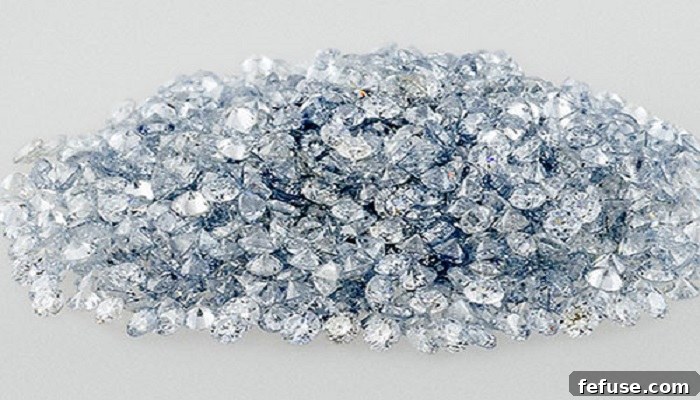
Unmasking the Impostors: A Lone Natural Diamond Amidst a Sea of HPHT Synthetics
The captivating world of gemology is in a constant state of flux, driven by relentless innovation in both diamond synthesis and the sophisticated techniques required for their identification. The Summer 2018 volume of Gems & Gemology, the authoritative publication of the Gemological Institute of America (GIA), brought to light an unprecedented and highly unusual case that vividly illustrated these evolving dynamics. The report detailed the astounding discovery of a single natural diamond, an unexpected anomaly, nestled within a massive parcel containing 1,102 High-Pressure/High-Temperature (HPHT) synthetic melee diamonds. This peculiar incident sent significant ripples throughout the diamond industry, starkly highlighting the advanced capabilities of modern synthetic diamond producers and underscoring the indispensable role of rigorous, cutting-edge gemological testing.
The Dynamic Landscape of Synthetic Diamonds and GIA’s Essential Role
The comprehensive report, meticulously co-authored by esteemed gemologists Stephanie Persaud, Wuyi Wang, Paul Johnson, and Ivana Petriska Balov, provided crucial background information for this unique finding. Their observations underscored a significant trend: over the preceding decade, remarkable advancements had been achieved in the methodologies employed to create synthetic diamond melee. This progress wasn’t merely about increasing production volume; it also significantly elevated the quality, clarity, and overall characteristics of the synthetic specimens themselves. These improvements meant that laboratory-grown diamonds were becoming increasingly challenging to differentiate from their natural counterparts without the aid of specialized scientific equipment and expert gemological analysis.
The escalating prevalence of high-quality synthetic melee diamonds presented a profound challenge to the global diamond trade. As a direct and necessary response to this growing trend, GIA, recognized globally as the foremost authority in gemological research, education, and grading, launched its invaluable Melee Analysis Service in 2016. Since its inception, this crucial service has experienced an exponential surge in the volume of synthetic melee submitted to GIA’s state-of-the-art laboratories for identification. This increase includes both parcels where the presence of synthetics was openly disclosed by the submitter and, more critically, those where the synthetic nature remained undisclosed. Such undisclosed submissions pose a significant and ongoing threat to the integrity of the diamond supply chain, potentially eroding consumer trust and creating an uneven playing field for ethical businesses.
Decoding “Salting”: An Unprecedented Inversion
Within the intricate workings of the diamond industry, it is not uncommon for parcels of melee diamonds submitted for laboratory analysis to contain a mixture of both natural and synthetic stones. The GIA report shed light on a well-known phenomenon in the trade referred to as “salting,” which typically involves the intentional or unintentional mixing of a small number of synthetic diamonds into a larger batch that is predominantly natural melee diamonds. This practice can be financially appealing to unethical traders, as synthetic diamonds generally possess a considerably lower market value than their natural equivalents. By mixing them in, they can effectively dilute the parcel’s true value while presenting it as an entirely natural product. Salting represents a serious ethical breach and carries substantial financial risks for buyers, further emphasizing the critical necessity for robust and reliable identification services provided by institutions like GIA.
However, the extraordinary case documented in the Gems & Gemology report presented a truly unprecedented inversion of this conventional “salting” scenario. Instead of encountering a handful of synthetics contaminating a largely natural parcel, GIA faced precisely the opposite: an overwhelming majority of synthetic diamonds containing just one solitary natural stone. This singular and unusual configuration immediately raised profound questions concerning the precise origin of the parcel and the circumstances that could lead to such an improbable distribution. The incident underscored the ever-present need for unwavering vigilance at every stage of the diamond supply chain, as new forms of misrepresentation can always emerge.
A Deep Dive into the GIA New York Lab’s Findings
The specific investigation that captured the attention of the global gemological community commenced when GIA’s renowned New York laboratory received a substantial parcel comprising 1,102 individual melee diamonds. This significant batch, collectively weighing 9.67 carats, was submitted for the institution’s thorough melee analysis service. The individual diamonds within this shipment were relatively modest in size, with diameters ranging from 0.98 to 1.52 millimeters. Such dimensions are highly common for melee stones, which are frequently used as accent diamonds in a wide array of jewelry designs, from delicate pavé settings to intricate halo designs.
The initial phase of the analysis involved GIA’s advanced, fully automated screening device. This sophisticated instrument is engineered for the rapid and efficient preliminary differentiation between natural diamonds, potential synthetics, and various diamond simulants. During this crucial screening process, an astonishing 1,093 of the stones were referred for more in-depth, secondary testing, indicating that their origin could not be immediately confirmed as natural. A smaller contingent of nine stones was identified as falling outside the standard service criteria, implying they might have been non-diamond materials or otherwise unsuitable for the standard analysis parameters due to their unique properties or condition. Following this rigorous initial referral, a meticulous, multi-stage spectroscopic analysis was systematically conducted on the 1,093 suspect stones. This exhaustive examination conclusively confirmed that an overwhelming 1,092 of them were, without a doubt, HPHT synthetic diamonds, leaving one solitary stone remaining as a mystery in the synthetic category.
Unusual Characteristics of the Synthetic Melee: A Distinct Blue Hue and Boron Influence
The authors of the GIA report meticulously highlighted a strikingly distinctive visual characteristic shared by the vast majority of these HPHT synthetic melee diamonds: they all exhibited a clear and consistent blue hue. This particular coloration immediately drew the attention of the highly experienced gemologists at GIA, as it was notably described as being “very different from most of the melee diamonds we have tested.” The pronounced blue color was subsequently attributed to the relatively high concentrations of boron incorporated within the diamonds’ crystal lattice. Boron is a unique element known to be deliberately introduced during the HPHT growth process, specifically to achieve desired colorations, such as blue, or to facilitate and enhance the overall crystal growth.
It is important to note that while some exceedingly rare natural blue diamonds, famously exemplified by the legendary Hope Diamond, also owe their magnificent color to the presence of boron, their geological formation process is vastly different. Natural blue diamonds form deep within the Earth’s mantle over eons under immense pressure and heat, incorporating boron from surrounding rocks. In stark contrast, the boron found in these HPHT synthetics is a deliberate and controlled additive, introduced during their rapid creation in highly controlled laboratory environments. The unusual intensity, consistency, and widespread presence of this blue hue across such a large parcel of synthetics strongly suggested a highly refined and specific growth technique was employed by the manufacturers, further underscoring the advanced capabilities and evolving methodologies of modern synthetic diamond production. This distinctive characteristic, while a significant clue during the identification process, also emphasized the need for comprehensive analysis, as not all synthetic diamonds necessarily display such overt features.
Advanced Spectroscopic Insights: Delving Beyond Superficial Attributes
To comprehensively understand the precise nature and origin of these diamonds, GIA researchers employed an array of advanced analytical techniques, including photoluminescence (PL) spectroscopy. PL spectroscopy is an exceptionally powerful and indispensable tool in contemporary gemological laboratories, capable of detecting minute impurities and subtle structural defects within a diamond’s atomic framework. These imperfections and inclusions act as unique, indelible fingerprints, providing invaluable clues about a diamond’s formation environment and its precise origin. A particularly crucial finding from the PL spectroscopy analysis was the complete absence of detectable peaks of nickel, an element frequently utilized as a metallic catalyst during the HPHT synthesis of diamonds.
The non-detection of nickel was a significant revelation, implying that either a different catalyst system was successfully employed during the growth of these specific HPHT synthetics, or the manufacturing process itself had achieved such a high level of refinement that residual catalyst metals were virtually eliminated from the final product. This specific detail further accentuated the “atypical” nature of these particular HPHT synthetic diamonds, suggesting a discernible evolution in synthesis methods that could potentially complicate identification using more conventional or less sensitive techniques. Further corroborating their synthetic origin, examination using the GIA DiamondView instrument—a proprietary device that utilizes targeted short-wave ultraviolet light to reveal intricate internal growth patterns—conclusively displayed distinctive HPHT growth patterns. These patterns are typically characterized by geometric shapes and clear internal zoning, indicative of rapid, controlled growth, which stands in stark contrast to the more irregular, complex, and sometimes dendritic growth patterns characteristic of natural diamonds. Moreover, the diamonds exhibited strong phosphorescence—a prolonged glow that persists visibly after the UV light source is removed—another characteristic frequently associated with HPHT synthetic diamonds, particularly those containing boron.
The Astonishing Discovery: A Singular Natural Amidst a Multitude
Despite the overwhelming and conclusive evidence overwhelmingly pointing to the synthetic nature of the vast majority of the parcel, a truly astonishing discovery was made during the final stages of the analysis: one single sample out of the 1,093 stones referred for in-depth testing was definitively and unequivocally confirmed to be a natural diamond. The authors of the GIA report openly conveyed their profound interest and surprise at this unique anomaly, explicitly stating, “It is interesting to note that only one natural was found in this parcel of melee.” This solitary natural stone represented a remarkable statistical outlier, an unexpected genuine gem nestled amidst a carefully crafted collection of laboratory-grown counterparts.
The presence of this lone natural diamond within such a predominantly synthetic batch sparks several intriguing possibilities and questions. Was its inclusion a mere accidental oversight, perhaps a stray stone from a previous batch that inadvertently found its way into the parcel of synthetics? Or could its presence have been a deliberate inclusion, a subtle, perhaps even sophisticated, attempt to introduce an air of authenticity or to sow confusion within an otherwise entirely synthetic offering? Regardless of its precise origin, its detection served as a powerful and irrefutable testament to the unparalleled precision, thoroughness, and advanced capabilities of GIA’s stringent testing protocols. Furthermore, this particular parcel set a new and significant record for GIA, representing “the largest percentage of undisclosed synthetic melee that GIA has seen” to date. This unprecedented proportion of undisclosed synthetics further amplified the gravity and significance of these findings, unequivocally reinforcing the critical and ongoing need for constant vigilance and advanced detection within the global diamond trade.
The Imperative of Advanced Gemological Testing in a Changing World
The comprehensive and meticulous analysis of this truly remarkable parcel of melee diamonds ultimately served to underscore the critical, indeed imperative, importance of advanced gemological testing in the contemporary diamond industry. The fact that the overwhelming majority of the HPHT synthetic melee displayed no detectable traces of nickel—an element long considered a common and reliable indicator for many types of synthetics—highlights just how rapidly and profoundly synthesis technologies are advancing. As manufacturers continue to refine their growth processes, producing ever cleaner, more perfect, and increasingly sophisticated synthetic diamonds, many traditional markers and identification techniques used by gemologists can become less reliable or even obsolete. This rapidly evolving technological landscape necessitates a continuous and proactive commitment to innovation in gemological science, research, and instrumentation.
GIA’s indispensable Melee Analysis Service, equipped with an arsenal of cutting-edge instruments such as the fully automated screening device, advanced PL spectroscopy, and the proprietary DiamondView, stands as a vital and unwavering bulwark against the potential infiltration of undisclosed synthetic diamonds into the natural diamond supply chain. The institution’s unwavering commitment to ongoing research and development ensures that GIA gemologists and the broader industry remain at the absolute forefront of identification capabilities. This relentless pursuit of scientific accuracy is paramount, serving to protect both the long-term integrity and reputation of the diamond industry and, most importantly, the trust and confidence of consumers worldwide. This particular case, thoroughly documented and published in Gems & Gemology, serves as a powerful and enduring reminder that in the increasingly complex and dynamic world of diamonds, meticulous scientific scrutiny and unparalleled expertise are not merely an advantage—they are an absolute, indispensable necessity for safeguarding the value and authenticity of these precious gems.
News Source: gjepc.org