
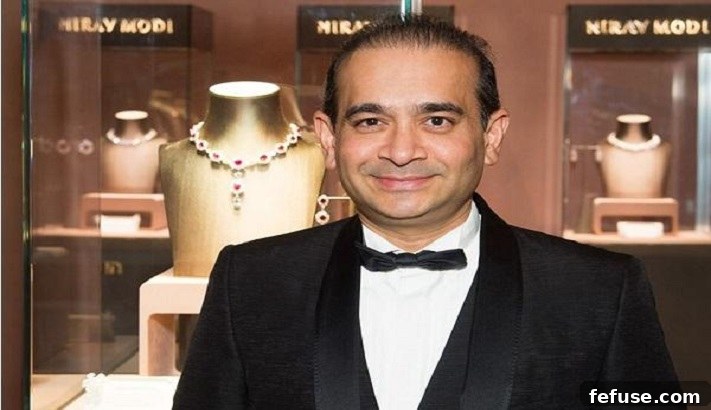
Fugitive Billionaire Jeweller Nirav Modi Arrested in London Amidst $2 Billion PNB Fraud Extradition Battle
In a significant development in one of India’s largest financial scandals, Nirav Modi, the once-celebrated diamond jeweller and central figure in an alleged $2 billion fraud that sent shockwaves through the country’s state-owned Punjab National Bank (PNB), has been apprehended in London. His arrest comes in response to a persistent extradition request from New Delhi, marking a crucial step in India’s pursuit of justice for the massive financial embezzlement.
Modi, whose luxurious boutiques once graced the world’s most prestigious shopping districts and whose elaborate diamond pieces adorned Bollywood and Hollywood stars, appeared before a Westminster Magistrates’ Court on Wednesday. Despite his legal team offering a substantial £500,000 security deposit, bail was firmly refused, underscoring the gravity with which UK authorities are treating the accusations. The court deemed him a flight risk, considering the significant value and sophisticated nature of the alleged fraud.
The Arrest: From Seclusion to Custody
The high-profile fugitive was taken into custody in central London on Tuesday, an event triggered by a seemingly mundane attempt to open a new bank account. A vigilant clerk, recognizing Modi from media reports, promptly alerted the police, indicating their suspicion that they had encountered “a wanted man,” as later recounted in court. This unexpected turn of events brought an end to months of speculation regarding Modi’s whereabouts, following reports of him living a relatively low-key but visible life in the British capital.
During the court hearing, Mr. Modi’s engagement was minimal, speaking only to confirm his identity. However, he unequivocally stated his non-consent to extradition to India, where he faces accusations of being a primary architect and beneficiary of a convoluted bank fraud that left a gaping $2 billion hole in PNB, India’s second-largest state-owned lender. This refusal sets the stage for what is expected to be a protracted and complex legal battle, involving intricate arguments surrounding both the alleged criminal acts and human rights considerations.
Unraveling the $2 Billion PNB Scam: A Web of Deception
The alleged fraud came to light shortly after Mr. Modi and his immediate family departed India in January 2018. Their exit coincided with the retirement of a cooperative bank employee who has since been implicated and charged with assisting in the elaborate scheme. PNB, in a stunning disclosure, reported its discovery of the alleged fraud just a few weeks after Modi’s departure, sending shockwaves through India’s banking sector and raising serious questions about regulatory oversight and internal controls.
According to detailed investigations by PNB and Indian criminal authorities, companies affiliated with Mr. Modi are accused of having improperly received nearly $2 billion worth of cash advances. These advances were ostensibly for legitimate trade finance activities and were procured from the overseas branches of various other Indian banks. The crucial element of the fraud lay in the alleged orchestration of these transactions through PNB’s Brady House branch, situated in the bustling heart of Mumbai’s financial district.
The sophisticated nature of the scheme involved the issuance of fraudulent Letters of Undertaking (LoUs) and foreign Letters of Credit (LCs) by certain PNB officials. These guarantees, essential for international trade finance, were transmitted to counterpart banks via SWIFT (Society for Worldwide Interbank Financial Telecommunication), the global financial messaging system. However, in a critical breach of protocol and integrity, these transactions were allegedly never recorded in PNB’s core banking system. This deliberate omission meant that the bank’s senior management and compliance departments remained tragically unaware of the colossal financial obligations accumulating in its name, allowing the fraud to escalate unchecked over several years.
From Diamond Mogul to Economic Fugitive
Nirav Modi’s journey from a celebrated entrepreneur to an alleged economic fugitive captivated international headlines. Once known for his exquisite designs and high-profile clientele, his brand was synonymous with luxury and global appeal. His fall from grace has become a cautionary tale in India’s financial landscape. After his departure from India, it was confirmed in June last year by UK officials that Mr. Modi had indeed fled to Britain, where he reportedly sought to claim political asylum, a common tactic employed by high-profile individuals facing charges in their home countries.
Indian authorities formally sought his extradition in August 2018, initiating a diplomatic and legal process that has finally culminated in his arrest. Despite being out of the intense media spotlight for months, Mr. Modi was occasionally spotted and filmed walking openly around London’s Oxford Street, notably near the luxury apartment he was reportedly occupying. This public visibility would later become a point of contention in court.
The Extradition Battle: Modi’s Defense and India’s Resolve
During Wednesday’s court proceedings, Mr. Modi’s lawyer presented a vigorous defense, asserting that the jeweller “very strongly” contested all allegations of wrongdoing. The defense team argued that the charges were “politically motivated,” a common claim in high-profile extradition cases, particularly those involving financial irregularities and prominent individuals. Furthermore, his lawyers contended that extraditing Mr. Modi would constitute a breach of his fundamental human rights, setting the stage for a prolonged legal fight on humanitarian grounds.
In a surprising revelation, Mr. Modi’s lawyer stated that he had been living in London “openly and very visibly,” even to the extent that the local council had invited him to register to vote. The defense also maintained that they had consistently informed Indian authorities of Mr. Modi’s purported “keenness to cooperate” with the investigation, contrasting sharply with the Indian government’s narrative of a fugitive evading justice. These statements aim to paint a picture of an individual not attempting to hide but rather seeking a fair legal process.
Conversely, the Indian government vehemently opposed Mr. Modi’s release on bail. Prosecutors argued that Modi possessed “considerable means” and, given the nature of the “very high value and sophisticated fraud,” he was highly unlikely to surrender to the court’s jurisdiction if granted temporary release. This stance reflects India’s unwavering determination to bring Modi back to face trial, emphasizing the significant financial implications and the precedent such a case sets for international financial crime.
Alleged Accomplices and Broader Implications
The network of alleged beneficiaries in the PNB fraud extends beyond Nirav Modi himself. His uncle, Mehul Choksi, another prominent diamantaire, is also implicated in the scheme and has reportedly fled to Antigua, an island nation in the Caribbean. Investigations also suggest the involvement of certain other members of Mr. Modi’s family in the elaborate financial conspiracy. The involvement of multiple individuals and entities highlights the complex and far-reaching nature of the fraud, making it one of the most intricate financial investigations in recent Indian history.
The court was further informed on Wednesday that Mr. Modi’s presence in London was initially lawful. He had arrived in January of the previous year, preceding the formal criminal allegations in India, with the intention of preparing for a stock market listing of his jewellery company, which was planned to have its head office in London. His lawyers asserted that he had been actively working in London for a company, earning a salary of £20,000 per month, and possessed a “wealth of material in support of his case,” suggesting a robust defense strategy.
The Road Ahead: A Protracted Legal Battle
This case is not merely about the alleged fraud itself but also about the intricate processes of international extradition law and the ongoing efforts to combat financial crime across borders. The UK’s legal system provides extensive avenues for appeal and review, meaning that the extradition process can often be a lengthy and arduous one, potentially spanning several years. Each step, from the initial court hearings to potential appeals in higher courts, will be meticulously contested by both sides.
The outcome of Nirav Modi’s extradition case holds immense significance for India. It will not only impact the efforts to recover the funds lost in the PNB scam but also serve as a crucial test case for India’s resolve in pursuing economic offenders who flee the country. A successful extradition would send a strong message about the diminishing safe havens for financial criminals and bolster international cooperation in tackling complex cross-border frauds.
For now, Nirav Modi is set to remain in custody, awaiting his next hearing scheduled for March 29. This upcoming date will be another pivotal moment in the unfolding legal drama, where further arguments regarding his bail and the substantive extradition request are expected to be presented. The world will be watching as this high-stakes legal battle progresses, seeking justice for a fraud that deeply impacted India’s financial integrity.
More information on related developments can be found at Mr Modi’s assets seized by Indian authorities.
News Source: Financial Times