
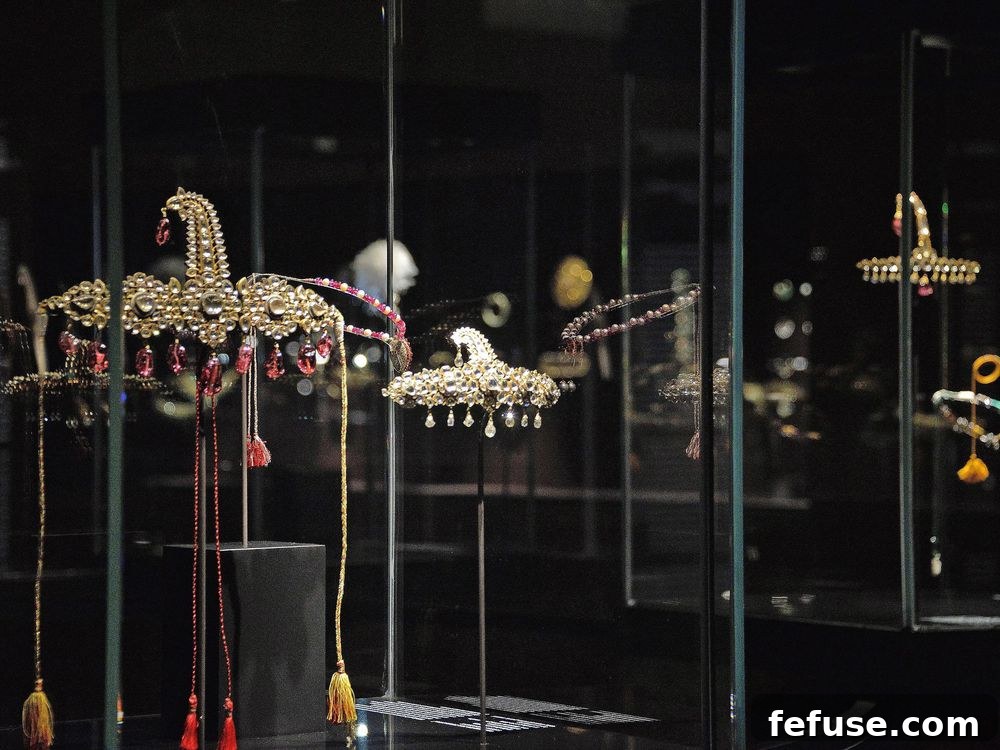
ROME — In a brazen act that has sent shockwaves through the international art and security communities, priceless jewels from the esteemed Al Thani Collection were stolen from a Venetian palace exhibit. The audacious daytime heist, which saw thieves calmly pocketing two exquisite pieces before melting into the crowds, has spotlighted significant security vulnerabilities in one of Italy’s most historic and revered venues. Authorities have launched an intense manhunt for the perpetrators, whose calculated precision suggests a professional operation targeting specific high-value items.
The Audacious Heist at Doge’s Palace: A Breach in Venice’s Cultural Heart
The city of Venice, renowned for its labyrinthine canals, historic architecture, and vibrant cultural scene, awoke to an unprecedented scandal following the theft of two magnificent jewels from the “Treasures of the Mughals and the Maharajas” exhibition. Housed within the venerable Palazzo Ducale, or Doge’s Palace, an institution synonymous with Venetian power and artistic legacy, the incident on Wednesday has severely embarrassed Italian security officials and raised critical questions about the protection of priceless artifacts in public display.
The Stolen Treasures: A Glimpse into Unrivaled Craftsmanship
The Al Thani Collection, curated by Qatar’s Sheikh Hamad bin Abdullah Al Thani, revealed details of the two stolen pieces, both exemplifying extraordinary design and material value. The first was an exquisite, delicate tasseled pendant. It featured a flawless 10-carat diamond, its brilliance further amplified by a surrounding halo of vivid rubies and sparkling smaller diamonds, creating a breathtaking interplay of light and color. This piece alone was a testament to the pinnacle of high jewelry design.
The second stolen item comprised a pair of earrings, simpler in form but no less magnificent in their impact. Each earring showcased a resplendent 30.2-carat pear-shaped diamond, accompanied by smaller, irregularly cut diamonds meticulously arranged to evoke the radiant burst of a star. The sheer size and matching quality of these two pear-shaped diamonds make the earrings exceptionally rare and valuable, a true marvel of nature and artistry combined.
The Artistry of Bhagat Jewelers: A Signature of Elegance
Both stolen pieces were masterpieces designed by Bhagat Jewelers, the exclusive Mumbai-based firm renowned globally for its unparalleled craftsmanship and unique aesthetic. Created in 2011 and 2014 respectively, these jewels bear the distinctive signature of Viren Bhagat, whose designs are celebrated for their quality gems and truly one-of-a-kind nature. Bhagat’s creations frequently fetch sums well into the seven figures, a testament to their exceptional artistic and material worth.
A hallmark of Bhagat’s style, evident in both the stolen pendant and earrings, is the innovative use of minimal platinum settings. This technique creates a remarkable illusion, making the precious stones appear as if they are effortlessly floating, unfettered by visible metalwork. This subtle yet sophisticated approach not only highlights the inherent beauty of the gems but also underscores the technical prowess and artistic vision that define Bhagat Jewelers’ reputation as a purveyor of high art.
The Mechanics of the Heist: A Professional Operation
Surveillance footage from the Doge’s Palace provides a chillingly calm account of the theft. The video captures one of the thieves approaching the display case with an unsettling sense of composure, appearing to open the showcase window with a key – or a device mimicking one. With practiced ease, the jewels were then discreetly placed into a pocket. While this individual executed the theft, an accomplice stood nearby, seemingly acting as a lookout, blending seamlessly with the unsuspecting crowd of museum-goers. The coordinated nature of their actions strongly suggests a well-rehearsed plan.
Police reports indicate that the alarm system was triggered approximately one minute after the theft occurred. This crucial delay provided the perpetrators with ample time to escape the immediate vicinity and disappear into the bustling Venetian thoroughfares. Investigators surmise that this precision timing, coupled with the apparent ease of accessing the display, points to a highly professional team. Further evidence supporting this theory is the fact that a valuable gold necklace displayed in the very same showcase was left untouched, indicating that the thieves had specific targets and were not merely opportunists.
The Al Thani Collection: A Legacy of Indian Splendor
The Al Thani Collection is globally recognized as one of the most significant private assemblies of Indian and Indian-inspired jewelry and artifacts. Comprising an impressive 270 pieces, the collection spans a remarkable 400 years, tracing the evolution of precious adornments from the opulent Mughal period to the contemporary era. It is a breathtaking showcase of precious stones, intricate jades, and invaluable artifacts that tell a story of cultural richness, artistic innovation, and imperial grandeur.
The collection’s more modern pieces frequently exhibit influences of the Art Deco style, a testament to the enduring appeal of Indian motifs and gems that captivated and inspired renowned Western jewelers such as Cartier during the last century. This cross-cultural dialogue underscores the profound impact of Indian design and craftsmanship on global jewelry trends, making the Al Thani Collection not merely a display of wealth, but a vital historical and artistic archive.
A Journey of “Treasures”: From Paris to Kyoto
The “Treasures of the Mughals and the Maharajas” exhibition, currently showing at the Palazzo Ducale on the picturesque edge of St. Mark’s Square, represents the latest stop in a prestigious international tour. This acclaimed exhibition has previously graced the halls of some of the world’s most distinguished cultural institutions, allowing a global audience to marvel at its splendor. Previous venues include the Grand Palais in Paris, the Victoria and Albert Museum in London, the Metropolitan Museum of Art in New York, and the tranquil Miho Museum near Kyoto, Japan. Each stop has affirmed the collection’s status as a cultural treasure, drawing immense crowds and critical acclaim.
The exhibit’s meticulous curation and its presentation in such iconic locations further amplify the gravity of the recent theft. These are not merely expensive items; they are pieces of history, artistic expressions of distinct cultures, and tangible links to centuries of human endeavor and aesthetic achievement. Their loss diminishes not just the collection itself, but the collective cultural heritage that such exhibitions aim to share and preserve.
The Aftermath: Manhunt, Embarrassment, and Future Implications
The immediate fallout from the heist has been swift and severe. An extensive manhunt has been initiated, with Italian police collaborating with international agencies to track down the professional thieves. The unique nature and immense value of the stolen jewels mean they are virtually impossible to sell through legitimate channels, suggesting they might either be broken down for their constituent gems or destined for the shadowy world of the black market for stolen art. The international nature of the collection and its exhibition also hints at the potential for the thieves to have already crossed borders, complicating the recovery efforts.
For Italy, a nation fiercely proud of its cultural patrimony and a frequent host of international art exhibitions, the theft is a source of profound embarrassment. It raises serious questions about the adequacy of security protocols, especially in historic venues that may not be equipped with state-of-the-art surveillance and alarm systems designed for contemporary threats. The incident could prompt a reevaluation of security measures across all major Italian museums and exhibition spaces, potentially leading to significant investments in technology and personnel to prevent future occurrences.
Beyond the immediate hunt for the culprits, this brazen act carries broader implications for the global art exhibition circuit. Such high-profile thefts inevitably lead to increased insurance premiums for lenders and venues, and potentially a reluctance from private collectors like Sheikh Hamad bin Abdullah Al Thani to lend their most valuable and irreplaceable pieces. This could impact the public’s ability to experience and appreciate these cultural treasures firsthand, thus hindering the educational and cultural exchange that exhibitions are designed to foster. The incident serves as a stark reminder of the constant battle against sophisticated criminal networks targeting the world’s most cherished works of art and craftsmanship.
As the investigation continues, the art world holds its breath, hoping for the swift recovery of these irreplaceable jewels. Their return would not only restore a significant portion of the Al Thani Collection’s splendor but also reaffirm the commitment to protecting our shared cultural heritage from those who seek to profit from its destruction.