
Venezuela’s Golden Gamble: A Nation’s Desperate Bid Amidst Collapse and Geopolitical Tensions
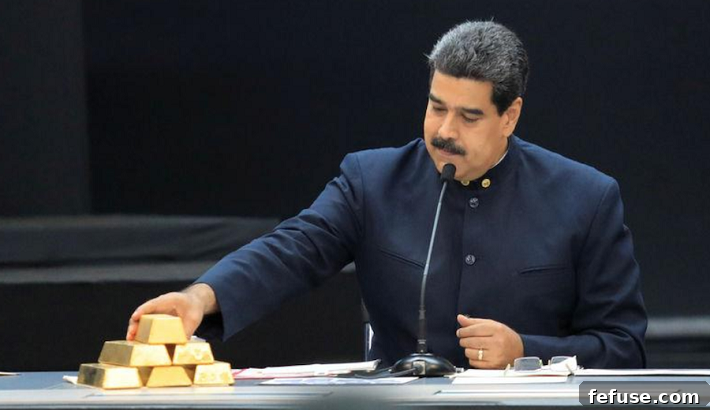
In a desperate attempt to stave off complete economic collapse, Venezuela, under President Nicolas Maduro’s embattled regime, is liquidating its most precious asset: gold. As the nation grapples with an unprecedented humanitarian and economic crisis, the sale of its bullion reserves underscores the dire state of affairs, highlighting gold’s timeless role as a last-resort store of value when national currencies become worthless.
The Gold Crisis and International Reactions
The Vanishing Bullion: A Mysterious Flight
The unfolding saga took a dramatic turn when a Venezuelan politician alleged that a Russian Boeing 777 had landed in Caracas, with the purported intent of transporting 20 tons of gold from the central bank’s vaults. This substantial haul, valued at approximately $840 million and representing 20% of the country’s central bank reserves, sent shockwaves across the globe.
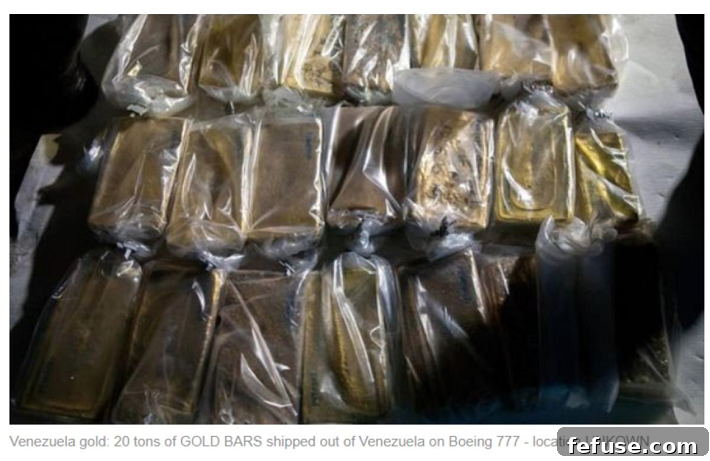
While initial reports lacked concrete evidence, Bloomberg news agency corroborated the claims, citing a source with direct knowledge of the matter who confirmed that 20 tons of gold had indeed been set aside for loading. However, in a sudden twist, the Maduro regime reportedly canceled the shipment just days later, leaving the international community to speculate on the intended destination and the motivations behind the aborted transfer.
Venezuela’s recent gold transactions offer some clues. Analysis of Swiss trade data indicates that nearly 100% of its $2 billion in gold exports over the past two years found their way to Turkey ($901 million) and the United Arab Emirates ($1.1 billion). These transactions have raised suspicions, particularly given reports that the gold may be illicitly ending up in Iran, circumventing stringent U.S. sanctions. Ankara has reportedly received warnings from the international community to cease any activities that could be perceived as “sanctions-busting.”
Adding to the intrigue, one of the private jets observed in Caracas during this period reportedly belonged to Ciner, a Turkish mining company. This connection further emphasizes Turkey’s growing role in Venezuela’s economic lifeline, especially considering Turkish President Erdogan’s public support for Maduro amidst the escalating chaos characterized by extreme hyperinflation and mass unemployment. The severity of Venezuela’s economic woes is starkly illustrated by the fact that the government struggles even to print its own currency, and basic necessities like a roll of toilet paper can cost millions of bolivars.
International Pressure and Frozen Assets
The attempt to move gold from the central bank follows a prior failed bid by the Maduro regime to repatriate approximately $1.2 billion in gold reserves held at the Bank of England. The Bank of England reportedly blocked this withdrawal, a significant blow to Venezuela’s efforts to access its total estimated $8.4 billion in gold reserves, according to the World Gold Council. These actions underscore the international community’s dwindling trust in Maduro’s leadership and its increasing recognition of National Assembly leader Juan Guaidó as Venezuela’s interim president, a stance publicly supported by the U.S., the UK, and several European nations.
In a concerted effort to exert pressure, the United States imposed sweeping sanctions on Venezuela’s state-owned oil company, PdVSA. The U.S. government views PdVSA as a primary vehicle for embezzlement and illicit financial activities, with the sanctions expected to immediately freeze around $7 billion in assets and impact an additional $11 billion this year. Crucially, these measures also block U.S. purchases of Venezuelan oil, severely restricting the regime’s access to its primary revenue stream and further isolating it on the global stage.
Russia’s Geopolitical Chess Game
A Lifeline of Loans and Collateral
The presence of a Russian plane in Caracas, potentially poised to transport gold, begins to make more sense when viewed through the lens of Russia’s deepening financial and political ties with Venezuela. Facing crippling debt of approximately $120 billion, the Maduro regime has increasingly turned to Moscow for financial succor, often using its remaining bullion as collateral for desperately needed loans.
Russia’s financial commitment to Venezuela has been substantial. Reports indicate that the Kremlin extended approximately $3 billion in loans in 2017 alone, with the New York Times further revealing that Russia provided an estimated $10 billion between 2013 and 2017. These loans, however, came at a price: access to Venezuela’s vast oil resources and increased geopolitical influence in a region traditionally dominated by the United States.
A prime example of this strategy is the acquisition by Rosneft, Russia’s state-owned oil giant, of nearly half of Citgo, PdVSA’s refining subsidiary in the United States. This significant purchase served as collateral for a $1.5 billion loan from the Kremlin to PdVSA, effectively giving Russia a strategic foothold in American energy infrastructure through its Venezuelan proxy. Rosneft’s investments extend beyond Venezuela, forming a key component of Russia’s broader foreign policy objectives, with significant engagements in Cuba, China, Egypt, and Vietnam, and active pursuit of deals in the Eastern Mediterranean and Africa. This strategic deployment of its oil company as a geopolitical instrument has allowed Russia to expand its global reach and mitigate the impact of Western sanctions on its own economy.
Oil as Leverage: A New Banker for Venezuela
In a pivotal shift, Russia has emerged as Venezuela’s primary financier, effectively replacing China, which has significantly curtailed its lending to the beleaguered South American nation. This dynamic has been crucial for Venezuela, as the Russian funds have been instrumental in sustaining its oil production amidst a severely depreciated infrastructure. Both Russia and China have demonstrated a willingness to accept Venezuelan oil as a form of payment for debt repayments, a transactional model that benefits Venezuela by enabling it to service its debts without depleting its dwindling foreign exchange reserves. This complex web of financial and political alliances paints a clear picture of why a Russian plane might have been waiting for tons of Venezuelan gold on a Caracas tarmac.
The Monroe Doctrine Revisited: A Challenge to US Hegemony
Historical Precedent and Modern Assertions
Russia’s overt meddling in Venezuela, a nation historically considered firmly within the United States’ sphere of influence, directly challenges a foundational tenet of American foreign policy: the Monroe Doctrine. First invoked by President James Monroe in the 1800s, this doctrine declared that any attempt by European powers to control independent states in North or South America would be viewed as “an unfriendly disposition towards the United States.” The original intent was to safeguard the newly independent Latin American colonies from recolonization by European empires, thereby allowing the U.S. to assert its own influence unimpeded.
Throughout history, the Monroe Doctrine has been invoked whenever U.S. interests in its “backyard” were perceived to be threatened, occasionally leading to direct interventions and even regime changes. During the Cold War, for instance, the U.S. reportedly attempted 18 overthrows of Latin American governments, with American forces assuming power in 10 instances. Venezuela itself has experienced such interventions, with allegations of U.S. involvement in a coup attempt against Maduro’s predecessor, Hugo Chavez – claims consistently denied by Washington.
Russia’s Provocation and Escalating Tensions
Recent events underscore the resurgence of this geopolitical tug-of-war. In 2017, then-President Donald Trump reportedly considered invading Venezuela, though he was dissuaded by his national security advisors. More recently, in December, Russia sent two nuclear-capable “Blackjack” bombers to Venezuela, a clear show of force aimed at shoring up support for a key ally and top oil supplier, but also a provocative act widely seen as a direct challenge to the 200-year-old Monroe Doctrine. By cozying up to a weakened regime like Maduro’s, offering financial aid and military support, the Kremlin is strategically gaining influence in a region traditionally viewed as America’s exclusive domain, raising the stakes in a complex geopolitical confrontation.
Venezuela’s Hidden Wealth: The Orinoco Belt and Global Oil Dynamics
Beyond Humanitarian Rhetoric: Following the Money
While U.S. officials frequently articulate humanitarian concerns for the suffering Venezuelan people and a desire to liberate them from a corrupt regime, a deeper examination reveals significant strategic and economic interests at play. As is often the case in international relations, following the money provides a more cynical, yet often accurate, understanding of underlying motivations.
A key indicator of these interests emerged at the end of December when Oilprice.com reported a confrontation between the Venezuelan navy and two Norwegian ships conducting seismic work in the waters of Guyana, Venezuela’s neighbor. The United States swiftly intervened, condemning the Venezuelan navy’s aggressive actions and defending Guyana. The reasons for this protective stance lie beneath the surface: ExxonMobil and its partner Hess Corp. are heavily investing in developing a string of massive oil discoveries off the coast of Guyana. These discoveries encompass an estimated 5 billion barrels of oil reserves, catapulting offshore Guyana to the top of ExxonMobil’s priority list. This small, impoverished South American nation has quickly become home to one of the world’s most active and attractive offshore oil plays.
For ExxonMobil, these discoveries are particularly crucial. In early 2018, the company unveiled an ambitious spending plan to significantly boost oil production by 2025, aiming to reverse years of stagnating output. Exxon’s reputation among shareholders had faced challenges as competitors began to catch up, making new, compelling investments vital. Exxon’s strategy to expand production and boost profits hinges on two key upstream targets: the Permian Basin in the U.S. (a popular bet for many oil companies) and, more significantly, offshore Guyana.
The U.S. government’s protection of American oil companies is hardly unprecedented. Should the U.S. successfully facilitate a pro-American government in Venezuela, it would undoubtedly assist major oil companies in accessing and developing what are, by far, the largest proven oil reserves in the world. This interest is amplified by the looming challenges faced by U.S. shale oil, which is projected to see a decline in output in the coming years due to the high depletion rates of shale wells – a phenomenon often termed “The Red Queen Syndrome,” where producers must pump ever faster just to maintain current production levels.
The Untapped Potential of the Orinoco Belt
Beyond Guyana, Venezuela itself holds an unparalleled prize: the Orinoco Belt, a vast region of heavy and extra-heavy oilsands, roughly the size of Costa Rica. Venezuela boasts an astonishing 298 billion barrels of proven oil reserves, the largest globally, with the majority located within the Orinoco. This oil is not only abundant but also generally easier and cheaper to produce than Canadian oilsands because it contains less bitumen, the dense, difficult-to-process oily sludge.
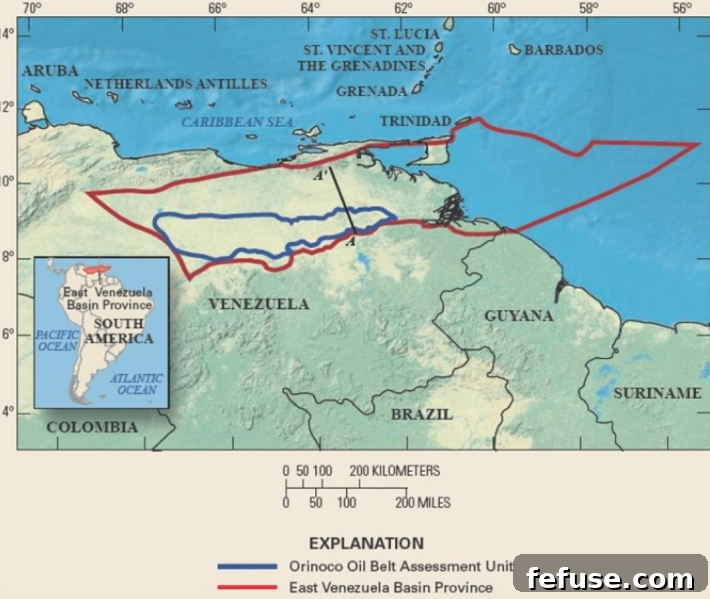
However, extracting this oil still requires significant investment and advanced technology, often involving open-pit mining or horizontal directional drilling. In the 1990s, former President Hugo Chavez welcomed foreign companies for their technological expertise. But in 2006-07, he moved to nationalize much of the industry, seizing control despite substantial investments from global giants like ExxonMobil, Chevron, ConocoPhillips, and BP. PdVSA was granted 60% ownership of the four most promising projects in the Orinoco, an order enforced by military presence. While Exxon and ConocoPhillips withdrew and pursued legal action (eventually receiving compensation), other companies opted to retain their 40% stakes, as reported by the Financial Times.
The exodus of foreign oil companies and their crucial technology, coupled with the Chavez government’s underestimation of the vast capital expenditures required, led to a significant decline in Orinoco’s output. According to Forbes, Venezuelan oil production has plummeted to a mere 1.5 million barrels per day, a stark contrast to more than double that figure before 2006. Installing a pro-Western government could potentially unlock this immense wealth, bringing in the necessary foreign investment and technological know-how to revitalize Venezuela’s struggling oil sector and reshape global energy markets.
Conclusion: Gold as the Ultimate Safe Haven
The desperate measures taken by the Venezuelan regime, particularly its frantic attempts to sell or collateralize its gold reserves, serve as a stark illustration of a nation in freefall. For the Venezuelan people, this translates into an enduring monetary hardship comparable to the hyperinflationary spirals witnessed in Weimar Germany. Yet, paradoxically, these events offer a powerful vindication of gold’s inherent value. In times of profound crisis, when fiat paper money becomes worthless and traditional financial systems crumble, gold stands as a tangible and universally accepted medium of exchange. It is notable that Maduro is not attempting to sell cryptocurrencies or other abstract assets to pay the bills; he is turning to gold.
Often dismissed by institutional investors on Wall Street as a “useless” investment that doesn’t yield growth or compounding returns, gold’s true purpose is frequently misunderstood. Conventional investment wisdom favors assets that produce a growing revenue stream, generating “sprouts” of income and systematic growth. Gold, lacking these characteristics, is often overlooked.
However, for the average citizen and, as Venezuela’s crisis vividly demonstrates, for nations, gold’s primary role is not as a growth investment, but as insurance. It provides a unique safeguard that paper money, or any other financial innovation, simply cannot deliver during periods of extreme turmoil. Whether it’s escaping Nazi Germany, buying food and medicine in a collapsing economy, or simply acquiring basic necessities like toilet paper during a crisis, gold offers a fundamental store of value and a universal medium of exchange. When paper money loses its value, gold becomes the ultimate asset for selling, bartering, and trading, a lesson President Maduro, in his desperate hour, has learned firsthand.
NewsSource: mining