
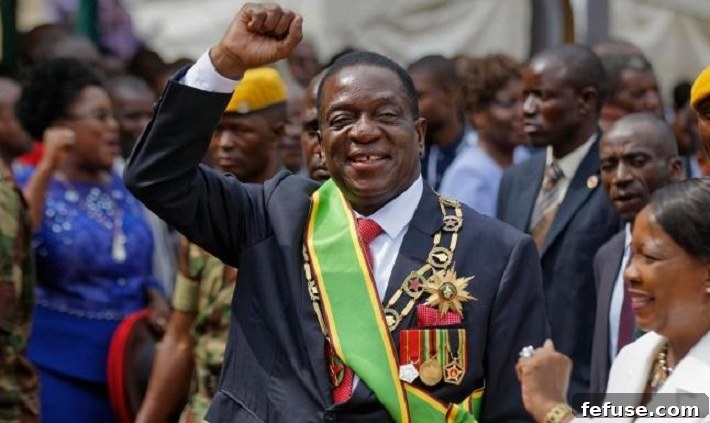
The United States has recently escalated its stance against Zimbabwe, imposing significant sanctions on President Emmerson Mnangagwa. These measures are a direct response to persistent concerns over human rights abuses, pervasive corruption, and the illicit trade of valuable resources such as gold and diamonds within the Southern African nation. This targeted action underscores Washington’s deepening apprehension regarding democratic regression and governance issues in Zimbabwe, signaling a critical pivot in international relations with the country.
US Targets Zimbabwe President Mnangagwa with Sanctions Over Human Rights Abuses and Corruption
On March 4, the U.S. Treasury Department’s Office of Foreign Assets Control (OFAC) officially designated President Emmerson Mnangagwa, along with ten other prominent individuals, including his wife, as subjects of these new sanctions. This move represents a strategic recalibration of U.S. policy toward Zimbabwe, moving away from broader, less effective sanctions on entities to a more focused approach aimed at individuals deemed directly responsible for undermining democracy and state integrity. The objective is to hold specific actors accountable, thereby preventing them from benefiting from illicit activities and human rights violations.
A Strategic Shift: Addressing Democratic Backsliding and Illicit Activities
Announcing the new sanctions, Deputy Secretary of the Treasury Wally Adeyemo reiterated the United States’ profound concerns, stating, “The United States remains deeply concerned about democratic backsliding, human rights abuses, and government corruption in Zimbabwe.” This statement encapsulates the core reasons behind the punitive measures, highlighting a comprehensive set of grievances that have plagued Zimbabwe for an extended period. The U.S. government maintains that these issues not only stifle economic development and stability but also erode the fundamental principles of a just and democratic society, affecting the lives of ordinary Zimbabweans.
The Treasury’s press release elaborated on the specific allegations leveled against President Mnangagwa, painting a grim picture of state-sanctioned malfeasance. It asserted, “Mnangagwa provides a protective shield to smugglers to operate in Zimbabwe and has directed Zimbabwean officials to facilitate the sale of gold and diamonds in illicit markets, taking bribes in exchange for his services.” This claim suggests a sophisticated network of corruption directly implicating the highest echelons of power, indicating that the illicit trade in precious minerals is not merely opportunistic but systematically facilitated by government officials under presidential directive. Such activities not only deprive the state of much-needed revenue but also fuel a shadow economy that benefits a select few, exacerbating economic inequality.
Allegations of Repression and Abuse of Power
Beyond economic misconduct, the sanctions also address severe human rights concerns. The Treasury explicitly stated, “Mnangagwa also oversees Zimbabwe’s security services, which have violently repressed political opponents and civil society groups.” This accusation points to a pattern of authoritarian governance where state apparatuses, particularly security forces, are allegedly deployed to suppress dissent, stifle democratic expression, and maintain political control through intimidation and force. Reports of arbitrary arrests, violent crackdowns on protests, and harassment of opposition figures have frequently surfaced from Zimbabwe, drawing international condemnation and underscoring the urgency of these targeted sanctions.
The impact of such repression extends beyond individual victims, creating an environment of fear that discourages civic engagement and undermines the rule of law. Civil society organizations, which often play a crucial role in advocating for human rights and good governance, find their operating space severely restricted. The U.S. government views these actions as a direct affront to democratic principles and a violation of the fundamental rights of the Zimbabwean people, necessitating a robust international response to promote accountability and encourage reform.
President Mnangagwa’s Vehement Denial and Zimbabwe’s Counter-Narrative
In response to these grave accusations, President Mnangagwa, 81, who assumed office in 2017 following a military-backed transition, has vehemently denied the claims. He has dismissed the allegations as “defamatory” and “malicious,” characterizing them as baseless attacks designed to undermine his administration and the sovereignty of Zimbabwe. His spokesman articulated a strong condemnation of the U.S. government’s actions, stating, “We condemn these malicious statements as completely uncalled for, defamatory, provocative, and a continuation of wanton hostilities against Zimbabwe by the US government.” This official rebuttal reflects a long-standing narrative within the Zimbabwean government, which often portrays international sanctions as unjustified interference in its internal affairs, rather than a consequence of its policies and actions.
The Zimbabwean government frequently argues that Western sanctions, including previous iterations, have had a detrimental effect on its economy, hindering development and exacerbating the suffering of its citizens. They often frame these measures as a legacy of colonial influence or an attempt to orchestrate regime change, rather than a response to governance deficits or human rights concerns. This counter-narrative seeks to galvanize domestic support and rally regional allies, often appealing to notions of national sovereignty and self-determination against perceived external pressures. The latest sanctions are likely to further entrench this defensive posture, complicating prospects for dialogue and engagement between Washington and Harare.
Broader Implications: Economic Strain and Political Reckoning
The introduction of these targeted sanctions is expected to have multi-faceted implications for Zimbabwe. For the sanctioned individuals, including President Mnangagwa and his wife, the measures entail asset freezes within U.S. jurisdiction and prohibitions on transactions involving U.S. persons. This effectively isolates them from the international financial system to a significant degree, limiting their ability to move or hide wealth generated through illicit means. While targeted sanctions are designed to minimize harm to the general populace, their psychological and practical impact can extend beyond the designated individuals, affecting their associates and potentially chilling investment flows into the country due to heightened perceived risk.
Economically, while these are not broad-based sanctions, they can indirectly impact investor confidence and international financial relationships. Global financial institutions and businesses often become more cautious when dealing with countries whose leaders are under international scrutiny for corruption and illicit trade. This added layer of risk can deter foreign direct investment, exacerbate capital flight, and complicate Zimbabwe’s efforts to secure much-needed loans and aid from multilateral institutions. The long-term effects could further strain an already fragile economy grappling with hyperinflation, high unemployment, and widespread poverty.
Politically, these sanctions could intensify internal pressures within Zimbabwe. They may embolden opposition movements and civil society groups by demonstrating international support for their calls for reform and accountability. Conversely, the government might respond by further consolidating power and cracking down on dissent, framing external pressure as an attack on national sovereignty. The sanctions could also influence succession politics within the ruling ZANU-PF party, potentially creating divisions among factions as individuals weigh the risks and benefits of continued association with sanctioned leaders. Regionally, the reaction from the Southern African Development Community (SADC) and the African Union will be closely watched, as these bodies often emphasize non-interference in member states’ internal affairs but also face calls to uphold democratic principles.
The Path Forward: Accountability and Reform
The U.S. government’s new sanctions policy underscores a commitment to fostering human rights, combating corruption, and promoting democratic governance in Zimbabwe. By shifting from broader sanctions to a more targeted approach, Washington aims to exert pressure directly on those it holds responsible for the country’s challenges, hoping to induce behavioral change. For these sanctions to be lifted, the U.S. has typically outlined conditions related to demonstrable improvements in human rights, a reduction in corruption, and free and fair electoral processes. The onus is now firmly on the Zimbabwean government to address these core concerns through tangible reforms that uphold the rule of law, protect fundamental freedoms, and ensure greater transparency and accountability in governance.
Ultimately, the effectiveness of these sanctions will depend on several factors, including the Zimbabwean government’s response, the coherence of international pressure, and the resilience of civil society within the country. The ongoing saga between the U.S. and Zimbabwe highlights a complex interplay of international diplomacy, human rights advocacy, and national sovereignty, with the welfare of the Zimbabwean people at its core. The international community will continue to monitor developments closely, hoping for a future where democracy and accountability prevail over corruption and repression.