
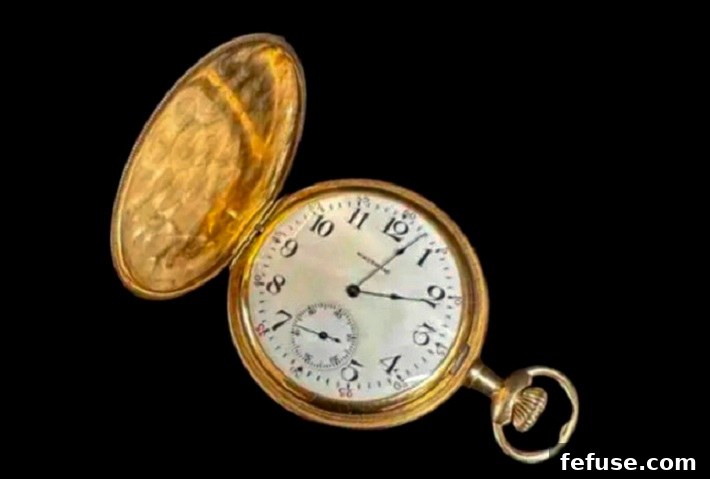
Titanic Gold Watch Sets Auction Record: A Glimpse into Luxury, Tragedy, and Enduring Fascination
The enduring mystique of the RMS Titanic continues to capture imaginations, not only through its epic tale of luxury and tragedy but also through the tangible echoes of its ill-fated maiden voyage. In a recent event that underscored this unwavering fascination, a 14-carat gold pocket watch, once belonging to the wealthiest passenger aboard the Titanic, John Jacob Astor IV, shattered auction records, selling for an astonishing $1.5 million. This unprecedented sale highlights the immense value placed on artifacts that bear witness to one of history’s most iconic maritime disasters.
A Record-Shattering Sale for a Priceless Piece of History
The historic auction took place in Wiltshire, England, spearheaded by the renowned auctioneers Henry Aldridge & Son, a firm long recognized for its expertise in Titanic memorabilia. The gold Waltham timepiece, an item of profound historical significance, soared past its pre-auction estimate of $187,000, ultimately fetching seven figures and establishing a new global benchmark for Titanic artifacts. This sale eclipses previous records, including the sale of a violin played as the ship sank, demonstrating the escalating value and intense demand for items directly linked to the legendary liner.
The identity of the successful bidder has been revealed as Patrick Gruhn, a 42-year-old German fintech entrepreneur. Gruhn, known for his previous executive role at the now-defunct cryptocurrency exchange FTX, made headlines with his acquisition, further intertwining contemporary finance with a piece of early 20th-century history. His purchase not only signifies a personal passion for historical collecting but also underscores the broad appeal and investment potential that such unique artifacts hold for discerning collectors worldwide.
John Jacob Astor IV: A Titan Aboard the Titanic
The provenance of the watch adds immeasurable layers to its historical weight. Its original owner, John Jacob Astor IV, was a figure of immense wealth and influence in the Gilded Age. A prominent American real estate magnate, investor, inventor, writer, and lieutenant colonel in the Spanish-American War, Astor was perhaps best known as the co-founder of the original Waldorf Astoria hotel in New York City. His personal fortune, estimated to be around $87 million (equivalent to several billion dollars today), made him the wealthiest passenger on the Titanic.
Astor’s story on the Titanic is one of both immense privilege and quiet heroism. He was traveling with his pregnant second wife, Madeleine Astor, on their return journey to the United States after a honeymoon in Europe. When the ship struck an iceberg on April 14, 1912, and it became clear that its fate was sealed, Astor exemplified the chivalrous codes of the era. He ensured his wife, Madeleine, was among the women and children given priority on the lifeboats, an act that undoubtedly saved her life. Madeleine Astor survived the tragedy, along with their unborn son, John Jacob Astor V.
John Jacob Astor IV, however, remained on the sinking ship. Witnesses reported seeing him calmly assisting other passengers before the final plunge. His body was eventually recovered from the icy waters of the Atlantic on April 22, 1912. Among the personal effects found on him were the now-famous 14-carat gold Waltham pocket watch, engraved with his initials “JJA,” along with gold-and-diamond cufflinks, a diamond ring, a gold pencil, and a leather pocketbook. These items provided a poignant and tangible link to the man who embodied both the peak of American wealth and the profound human cost of the Titanic disaster.
The Watch: From Wreckage to Restoration and Reverence
The journey of this particular pocket watch from the depths of the Atlantic to a record-breaking auction block is a testament to its enduring significance and meticulous preservation. Upon its recovery, the watch was carefully returned to John Jacob Astor IV’s family. It underwent a complete restoration, a painstaking process that brought the timepiece back to its former glory. This restoration was not merely an act of repair but one of historical reverence, ensuring that a piece of the past could continue to tick with renewed life.
Following its restoration, the watch was notably worn by Astor’s son, Vincent Astor, further cementing its familial and historical lineage. This continuous chain of ownership and personal connection elevates the watch beyond a mere artifact, transforming it into a cherished heirloom that silently carried the legacy of one of the Titanic’s most prominent victims. The auction house, Henry Aldridge & Son, underscored this unique trajectory, stating, “The watch itself was completely restored after being returned to Mr. Astor’s family and worn by his son (Vincent), making it a unique part of the Titanic story and one of the most important pieces of horological history relating to the most famous ship in the world.”
Indeed, the watch is more than just a time-telling device; it is a profound symbol. It represents the pinnacle of luxury travel and the stark contrast of human vulnerability in the face of nature’s power. Its intricate mechanics, housed within its gleaming gold casing, once marked the hours for one of the world’s wealthiest men, unknowingly counting down the moments to an unforeseen catastrophe. Today, it serves as a powerful reminder of that night, a tangible link to a bygone era, and a silent narrator of Astor’s final, courageous moments.
The Enduring Allure of Titanic Memorabilia
The record-setting sale of John Jacob Astor IV’s pocket watch is not an isolated incident but rather a striking example of the robust and continually expanding market for Titanic memorabilia. The fascination with the ship, its passengers, and its tragic fate shows no signs of waning, driving incredible demand and prices for authentic artifacts. Why do these items command such astronomical sums?
Firstly, the Titanic story itself is an unparalleled narrative. It encapsulates themes of human ambition, technological hubris, social hierarchy, individual heroism, and collective tragedy. Every item recovered from the wreck or associated with its passengers and crew offers a direct, personal connection to this powerful human drama. These aren’t just objects; they are storytellers, each bearing a fragment of the past.
Secondly, the rarity and finite nature of these artifacts contribute significantly to their value. With the Titanic resting nearly 4,000 meters beneath the ocean’s surface, and the ship itself gradually deteriorating, the pool of recoverable and identifiable items is limited. Authenticity, provenance, and condition are paramount, and items with a direct link to well-known figures like John Jacob Astor IV are exceedingly rare and thus highly coveted.
Finally, there’s an undeniable emotional and historical resonance. Owning a piece of the Titanic is, for many, like owning a piece of a pivotal historical moment. It’s a way to tangibly connect with a monumental event, to touch history, and to honor the memories of those who lived and died on that fateful voyage. From personal letters and photographs to fragments of the ship’s structure and luxurious personal effects, each artifact offers a unique window into a world that was forever changed on April 15, 1912.
Conclusion: A Timeless Legacy
The sale of John Jacob Astor IV’s gold pocket watch for $1.5 million is more than just a financial transaction; it’s a profound statement about our collective memory and the enduring power of history. It underscores the unparalleled allure of the Titanic, a vessel whose story continues to resonate across generations and cultures. This meticulously restored timepiece, once ticking away the final hours of a Gilded Age titan, now stands as a powerful symbol of luxury, loss, and the eternal human desire to connect with and preserve the echoes of the past. As long as the story of the “unsinkable” ship continues to captivate, the value and reverence for its authentic artifacts will undoubtedly endure, cementing their place not just as historical relics, but as timeless treasures.