
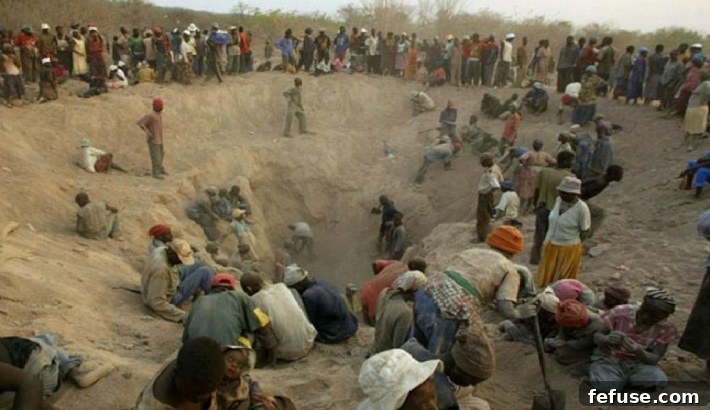
Transforming the Narrative: Shifting Focus from “Blood Diamonds” to Sustainable Artisanal Mining
For too long, the global conversation surrounding diamonds mined by hand in some of the world’s most impoverished regions has been dominated by the term “blood diamonds” or “conflict diamonds.” While this focus has undeniably played a crucial role in highlighting the devastating impact of conflict minerals, it has inadvertently overshadowed the livelihoods of millions who depend on artisanal and small-scale mining (ASM) for their survival. As Gabriela Flores articulately pointed out in a guest blog for the International Institute for Environment and Development (IIED), this narrow perspective often prevents a broader, more constructive dialogue on how to genuinely support these communities and help them thrive.
The time has come to reframe this critical discussion. Instead of solely focusing on the negative connotations, we must actively engage in a conversation about empowering ASM diamond mining communities to evolve into sustainable, legitimate small-scale producers. The stakes are incredibly high, both for the individuals involved and for the global diamond supply chain. The World Bank estimates that a significant 20 percent of the world’s diamond supply originates from this very sector. Furthermore, aligning with the ambitious “leave no one behind” principle of the United Nations Sustainable Development Goals (SDGs), there’s a clear blueprint for action that governments, industry players, and civil society must embrace across all sectors, including ASM.
The Enduring Shadow of “Blood Diamonds” and the Need for a Paradigm Shift
The term “blood diamonds” emerged in the late 1990s, bringing global attention to diamonds mined in war zones and sold to finance armed conflicts, particularly in countries like Sierra Leone and Angola. This powerful narrative led to international efforts, most notably the Kimberley Process Certification Scheme (KPCS), designed to prevent conflict diamonds from entering the mainstream legitimate diamond trade. While the Kimberley Process has achieved some success in stemming the flow of such diamonds, the enduring power of the “blood diamond” label continues to cast a long shadow over the entire ASM sector, often unfairly stigmatizing millions of honest, hardworking miners.
The challenge is that the original narrative, while necessary, created a perception that all artisanal diamonds are inherently problematic. This oversimplification often overlooks the vast majority of ASM operations that are not linked to conflict but are instead a vital source of income for families struggling against extreme poverty. By exclusively focusing on conflict, the opportunity to address the root causes of poverty, improve working conditions, and foster sustainable development in these communities is often missed. It’s akin to throwing the baby out with the bathwater – demonizing an entire sector, rather than isolating and dealing with the problematic elements while nurturing the rest.
Unlocking Potential: Artisanal and Small-Scale Mining as a Catalyst for Development
Artisanal and small-scale mining, particularly in the diamond sector, represents a complex ecosystem. It’s characterized by its labor-intensive nature, minimal mechanization, and often informal structures. Yet, for millions, it’s not merely an occupation but a lifeline. In many remote and rural areas where alternative economic opportunities are scarce, diamond mining offers a chance at survival, providing income for food, education, and basic necessities. The potential for this sector to drive positive change and contribute meaningfully to local and national economies is immense, provided it is managed responsibly and supported strategically.
The SDGs offer a comprehensive framework for addressing global challenges, and many of their targets resonate directly with the potential for responsible ASM. Goals such as No Poverty (SDG 1), Decent Work and Economic Growth (SDG 8), Industry, Innovation, and Infrastructure (SDG 9), and Responsible Consumption and Production (SDG 12) all highlight areas where ASM, when supported, can make a significant difference. The aim is not to eliminate ASM – which would be unrealistic and economically devastating for countless communities – but to transform it into a formal, regulated, safe, and environmentally sound industry that benefits both miners and society at large.
Key Strategies for Sustainable Diamond Mining: Insights from Gabriela Flores
To truly shift the conversation and unlock the sustainable development potential of ASM diamonds, Gabriela Flores outlined several critical areas for intervention. These ideas form a robust framework for fostering positive change within the sector.
1. Beyond Technical Fixes: Embracing Participatory Environmental Management
Environmental management in mining, especially in ASM, is often perceived as a purely technical challenge. The assumption is that simply implementing new technologies or imposing stricter regulations will solve environmental degradation. However, as Flores rightly points out, this perspective is incomplete and often ineffective. While technical solutions and regulatory frameworks are important components, they are insufficient on their own. The real key to effective environmental stewardship lies in fostering participatory and inclusive processes.
This means moving beyond top-down approaches and actively involving all relevant parties – from local miners and community members to local governance bodies and environmental experts – in understanding the problems and co-creating solutions. When communities are part of the diagnostic and decision-making process, they gain ownership of the solutions. This could involve community-led environmental impact assessments, the co-development of local regulations based on traditional knowledge and best practices, or the establishment of local monitoring committees. Such inclusive engagement helps all stakeholders arrive at a common understanding of the environmental challenges and build consensus on practical solutions for their implementation. This collaborative approach significantly increases the likelihood that environmental management strategies for ASM will not only be implemented but will also be sustainable and truly effective in the long run.
2. Cultivating Shared Responsibility: The Power of Engagement and Communication
Safeguarding the environment and ensuring responsible practices within the ASM sector is, without doubt, a shared responsibility. However, the adage that “when something is everyone’s responsibility, it quickly turns into no one’s responsibility” holds a stark truth. This phenomenon arises when there is a lack of clear roles, accountability, and communication among the diverse stakeholders involved. To prevent this, robust engagement and transparent communication are absolutely essential.
Effective engagement requires all stakeholders – including miners, local communities, government agencies, buyers, civil society organizations, and even end consumers – to be unequivocally clear about their respective roles and responsibilities. This involves establishing agreed-upon collaborative actions, regularly tracking progress against environmental impact assessments and rehabilitation plans, and openly sharing information about available technologies, best practices, and know-how. By fostering an environment of open dialogue and mutual accountability, trust is built, and collective action becomes a tangible reality. Regular multi-stakeholder forums, transparent reporting mechanisms, and easily accessible communication channels are vital tools in ensuring that everyone is on the same page, working towards common goals, and holding each other accountable for the shared responsibility of creating a sustainable and ethical diamond mining sector.
3. Amplifying Success Stories and Mobilizing Support
The narrative around ASM is often dominated by negative reports concerning child labor, poor working conditions, and environmental damage. While these issues demand urgent attention, an exclusive focus on them obscures the positive developments and successful initiatives that are beginning to emerge. To truly inspire change and attract further investment and support, there is a critical need for more compelling success stories and a broader network of supporters.
While programs from agencies like USAID and initiatives such as De Beers’ Gemfair platform (which aims to improve market access and fair pricing for artisanal miners) are commendable steps, they represent only a fraction of what is needed. We need to actively seek out, document, and widely disseminate examples that clearly demonstrate how to unlock the sustainable development potential of ASM diamonds. These success stories could highlight communities that have successfully implemented environmental remediation, improved safety standards, achieved fair market access, or diversified their local economies beyond mining. Such examples serve as powerful proof-of-concept, inspiring other communities, attracting further funding, and demonstrating to governments and the private sector that investment in responsible ASM yields tangible, positive results. Moreover, building a stronger coalition of supporters – from international organizations and ethical consumers to private sector partners and policymakers – is crucial for scaling up these initiatives and transforming the sector more broadly.
Expanding the Vision: Additional Pillars for Responsible ASM
Beyond Flores’s insightful points, several other dimensions are crucial for a truly sustainable and ethical ASM sector:
Ensuring Fair Market Access and Value Chains
One of the most pressing challenges for artisanal miners is access to fair markets. Often operating in informal settings, they are vulnerable to exploitation by middlemen who purchase their diamonds at significantly undervalued prices. This lack of transparency and direct market access perpetuates poverty, even when miners are producing high-quality gems. Initiatives that connect miners directly to legitimate buyers, provide transparent pricing, and facilitate formalization can dramatically improve livelihoods. Developing robust, transparent, and ethical supply chains is paramount to ensuring that the wealth generated by diamonds benefits the communities extracting them.
Formalization and Regulatory Frameworks
Bringing ASM operations into the formal economy is a complex but necessary step. Formalization involves registering miners, granting legal licenses, establishing clear land tenure, and implementing enforceable health, safety, and environmental regulations. While often met with resistance due to bureaucratic hurdles and costs, formalization offers significant benefits. It provides miners with legal recognition, access to financial services, and better protection of their rights. For governments, it creates a taxable base and better oversight, enabling them to provide essential services and enforce standards. A delicate balance is needed to create frameworks that are accessible, affordable, and practical for small-scale operations.
Empowering Communities Through Education and Technology
Investment in human capital and appropriate technology can significantly enhance the sustainability and efficiency of ASM. Training programs can equip miners with better mining techniques that are less environmentally destructive and more efficient, reducing waste and increasing yields. Education on basic business management, financial literacy, and occupational health and safety is also vital. Furthermore, introducing simple, affordable technologies – such as improved water pumps, safer excavation tools, or basic gemological equipment for valuing stones – can dramatically improve working conditions, reduce environmental impact, and empower miners to better identify and value their produce, ensuring they receive fair compensation.
The Road Ahead: A Collective Responsibility for Ethical Diamonds
The journey towards a truly sustainable and ethical diamond mining sector requires a collective effort and a fundamental shift in perception. By moving beyond the often-simplistic “blood diamond” narrative, we open the door to a more nuanced understanding of artisanal mining – recognizing its complexities, acknowledging its challenges, but most importantly, embracing its immense potential as a driver of positive change.
Governments, international organizations, the private sector, and consumers all have a vital role to play. By supporting participatory environmental management, fostering genuine stakeholder engagement, amplifying success stories, ensuring fair market access, promoting formalization, and investing in education and appropriate technology, we can transform ASM from a stigmatized industry into a powerful force for sustainable development. The goal is clear: to ensure that the diamonds adorning our lives contribute not to conflict or exploitation, but to prosperity, dignity, and environmental stewardship for the millions whose livelihoods depend on their extraction.
News Source: idexonline