
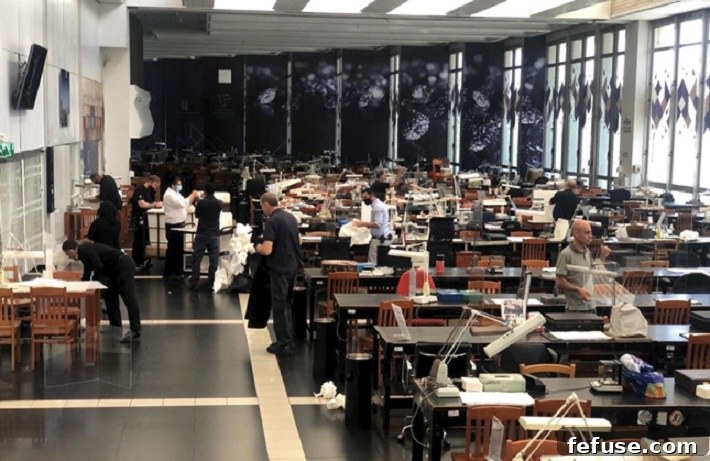
The global diamond industry, a sector built on trust, close personal interaction, and meticulous inspection, faced unprecedented challenges with the onset of the COVID-19 pandemic. As lockdowns swept across the world, physical trading hubs, vital for the industry’s operation, were forced to close their doors. Among these significant closures was the Israel Diamond Exchange (IDE), a powerhouse in the international diamond trade, which temporarily ceased operations on March 15, 2020, in response to government-mandated health lockdowns.
However, demonstrating remarkable resilience and adaptability, the IDE proudly announced the reopening of its iconic Trading Floor on Sunday, May 24, 2020. This pivotal moment signaled not just a return to activity for one of the world’s leading diamond exchanges but also a powerful symbol of recovery and a cautious step towards a “new normal” for the entire global diamond market. The reopening, while eagerly anticipated, came with a clear understanding that the way business is conducted would be fundamentally transformed to prioritize health and safety.
Navigating the New Normal: IDE’s Commitment to Safety and Continuity
The Israel Diamond Exchange is renowned globally as a central hub for both rough and polished diamond trading, attracting thousands of buyers and sellers from around the world. Its closure for over two months had a significant ripple effect across the supply chain, impacting miners, manufacturers, and retailers alike. The decision to reopen was a complex one, balancing the urgent need to revitalize trade with the paramount responsibility of ensuring the well-being of its members and staff.
In a formal statement announcing the reopening, the IDE emphasized that the trading floor would operate under a completely revised format, meticulously designed to comply with evolving government-mandated safety practices for workplaces. This wasn’t merely a return to business as usual; it was an embracing of a proactive strategy to mitigate health risks while facilitating critical trade activities. The phased approach began on May 3, as the Israeli government gradually eased national restrictions, allowing the IDE to prepare thoroughly for its full Trading Floor operations.
Transforming the Trading Floor: A Blueprint for Secure Diamond Commerce
The heart of the Israel Diamond Exchange, its sprawling Trading Floor, underwent substantial modifications to align with the new health and safety paradigm. To manage activity and minimize potential exposure, the vast space has been intelligently segmented into two distinct areas: one dedicated solely to polished diamond trading and another exclusively for rough diamond trading. This clear segregation aims to streamline operations and reduce unnecessary interaction between different groups of traders.
Beyond spatial division, the IDE implemented a suite of advanced safety measures that set a new benchmark for physical trading environments. The number of traders permitted on the floor at any given time has been significantly reduced, ensuring ample space for social distancing. Each trading table, traditionally a space for close negotiation, has been retrofitted with transparent partitions. These sturdy dividers act as protective barriers, offering an enhanced layer of safety during essential face-to-face interactions. These physical modifications demonstrate a forward-thinking approach to maintaining the essence of diamond trading – personal inspection and negotiation – while adapting to contemporary health requirements.
Furthermore, stringent behavioral protocols are now mandatory for anyone entering the Trading Floor. Traders are required to maintain a strict two-meter distance from others at all times, wear protective masks diligently, and crucially, sign a daily health declaration. This declaration serves as a vital screening tool, ensuring that individuals entering the premises are aware of and comply with health guidelines, contributing to a collective safe environment. These measures collectively underscore the IDE’s unwavering commitment to creating a secure and responsible trading ecosystem.
A Symbolic Reopening: The Heart and Soul of the Industry
The sentiment surrounding the reopening was eloquently captured by Eran Zini, Managing Director of the Israel Diamond Exchange. He expressed immense excitement about welcoming members back to the trading floor, referring to it as “the heart and soul of the Israel Diamond Exchange.” This statement resonates deeply within the diamond community, as the physical exchange has always been more than just a marketplace; it is a vibrant community hub, a center for networking, knowledge exchange, and relationship building that is fundamental to the industry’s character.
Mr. Zini emphasized that this reopening signifies a “very significant return to normality” and powerfully “symbolizes that the diamond industry is back in business.” This declaration is crucial for boosting confidence across the entire value chain, from miners in distant lands to jewelers serving end consumers. However, he also reiterated the unwavering commitment to safety: “Still, we are very strictly enforcing government guidelines, since protecting the health and safety of our members is above all.” This balanced perspective – celebrating recovery while prioritizing well-being – is key to sustainable operation in the post-pandemic era.
Broader Implications for the Global Diamond Market
The Israel Diamond Exchange’s proactive and comprehensive approach to reopening offers valuable insights and potential blueprints for other global diamond bourses and trading centers. As other countries and industries contemplate their own returns to physical operations, the IDE’s experience highlights the importance of detailed planning, significant infrastructural adaptations, and consistent enforcement of new behavioral norms. This move by a major player like IDE sends a strong signal of resilience and innovation throughout the international diamond community.
The post-COVID-19 landscape will undoubtedly continue to evolve, with digital platforms playing an increasingly important role in certain aspects of diamond trading. However, the decision by IDE to invest heavily in making its physical trading floor safe underscores the enduring value of direct interaction in the diamond sector. The tactile nature of diamonds, the intricate details that require in-person inspection, and the trust built through face-to-face negotiation remain irreplaceable elements for many transactions, especially for high-value rough and polished stones.
The focus on health declarations and rigorous sanitation also reflects a broader societal shift towards greater awareness and responsibility regarding public health. This emphasis on trust and safety will likely extend beyond the trading floor, influencing how business relationships are forged and maintained across the entire diamond supply chain. Consumers, too, are becoming more conscious of the ethical and health-related aspects of the products they purchase, making transparency and responsible operations more critical than ever.
Paving the Way Forward
The reopening of the Israel Diamond Exchange Trading Floor on May 24, 2020, marks a landmark event for the global diamond industry. It is a testament to the sector’s determination to overcome adversity, adapt to new realities, and continue its vital role in the international economy. By implementing stringent safety protocols, redesigning its physical space, and communicating a clear commitment to member well-being, the IDE is not merely reopening; it is redefining what it means to conduct diamond trading responsibly and safely in a changed world. This endeavor offers hope and a practical model for how traditional industries can successfully navigate the complexities of a post-pandemic future, ensuring continuity, security, and sustained growth for years to come.