
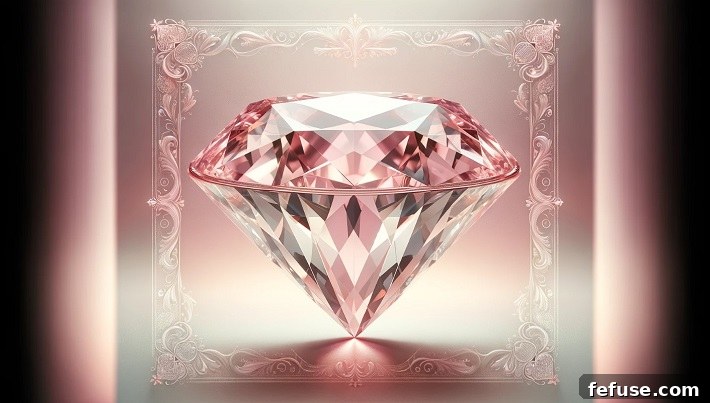
Pink diamonds, with their enchanting allure and profound rarity, stand as a testament to nature’s artistry and geological marvels. For centuries, these extraordinary gemstones have captivated the hearts of collectors, connoisseurs, and anyone with an appreciation for unparalleled beauty and luxury. Far beyond their aesthetic appeal, pink diamonds embody deep symbolism, serving as cherished tokens of affection, elegance, and individuality. Unlike their colorless counterparts, which are prized for their transparency, pink diamonds derive their immense value and desirability from their vivid and captivating hue, making them a pinnacle of gemstone collecting and a shrewd investment opportunity.
The world of diamonds is vast and varied, defined by meticulous criteria such as size, cut precision, and the absence or presence of color. While traditional colorless diamonds have long dominated the market, particularly in engagement settings, the increasing appreciation for fancy colored diamonds has brought forth a dazzling spectrum of hues, including blues, greens, yellows, reds, and most notably, pinks. Among these, pink diamonds command particular attention, distinguished by their scarcity and breathtaking visual impact.
Their exceptional rarity places pink diamonds at the zenith of the diamond market, rendering them some of the most sought-after and valuable gemstones on Earth. Their allure is multifaceted, stemming not only from their extreme scarcity but also from the rich spectrum of pink tones they exhibit, ranging from delicate blush to intense fuchsia. This guide delves into the intricate world of selecting and appreciating Argyle pink diamonds and other fancy pink diamonds, providing comprehensive insights to empower you in making an informed and confident choice for your collection or as a significant personal acquisition.
Unveiling the Mystery of Pink Diamonds
Pink diamonds are in a league of their own, distinguished by their striking pink coloration that places them among the elite category of fancy colored diamonds. Unlike most other colored diamonds, whose hues are often attributed to chemical impurities (like nitrogen for yellow or boron for blue), the precise origin of pink color in diamonds remains somewhat of a scientific enigma. The prevailing theory suggests that the color is a result of structural deformation in the diamond’s crystal lattice during its formation deep within the Earth. These immense pressures cause a compaction of atoms, leading to a selective absorption of light that results in the magnificent pink hue. This unique geological process contributes significantly to their rarity and fascination.
Historically, the vast majority—an estimated 90%—of the world’s finest pink diamonds, particularly those with the most intense and vibrant colors, originated from the legendary Argyle diamond mine in Western Australia. The Argyle mine became synonymous with pink diamonds, producing an array of hues from pale rose to deep purplish-pink. Its closure in November 2020 marked a pivotal moment in the diamond industry, profoundly impacting the supply and market dynamics of these already rare gems. With its primary source now depleted, the scarcity and inherent value of natural pink diamonds have only escalated, transforming them into even more coveted treasures for collectors and investors worldwide.
Due to their unparalleled scarcity and historical provenance, pink diamonds command premium prices in the global gem market. They are prominently featured in bespoke high-end jewelry, including exquisite engagement rings, elegant earrings, and breathtaking necklaces, often serving as the centerpieces of designer collections. Beyond their role in adornment, pink diamonds are also highly sought after by discerning collectors and investors, who recognize their exceptional potential for capital appreciation and their enduring status as tangible assets. Their unique blend of beauty, rarity, and historical significance makes them a truly distinctive investment.
The Enduring Symbolism of Pink Diamonds
Pink diamonds are not merely admired for their breathtaking aesthetic appeal; they are deeply imbued with powerful symbolic meanings that resonate with human emotions and aspirations. Thanks to their gentle yet captivating pink tone, they are universally associated with romance, tender love, and heartfelt affection. This profound connection makes them an exceptionally popular choice for engagement rings and other significant romantic jewelry, where they symbolize an enduring bond and a unique expression of devotion.
Beyond romance, pink diamonds also signify elegance, sophistication, and a distinct sense of femininity. They appeal to individuals who seek to express their unique personal style and individuality, offering a departure from traditional diamond choices. The vibrancy of their color can also evoke feelings of joy, celebration, and optimism, making them perfect for commemorating life’s most precious moments. Choosing a pink diamond is more than just selecting a beautiful gemstone; it is an embrace of personal sentiment, a statement of refined taste, and a celebration of emotional depth. They represent an investment in both intrinsic beauty and profound meaning, making them cherished heirlooms passed down through generations.
Extraction and Sourcing: A Story of Rarity and Challenge
The journey of a pink diamond from deep within the Earth to a collector’s showcase is an epic tale of geological forces and human perseverance. The extraction of these magnificent gems is an extraordinarily complex and labor-intensive process, primarily due to their extreme rarity and the fact that they are found in only a handful of geological locations across the globe. For decades, the Argyle mine in Australia was the undisputed champion, responsible for producing approximately 90% of the world’s supply of gem-quality pink diamonds.
The closure of the Argyle mine in 2020 dramatically intensified the scarcity of natural pink diamonds. This event sent ripples across the global diamond market, causing prices to surge and intensifying the search for alternative sources. While smaller deposits of pink diamonds have been found in places like Brazil, Russia, and India, none have ever matched the consistent quantity or exceptional quality produced by Argyle. This unprecedented supply constraint means that acquiring a natural pink diamond today is a testament to discerning taste and a profound appreciation for true rarity. The limited availability ensures that these gems will continue to appreciate in value, solidifying their status as highly coveted assets.
Innovative Cutting and Crafting Techniques for Pink Diamonds
The transformation of a rough pink diamond into a scintillating jewel demands an extraordinary level of skill, precision, and artistic vision. Cutting and crafting pink diamonds requires highly specialized expertise, as the primary goal is not just to maximize brilliance, but to enhance and concentrate their natural, unique hues. Expert diamond cutters carefully analyze each rough stone to determine the optimal cut that will best showcase its inherent color and maximize its luminosity. Unlike colorless diamonds where cuts often aim for maximum fire and scintillation, fancy colored diamonds are often cut to retain as much color as possible, sometimes at the expense of traditional brilliance.
Advancements in diamond cutting technology have revolutionized this intricate process. The integration of sophisticated tools such as laser technology and computer-aided design (CAD) allows master jewelers to plan and execute cuts with unparalleled accuracy. These innovations enable the creation of specific cut styles, such as radiant, cushion, or oval cuts, which are often favored for fancy colored diamonds because their facet patterns are adept at deepening and distributing color evenly throughout the stone. These precise cuts ensure that each pink diamond’s unique characteristics—its distinctive shade, saturation, and tone—are exquisitely highlighted in the finished jewelry piece, revealing its full potential and captivating beauty.
The Dynamic Market Value of Pink Diamonds
The market value of pink diamonds is subject to a fascinating interplay of rarity, demand, and intrinsic beauty, making it one of the most dynamic segments of the global gem market. Their extreme scarcity inherently places them at a significantly higher value point than most other diamonds, including the more common colorless varieties. Historical data consistently shows that pink diamonds have demonstrated robust price appreciation over decades, often outperforming traditional investment assets.
Several key factors influence their market value. The intensity and purity of the pink color are paramount; diamonds with a strong, vivid, or deep pink hue are exponentially more valuable than those with lighter or fainter tones. The diamond’s origin also plays a critical role; pink diamonds from historically renowned sources like the Argyle mine often carry a substantial premium due due to their unique color characteristics and documented provenance, along with the added prestige of their now-closed source. Current market demands, auction results for famous pink diamonds, and global economic trends also contribute to fluctuations. With the cessation of production from Argyle, the dwindling supply of new natural pink diamonds ensures that their market value will likely continue its upward trajectory, making them a highly desirable asset for long-term investment.
Valuation Criteria: Understanding the 4Cs of Pink Diamonds
Like all diamonds, pink diamonds are meticulously assessed and graded based on the universally recognized 4Cs—cut, color, clarity, and carat weight. This standardized framework, rigorously applied by esteemed gemological institutes such as the GIA (Gemological Institute of America), provides a comprehensive measure of a diamond’s quality and value, albeit with specific nuances for fancy colored stones.
Cut: For pink diamonds, the cut plays a nuanced but vital role. While a well-crafted cut enhances a diamond’s overall brilliance and ability to reflect light, for fancy colored diamonds, the cut is often optimized to deepen and concentrate the color, rather than solely maximizing sparkle. Certain cuts, like radiant, cushion, and oval, are frequently chosen because their facet arrangements are particularly effective at distributing and intensifying the pink hue, making the color appear more vibrant and saturated. An expertly executed cut for a pink diamond will balance brilliance with color enhancement.
Color: This is, without a doubt, the most crucial determinant of value for pink diamonds. Unlike colorless diamonds where the absence of color adds value, for pink diamonds, value dramatically increases with the intensity, purity, and evenness of the pink hue. The GIA grades fancy colored diamonds on a scale that includes Faint, Very Light, Light, Fancy Light, Fancy, Fancy Intense, Fancy Vivid, Fancy Deep, and Fancy Dark. Fancy Intense and Fancy Vivid pink diamonds are the most prized and command the highest prices due to their exceptional saturation and vibrant appearance. The presence of secondary hues, such as purple or orange, can also influence value, with purplish-pink often being highly sought after.
Clarity: This refers to the presence of internal characteristics (inclusions) and external blemishes (bypasses). Fewer flaws and imperfections mean a higher clarity grade and, consequently, a higher value. While clarity is important, for fancy colored diamonds, a high clarity grade (like Internally Flawless or VVS) is secondary to an exceptional color grade. A pink diamond with a stunning Fancy Vivid color but a slightly lower clarity grade (e.g., VS2) might still be more valuable and desirable than one with a faint pink color but flawless clarity, as long as the inclusions are not visible to the naked eye and do not affect the diamond’s durability.
Carat Weight: The weight of the diamond, measured in carats, also plays a critical role in its overall value. As with all diamonds, larger pink diamonds are exponentially rarer and thus significantly more valuable. The price per carat typically increases dramatically as the carat weight goes up, reflecting the extreme scarcity of larger stones. A 1-carat Fancy Vivid pink diamond is an extraordinary rarity and will command an astronomical price compared to smaller stones of similar color intensity.
The Importance of Certification and Authenticity
Given the significant investment involved in purchasing a pink diamond, it is absolutely paramount to ensure its authenticity and to have its characteristics verified by a reputable, independent gemological laboratory. Organizations like the Gemological Institute of America (GIA) are the industry standard for diamond grading. A comprehensive grading report from such an institution will confirm whether the diamond is natural or treated, specify its exact color grade (e.g., Fancy Intense Purplish Pink), clarity, cut, and carat weight, and often include a plot diagram showing the diamond’s inclusions. This certification provides an essential layer of assurance, protecting your investment and guaranteeing the diamond’s stated quality.
Choosing Your Pink Diamond: Practical Advice
Embarking on the journey to acquire a pink diamond is an exciting endeavor. Consider your budget first, as it will largely dictate the size and intensity of the color you can achieve. Next, decide on your preferred hue and saturation – do you desire a delicate light pink or a bold Fancy Vivid purplish-pink? While clarity is important, for fancy colors, prioritize color intensity. For investment purposes, certified natural pink diamonds, especially those from Argyle, tend to hold and increase value best. Finally, think about the setting: the metal choice (e.g., rose gold or platinum) and surrounding stones can significantly enhance or complement the pink diamond’s unique color, bringing out its full potential.
Care and Maintenance Tips for Your Pink Diamond
Pink diamonds, like all exquisite gemstones, require diligent care and maintenance to preserve their inherent beauty and enduring value. Proper handling and regular cleaning will ensure your pink diamond jewelry remains as radiant as the day you acquired it. It is recommended to clean pink diamond jewelry with a gentle solution of mild soap and lukewarm water. Use a soft-bristled brush, such as a soft toothbrush, to carefully scrub away any accumulated dirt, oils, or lotions from both the diamond and its setting. After cleaning, rinse thoroughly with clean water and dry with a soft, lint-free cloth.
To prevent scratches and damage, always store pink diamond jewelry separately from other pieces. A fabric-lined jewel case with individual compartments or soft pouches is ideal. Avoid exposing your pink diamond to harsh chemicals, such as chlorine bleach or abrasive cleaners, as these can potentially damage the metal setting or, in rare cases, affect the diamond’s surface. Regular professional cleaning and inspection by a trusted jeweler are also highly advisable. This ensures the setting remains secure and any potential issues are addressed promptly, safeguarding your precious investment.
Pink diamonds are more than just gemstones; they are timeless embodiments of beauty, immense value, deep symbolism, and unparalleled rarity. Whether you are a seasoned investor, a passionate collector, or an admirer drawn to their unique charm, a thorough understanding of their rich history, the formidable sourcing challenges, and the intricate market dynamics is absolutely crucial. With legendary sources like the Argyle mine now closed, these extraordinary gems are becoming progressively rarer, solidifying their allure and ensuring that demand for them will only intensify. Choosing a pink diamond is choosing a piece of history, a work of natural art, and a coveted treasure that represents a truly timeless and exceptional investment.