

Signet Jewelers Leads the Way: Lab-Grown Diamonds Now Sparkle Across All Major US Brands
In a pivotal move that underscores a significant shift within the global jewelry industry, Signet Jewelers, the world’s largest diamond jewelry retailer, has officially rolled out its selection of lab-grown diamond jewelry across all its major US retail outlets. This strategic expansion signals a strong endorsement of man-made diamonds, marking a new era for consumers seeking ethical, sustainable, and often more accessible alternatives to traditional mined stones.
The journey began earlier this year with James Allen, the prominent e-tailer acquired by Signet in 2017, pioneering the offering of lab-grown diamonds within the Signet portfolio. This initial success paved the way for a broader integration, demonstrating consumer readiness and market demand for these innovative gems. Now, the sparkle of lab-grown diamonds can be found not just online, but physically on display in leading brick-and-mortar stores nationwide.
A Widespread Rollout: From Online to In-Store Presence
The comprehensive nature of Signet’s latest initiative is truly remarkable. David Bouffard, a spokesperson for Signet, confirmed to American trade publication JCK, that “lab-created diamonds are available in both fashion and bridal jewelry at James Allen, Kay, Zales, and Jared stores, as well as their e-commerce sites.” This statement highlights the widespread availability across Signet’s diverse brand portfolio, catering to a broad spectrum of customer preferences and price points.
This widespread adoption represents a rapid acceleration from previous, more cautious approaches. Earlier this year, for example, Kay Jewellers’ “Modern Creation” line, featuring lab-grown diamonds, was limited to a mere four locations in Florida. Zales, another flagship brand, had not yet introduced them at all. The speed with which Signet has scaled this offering across all Kay and Zales stores is indicative of both internal confidence and a clear response to evolving consumer trends.
Signet’s proactive stance is not just about meeting demand; it’s about shaping the future of diamond retail. By integrating lab-grown options alongside their extensive natural diamond collections, Signet is addressing a growing segment of consumers who prioritize transparency, ethical sourcing, and value without compromising on the timeless beauty and brilliance of diamonds.
Navigating the New Landscape: Consumer Education and Choice
As Signet introduces this dual offering, a crucial element of its strategy involves educating consumers about the distinctions and similarities between lab-grown and natural diamonds. The company recognizes that empowering customers with accurate information is key to fostering trust and facilitating informed purchasing decisions. On the Kay Jewellers website, for instance, Signet provides a clear and concise chart designed to help consumers understand these differences, ensuring transparency in their buying journey.
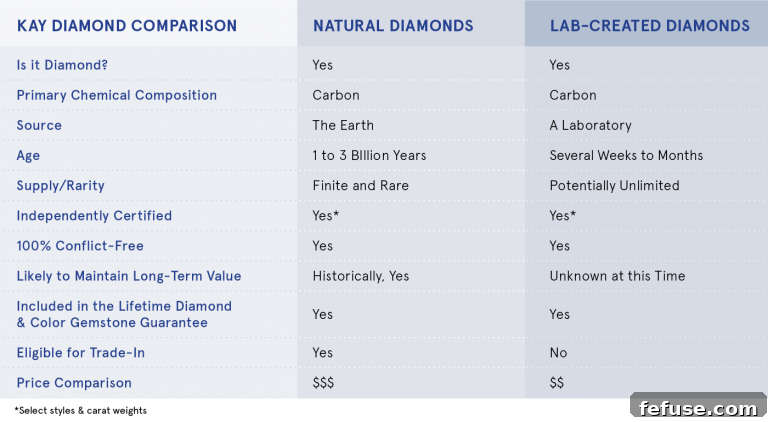
This educational material highlights several key aspects:
- Origin: Natural diamonds are formed deep within the Earth over billions of years, while lab-grown diamonds are created in a controlled environment using advanced technological processes that mimic natural conditions. Both are chemically, physically, and optically identical as diamonds.
- Long-Term Value: The chart points out that natural diamonds, being “from the Earth,” have “historically” shown a likelihood to maintain long-term value due to their finite nature. Conversely, the long-term value trajectory for lab-grown stones is noted as “unknown at this time.” This careful distinction acknowledges the historical market behavior of natural diamonds while recognizing the newer, evolving market dynamics of lab-grown counterparts.
- Supply: Natural diamonds are characterized by a “finite and rare” supply, emphasizing their scarcity. In contrast, lab-grown diamonds possess a “potentially unlimited” supply, reflecting the capacity for continuous production through technological advancements. This distinction plays a significant role in pricing and market availability.
- Ethical and Environmental Considerations: While not explicitly detailed in the provided chart text, the broader industry conversation often surrounds the ethical sourcing of natural diamonds and the reduced environmental footprint associated with many lab-grown production methods. Signet’s move aligns with a growing consumer desire for transparent and responsible sourcing.
By providing such clarity, Signet aims to help customers make choices that align with their personal values, budgets, and understanding of long-term investment versus immediate value and modern sustainability.
Expanding Offerings and Competitive Pricing
The introduction of lab-grown diamonds also opens up new opportunities for pricing and product diversity. For instance, Zales currently showcases a diverse collection of two dozen lab-grown diamond pieces. These offerings span a wide price range, starting from under $1,000 and extending up to approximately $7,500. This pricing flexibility makes diamond jewelry more accessible to a broader demographic, allowing more consumers to own a piece of diamond luxury, whether for everyday wear or special occasions.
The competitive pricing of lab-grown diamonds, typically 30-50% less than their natural equivalents, is a significant draw. This allows consumers to purchase larger stones or more intricate designs within their budget, or to allocate savings towards other aspects of a major purchase, such as an engagement ring. For Signet, this broadens its market appeal, attracting price-conscious buyers and those who prioritize size and sparkle for their investment.
The Global Outlook: UK Market Awaits Full Embrace
While the US market has demonstrated a quicker embrace of lab-grown diamonds, the trend is steadily gaining momentum across the Atlantic. The phenomenon has been generating increasing traction in the UK over the last couple of years, with independent jewelers and smaller chains beginning to stock these innovative gems. However, Signet’s UK-based brands, Ernest Jones and H Samuel, currently remain its only brick-and-mortar outlets without a lab-grown diamond jewelry offer.
This poses a pertinent question for industry observers and consumers alike: will Signet extend its lab-grown diamond jewelry offer to its significant UK store network? The answer likely hinges on several factors, including market research into UK consumer preferences, regulatory environments, and the strategic timing for such a significant launch. Cultural perceptions of value and tradition might also play a larger role in the UK, potentially necessitating a more gradual and targeted introduction.
Should Signet decide to roll out lab-grown diamonds in the UK, it would undoubtedly accelerate the acceptance and growth of this category in the British jewelry market. As a dominant player, Signet’s endorsement would lend considerable credibility and visibility, encouraging wider consumer adoption and potentially influencing other retailers to follow suit. The move would not only diversify their product range but also align with global trends towards more ethical and sustainable consumer choices, which are increasingly important to younger demographics in the UK.
Strategic Implications for Signet and the Diamond Industry
Signet’s comprehensive adoption of lab-grown diamonds is more than just a product expansion; it’s a profound strategic realignment within the competitive jewelry landscape. By embracing lab-grown diamonds, Signet is positioning itself to capture a share of the rapidly growing market for these stones, while simultaneously future-proofing its business against evolving consumer preferences and ethical considerations.
This strategy allows Signet to appeal to a broader customer base, including environmentally conscious millennials and Gen Z buyers who are often drawn to the sustainable and conflict-free aspects of lab-grown diamonds. It also provides a diverse range of price points, making diamond ownership more accessible and appealing to various income levels.
The move by a retail giant like Signet also sends a powerful signal to the broader diamond industry. It validates lab-grown diamonds as a legitimate and desirable product, potentially accelerating their acceptance among other mainstream jewelers and influencing natural diamond producers to enhance their own transparency and ethical sourcing initiatives. The coexistence of both natural and lab-grown diamonds within Signet’s stores suggests a future where both categories thrive, each serving distinct market segments and consumer needs.
The Future Sparkles Bright: A New Chapter for Diamond Jewelry
The integration of lab-grown diamonds across Signet’s major US brands marks a significant milestone in the evolution of the jewelry industry. It reflects a dynamic market responding to innovation, consumer values, and economic realities. As technology advances and production methods become more efficient, the appeal and accessibility of lab-grown diamonds are only set to grow.
Signet Jewelers is not merely selling jewelry; it is selling choice, transparency, and a vision for the future of fine adornment. Whether a customer seeks the timeless allure and historical value of a natural diamond or the ethical innovation and accessible brilliance of a lab-grown stone, Signet is now equipped to cater to every preference. The question of when this comprehensive offering will reach the UK remains, but the trajectory for lab-grown diamonds globally, spearheaded by industry leaders like Signet, is undeniably upward.
News Source: professionaljeweller