
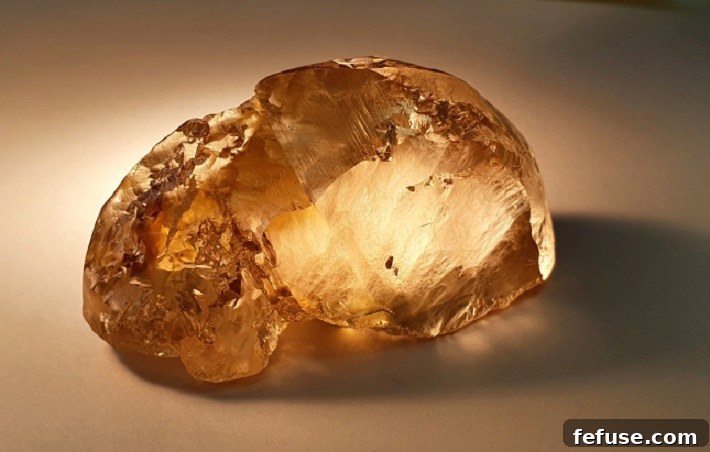
Yakutia Unearths Record-Breaking 236-Carat Intense Yellow-Brown Diamond: A Monumental Discovery
The vast, enigmatic expanse of Yakutia, officially known as the Sakha Republic, within the Russian Federation, has once again etched its name into the annals of diamond history. This majestic and mineral-rich region has yielded its largest ever natural color diamond – a breathtaking 236-carat rough stone, distinguished by its intense yellow-brown hue. This singular discovery not only underscores Yakutia’s status as a global powerhouse in diamond production but also captivates the world with the sheer rarity and beauty of nature’s hidden treasures.
Unearthed from the prolific Ebelyakh alluvial diamond deposit, nestled alongside the historic Anabar River, this extraordinary gem was brought to light by a subsidiary of Alrosa, the world’s largest diamond mining company by volume. Alluvial deposits, formed by the erosion of primary kimberlite pipes and the subsequent transport of diamonds by ancient rivers, are renowned for yielding stones of exceptional quality and often, significant size, as evidenced by this latest find.
Anatomy of a Colossal Gem: Dimensions and Ancient Origins
The newly discovered diamond presents an impressive physical profile, measuring a substantial 47 x 24 x 22 millimeters. Its impressive dimensions are matched only by its venerable age, which experts estimate to be between 120 and 230 million years old. Such an age places its formation deep within the Mesozoic Era, a period when dinosaurs roamed the Earth, offering a profound connection to our planet’s ancient geological past. The sheer scale and antiquity of this stone mark it as a truly unique specimen, a testament to the immense pressures and temperatures deep within the Earth’s mantle that create these crystalline wonders.
Pavel Vinikhin, the discerning head of diamonds at Alrosa’s cutting and polishing division, articulated the significance of this find with profound insight. “Such a large natural color rough diamond is a unique discovery,” he stated, emphasizing the unparalleled nature of the stone. His words resonate with the industry, where large natural color diamonds are celebrated not just for their size but for their inherent rarity and the complex geological processes that give them their distinctive hues.
Alrosa’s Meticulous Journey: From Rough to Potential Radiance
Following its remarkable extraction, the 236-carat diamond has embarked on a crucial journey within Alrosa’s sophisticated infrastructure. It is currently housed at Alrosa’s United Selling Organization, where a team of highly skilled specialists is meticulously studying and evaluating its every facet. This rigorous assessment process involves detailed analysis of the stone’s internal characteristics, its potential clarity, and the optimal strategy for unlocking its maximum value. Factors such as inclusions, structural integrity, and the distribution of its captivating yellow-brown color are scrutinized with advanced technology and expert eyes.
The decision ahead for Alrosa is a pivotal one: will this magnificent rough diamond be entrusted to their in-house manufacturers for cutting and polishing, or will it be offered for sale as a rough stone on the international market? Vinikhin acknowledged the universal appeal of such a find: “Of course, cutters in any country will be interested in such a diamond, as it has the potential to give several high quality polished diamonds.” This statement highlights the immense potential and global demand for a stone of this caliber, which could yield not just one, but multiple exquisite finished gems.
The Mystique of Natural Color Diamonds: A Spectrum of Rarity
While colorless diamonds have long held a coveted position in the jewelry world, natural color, or “fancy color,” diamonds occupy an even rarer and more exclusive niche. Unlike colorless diamonds, which are graded on the absence of color, fancy color diamonds are prized for the intensity and purity of their hues. Colors such as pink, blue, green, and indeed, yellow and brown, occur when trace elements are present during the diamond’s formation, or when structural defects are created within the crystal lattice due to immense pressure and heat deep within the Earth.
The “intense yellow-brown” descriptor for this Yakutian giant is particularly intriguing. While brown diamonds are relatively common, an intense and vibrant yellow-brown hue in such a large specimen is exceedingly rare and highly sought after. These diamonds often possess a warmth and depth of color that is unmatched, appealing to collectors and connoisseurs who appreciate uniqueness and natural artistry. The market for fancy color diamonds has seen consistent growth, with record-breaking prices achieved for exceptional stones, underscoring their enduring value and appeal as both investments and objects of profound beauty.
Yakutia: Russia’s Diamond Heart and a Land of Extremes
The Republic of Yakutia, also known as Sakha, is far more than just a source of incredible diamonds; it is a region of epic proportions and stark beauty. Occupying an astounding one-fifth of the Russian Federation’s total area, Yakutia is geographically immense. To put its size into perspective, it is larger than Germany, France, Austria, Italy, Finland, Greece, and Sweden combined. This colossal territory is characterized by its extreme continental climate, with some of the coldest inhabited places on Earth, where temperatures can plummet to astonishing lows.
Despite these harsh conditions, Yakutia’s geological bedrock is extraordinarily rich, making it the primary diamond-producing region in Russia and a significant contributor to global supply. Its vast, ancient cratons hold numerous kimberlite pipes – the volcanic conduits that bring diamonds from the Earth’s mantle to the surface – as well as extensive alluvial deposits. The arduous work of diamond mining in such an environment requires immense logistical effort, technological innovation, and human resilience, cementing Yakutia’s reputation as a frontier of mineral wealth.
The Journey from Rough to Radiance: The Art of Diamond Cutting
The prospect of this 236-carat rough diamond yielding “several high quality polished diamonds” is a testament to the intricate art and science of diamond cutting. Once the stone’s internal characteristics have been fully mapped, expert planners will determine the optimal strategy for cleaving, sawing, and polishing. This process aims to maximize the yield of polished carat weight while enhancing the diamond’s inherent brilliance, fire, and scintillation.
The journey typically begins with careful planning, often utilizing advanced 3D scanning and computer modeling to explore various cutting options. The rough stone might then undergo cleaving, where a precise blow along a specific crystallographic plane separates it, or sawing, which uses lasers or diamond-edged blades to divide the stone. Subsequent steps include bruting, which shapes the diamond into a rough girdle, and then the painstaking process of polishing, where facets are meticulously ground and polished to exacting angles. For a stone of this size and importance, the cutters involved would be among the most experienced and skilled in the world, capable of unlocking its full potential and transforming a rough wonder into a dazzling collection of finished jewels, each a testament to Yakutia’s enduring diamond legacy.
Conclusion: A Gemstone for the Ages
The discovery of the 236-carat intense yellow-brown diamond in Yakutia is more than just a significant find; it is a geological marvel and a testament to the persistent allure of Earth’s hidden treasures. It reinforces Alrosa’s pivotal role in the global diamond industry and highlights Yakutia’s irreplaceable contribution to the world’s supply of these precious gems. As specialists meticulously evaluate its future, the diamond holds the promise of not only enriching the world with stunning polished stones but also furthering our understanding of the planet’s ancient processes. This extraordinary rough diamond stands as a beacon of natural beauty and enduring value, captivating the imagination of gemologists, collectors, and enthusiasts worldwide, and adding another glittering chapter to the timeless story of diamonds.