
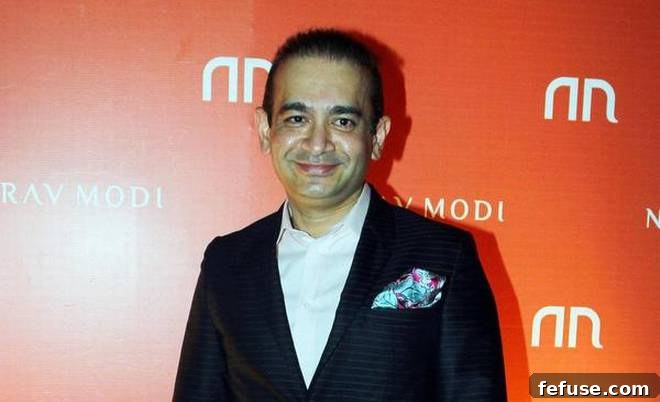
Nirav Modi Seeks Political Asylum in UK Amidst Staggering PNB Fraud Allegations
In a developing story that has captured international attention, Nirav Modi, the prominent billionaire diamantaire at the nexus of India’s colossal ₹13,578-crore (approximately $2 billion USD) Punjab National Bank (PNB) fraud, has reportedly sought political asylum in the United Kingdom. This high-stakes legal manoeuvre places him in London, where he claims to be a victim of “political persecution,” a defence strategy that complicates India’s ongoing efforts to bring him to justice. The Financial Times first broke the news, citing insights from both Indian and British officials, bringing to light another significant financial fugitive seeking refuge on British soil.
The UK Home Office, in line with its standard operating procedures, has refrained from commenting on individual immigration or asylum cases. This protocol underscores the confidential nature of such proceedings but does little to quell the intense public and governmental scrutiny surrounding Modi’s presence in Britain. Efforts by news agencies to reach Nirav Modi for comment regarding the FT report have thus far been unsuccessful, leaving much to speculation about his immediate legal strategy and living situation.
The Anatomy of the PNB Fraud: A Financial Catastrophe
The fraud, which came to light in early 2018, involved an intricate scheme that exploited vulnerabilities within PNB’s internal systems and its communication with international banking networks. PNB, India’s second-largest state-run bank, revealed that two jewellery conglomerates, primarily led by Nirav Modi and his uncle Mehul Choksi, had defrauded the bank over several years. The core of the illicit operation involved obtaining credit from overseas branches of other banks. This was achieved through the issuance of fraudulent Letters of Undertaking (LoUs) and Foreign Letters of Credit (FLCs) by rogue PNB staff at a single Mumbai branch. These guarantees were issued without adequate collateral or proper entries in the bank’s core banking system, effectively bypassing established financial safeguards.
The modus operandi was deceptively simple yet devastatingly effective. Corrupt PNB employees used the SWIFT interbank messaging system to transmit fraudulent LoUs to overseas branches of Indian banks, which then extended credit to Modi’s and Choksi’s companies, ostensibly against PNB’s guarantee. Critically, these transactions were not recorded in PNB’s internal core banking software, allowing the fraud to go undetected for years. The sheer scale and duration of the scheme exposed significant systemic lapses within PNB and raised serious questions about oversight and compliance within India’s public sector banking framework.
Nirav Modi’s Flight and the Asylum Gambit
Following the uncovering of the fraud, Nirav Modi promptly fled India, embarking on a complex journey across multiple countries before eventually settling in the UK. His decision to seek political asylum in London introduces a new layer of complexity to an already intricate legal battle. By claiming “political persecution,” Modi’s legal team is attempting to argue that the charges against him are not genuinely criminal but are politically motivated, thereby making him eligible for protection under international asylum laws. This strategy, if successful, could potentially shield him from extradition to India.
For an asylum claim to be successful in the UK, an applicant must demonstrate a well-founded fear of persecution on grounds of race, religion, nationality, membership of a particular social group, or political opinion, should they be returned to their home country. While financial fraud cases are typically viewed as criminal matters, a claimant might argue that the pursuit is disproportionate, politically charged, or that they will not receive a fair trial due to political interference. India, however, vehemently rejects any such claims, asserting that the charges against Modi are purely criminal and based on extensive evidence of financial malfeasance.
India’s Relentless Pursuit: Extradition Efforts and Legal Proceedings
The Indian government has made it unequivocally clear that it intends to pursue all legal avenues to bring Nirav Modi back to India to face trial. The Ministry of External Affairs (MEA) confirmed to the Financial Times that it was awaiting formal requests from India’s law enforcement agencies – primarily the Central Bureau of Investigation (CBI) and the Directorate of Enforcement (ED) – before initiating a formal extradition request. These agencies have been diligently working to build an ironclad case against Modi and his co-conspirators.
Already, significant legal steps have been taken in India. Charges have been filed against over 25 individuals in connection with the PNB fraud. This comprehensive list includes Modi, his uncle Mehul Choksi, former PNB chief Usha Ananthasubramanian, two of the bank’s executive directors, and three companies directly linked to Nirav Modi. Both Modi and Choksi have consistently denied any wrongdoing, maintaining their innocence amidst the overwhelming evidence presented by Indian authorities.
Further intensifying the legal pressure, senior executives at PNB were formally accused by the police in a court-filed charge sheet of misleading the central bank (Reserve Bank of India) in late 2016. The accusation centres on the executives’ handling of the financial messaging system (SWIFT) and the credit guarantees that formed the very bedrock of the multi-crore fraud. These charges highlight a systemic failure within the bank and point to a conspiracy that extended beyond just a few rogue employees.
The Broader Context: India’s Battle Against Fugitive Economic Offenders
Nirav Modi’s case is not an isolated incident; it forms part of a larger pattern of high-profile Indian business figures absconding to the UK to evade legal proceedings in India. India is currently engaged in a strenuous legal battle to extradite Vijay Mallya, the flamboyant liquor and aviation tycoon. Mallya, accused of defaulting on substantial loans for his defunct Kingfisher Airlines, relocated to Britain in March of the preceding year. His ongoing extradition proceedings have set a precedent, illustrating both the legal complexities and the diplomatic challenges inherent in bringing fugitives back from the UK.
The presence of multiple high-profile Indian fugitives seeking refuge in the UK has become a significant point of contention in India-UK bilateral relations. The Indian government views these cases not merely as individual legal matters but as critical tests of international cooperation in combating financial crime. The successful extradition of such individuals is seen as vital for upholding the rule of law, restoring public faith in the financial system, and deterring future economic offences. The UK’s commitment to due process and human rights, while fundamental, often leads to protracted legal battles that test the patience of the requesting nation.
The Indian government has enacted the Fugitive Economic Offenders Act to specifically target individuals like Modi and Mallya, allowing for the confiscation of their properties and assets even before conviction. This aggressive stance underscores India’s determination to create an environment where economic offenders cannot escape justice by fleeing the country. The outcome of Nirav Modi’s asylum claim and potential extradition will undoubtedly have far-reaching implications, not only for the individuals involved but also for the future of international legal cooperation in the fight against global financial crime.
Conclusion: A Long Road to Justice
The saga of Nirav Modi, from a celebrated jeweller to an alleged mastermind of a colossal banking fraud and now an asylum seeker, encapsulates the intricate challenges of modern financial crime and international jurisprudence. As he navigates the complex web of UK asylum law, India remains steadfast in its resolve to ensure that justice is served. The protracted legal battles, the diplomatic efforts, and the inherent complexities of cross-border legal systems mean that the path to a final resolution will likely be long and arduous. Yet, for India, bringing Nirav Modi back to face the charges is not just about one case; it’s about sending a clear message that no economic offender, no matter how powerful, can evade accountability.