
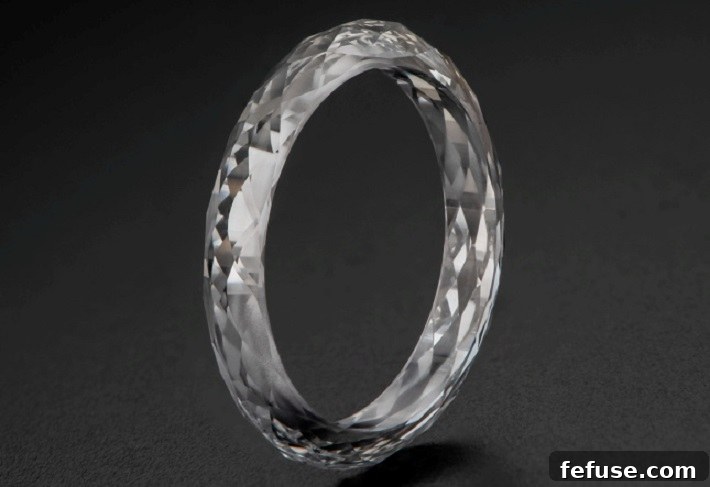
In the dynamic and ever-evolving landscape of luxury and technological innovation, a truly groundbreaking piece of jewelry has emerged, redefining what is possible in diamond craftsmanship and design. We are talking about an extraordinary 4.04-carat solid-faceted ring, meticulously carved entirely from a single lab-grown diamond. This isn’t merely a ring; it’s a profound statement on the harmonious fusion of cutting-edge scientific advancement, precision engineering, and timeless artistic vision. Its creation not only showcases the incredible strides made in synthetic diamond technology but also sets a new, elevated benchmark for bespoke jewelry design, capturing the imagination of experts and enthusiasts across the globe. This remarkable achievement stands as a shining testament to human ingenuity and the boundless potential of modern material science, offering a glimpse into the future of luxury adornment.
The Unprecedented Splendor of a Single-Crystal Diamond Ring
This exceptional piece of jewelry represents a significant paradigm shift from traditional diamond rings, which customarily feature a precious gemstone meticulously set into a metal band. Instead, this particular ring is a monolithic structure, entirely composed of pure diamond, offering an unparalleled aesthetic and a unique tactile experience. Weighing precisely 4.04 carats, its solid-faceted form is engineered to catch and refract light in a spectacular, almost otherworldly display, promising unparalleled brilliance, fire, and scintillation. The very concept of wearing a ring entirely carved from a single, unbroken crystal of diamond evokes a profound sense of ultimate purity, seamless elegance, and incredible strength. This innovative design unequivocally sets it apart in the annals of jewelry history, symbolizing a new era where the boundaries of natural and human-created beauty are not just blurred but elegantly intertwined to produce wonders that captivate and inspire awe.
The Visionaries Behind the Sparkle: Dutch Diamond Technologies and Heursel’s Collaboration
The realization of this stunning marvel was the result of a powerful and synergistic collaboration between two highly distinguished entities, each contributing their unique expertise and vision. Dutch Diamond Technologies (DDT), a name synonymous with pioneering work in advanced diamond material solutions, spearheaded the technological aspects of the project. Their profound understanding of diamond growth, cutting-edge manipulation techniques, and precision engineering was absolutely instrumental in transforming a raw lab-grown diamond plate into such a refined piece of wearable art. Collaborating with DDT was Heursel, a prestigious Belgian jewelry store boasting a rich heritage steeped in centuries of exquisite craftsmanship and artistic sensibility. This partnership perfectly encapsulated the very essence of the “fusion between cutting-edge technology and traditional craftsmanship,” a description aptly provided by the laboratory involved in the ring’s creation. DDT provided the scientific prowess and initial, intricate shaping capabilities, while Heursel undoubtedly contributed their refined artistic vision, masterful finishing touches, and an acute understanding of luxury aesthetics, ensuring the ring not only functioned as a triumph of engineering but also shone brilliantly as a beacon of luxury and elegance.
GIA’s Unprecedented Evaluation: A Mark of Authenticity and Excellence
Adding an unparalleled layer of credibility and global prestige to this innovative creation, the ring underwent a rigorous and comprehensive evaluation by the Gemological Institute of America (GIA) in New York. GIA is universally recognized as the foremost authority in gemological research, education, and the establishment of industry standards, making their assessment of this piece of monumental importance. Their meticulous evaluation unequivocally confirmed the diamond’s intrinsic characteristics, authenticated its lab-grown origin, and verified the exceptional quality of its craftsmanship. The GIA’s esteemed endorsement serves as a powerful testament to the superior quality and indisputable legitimacy of this innovative piece, assuring consumers and industry professionals alike of its genuine nature and exceptional artistry. This official certification from such a revered and impartial institution further elevates the status of lab-grown diamonds, firmly establishing them as not just viable alternatives to natural stones, but as materials capable of enabling new frontiers in jewelry design and pushing the very boundaries of traditional diamond aesthetics.
From Lab to Luxury: The Meticulous Manufacturing Process Unveiled
The intricate journey from an unrefined diamond plate to a perfectly formed, wearable ring is a testament to extraordinary precision, unwavering dedication, and immense patience. This magnificent 4.04-carat ring commenced its life as a considerably larger 8.54-carat lab-grown diamond plate. This initial plate was created using the Chemical Vapor Deposition (CVD) method, a highly sophisticated and controlled technique that involves introducing carbon-containing gases into a precisely maintained vacuum chamber. Within this environment, carbon atoms are systematically deposited onto a substrate, layer by meticulous layer, gradually forming a pure, single-crystal diamond. The strategic employment of the CVD process is crucial, as it allows for the controlled growth of high-quality, sizable single-crystal diamonds, making ambitious projects of this scale and complexity genuinely possible.
Laser Precision and Unwavering Dedication: The Cuijk Chapter
Once the foundational diamond plate was successfully grown to the required specifications, the truly meticulous process of transforming it into a wearable ring commenced. The initial, intricate shaping of the diamond was achieved through the application of highly advanced laser-cutting technology. Laser cutting offers unparalleled precision and control, qualities that are absolutely essential when working with a material as incredibly hard, yet inherently unforgiving, as diamond. This initial phase alone, which included crucial pre-grinding and foundational shaping operations, demanded an astonishing 1,131 hours of dedicated processing. This intensive and highly specialized work was diligently carried out in the Dutch town of Cuijk, a location that underscores the deep commitment, innovative spirit, and formidable technical prowess of Dutch Diamond Technologies. Every angle, every curve, and every nascent facet had to be meticulously planned, calculated, and executed to infinitesimal tolerances to ensure both the structural integrity and the ultimate aesthetic perfection of the final ring. The slightest miscalculation or deviation in this stage could lead to catastrophic structural failure, rendering months of painstaking work and a valuable raw material null and void.
The Art of Polishing: Bringing Forth the Brilliance in Belgium
Following the intricate laser cutting and initial shaping, the ring embarked upon its final, equally demanding, and immensely crucial stage: polishing. This intensive phase, meticulously carried out in Belgium, required an additional 751 hours of dedicated and highly specialized labor. Polishing a diamond is an art form in itself, demanding not only extreme patience but also the skilled hand of master artisans who meticulously work on the stone’s surface to enhance its inherent brilliance, fire, and captivating scintillation. This intricate process systematically removes any microscopic imperfections, striations, or rough spots that might remain from the cutting phase, thereby bringing the diamond’s natural sparkle and internal light play to its absolute full potential. The close collaboration with Heursel during this critical stage was undoubtedly vital, expertly leveraging their centuries-old expertise in fine jewelry finishing and their nuanced understanding of diamond aesthetics to achieve a flawless, mirror-like surface. In total, the complete creation of this single, extraordinary ring demanded an astounding 1,882 hours of combined processing and polishing, a staggering figure that powerfully highlights the monumental effort, unparalleled expertise, and significant technological investment poured into its making. This arduous journey, fraught with inherent technical challenges and requiring immense patience and precision, ultimately delivered a piece of unparalleled beauty, engineering marvel, and artistic triumph.
Navigating the Perils: The Intricate Challenges of Single-Crystal Diamond Carving
The creation of a solid single-crystal diamond ring is, by its very nature, an endeavor fraught with immense technical challenges, as eloquently highlighted by the GIA in an insightful online research note. “Manufacture of a solid single-crystal diamond ring is a very complex and challenging process,” GIA stated, underscoring the formidable obstacles involved. This inherent complexity stems directly from the unique crystallographic properties of diamond itself. While diamond is universally renowned as the hardest known natural material, making it incredibly durable, it is also inherently brittle and prone to fracture along its specific cleavage planes if not handled and manipulated with the utmost care and precision. The risks involved throughout the carving process are incredibly significant and ever-present: “Once material is removed from the crystal, very fine fractures and imbalanced strain can have severe consequences and the ring can shatter.” This profound cautionary note from the GIA vividly underscores the highly specialized knowledge, state-of-the-art equipment, and meticulous control required to undertake such an ambitious project successfully. Any pre-existing internal stress, even one imperceptible to the naked eye or standard magnification, could propagate disastrously, leading to a catastrophic failure during either the intricate carving or the delicate polishing stages, effectively turning months of dedicated work and a valuable raw material into mere dust. The successful completion of this ring is therefore a powerful testament not only to the advanced technological prowess employed but also to the profound and nuanced understanding of diamond crystallography, mechanical properties, and stress management held by its visionary creators.
A Defining Moment for the Lab-Grown Diamond Industry and Beyond
This 4.04-carat lab-grown diamond ring signifies a truly momentous milestone, particularly when viewed within the extensive context of GIA’s comprehensive evaluation history. Tom Moses, executive vice president and chief laboratory and research officer at GIA, astutely emphasized this critical point: “Although this is not the first ‘ring’ of this type that has been reported, it is the first time GIA has evaluated a ring carved from a single laboratory-grown diamond.” This crucial distinction is paramount. While theoretical concepts, speculative designs, or even rudimentary experimental versions of solid diamond rings may have existed or been discussed prior, GIA’s formal, independent evaluation and subsequent authentication of a single *lab-grown* diamond ring definitively validates the remarkable maturity, sophisticated capabilities, and impressive consistency of modern synthetic diamond production. This pivotal event firmly solidifies the position of lab-grown diamonds as not merely viable alternatives to their natural counterparts, but as innovative materials inherently capable of enabling entirely new categories of avant-garde jewelry and unprecedented forms of artistic expression. It signals a new era where technology empowers artistry to create what was once considered impossible.
The Future is Bright: Expanding Creative Horizons with Man-Made Diamonds
Moses further articulated the far-reaching future implications of such groundbreaking achievements, stating with foresight, “As technology continues to evolve with man-made diamond growth, we expect to see more creative ways for this product to be used.” This visionary outlook powerfully suggests that the 4.04-carat single-crystal ring is merely the auspicious beginning of a much larger narrative. With continuous and relentless advancements in both CVD (Chemical Vapor Deposition) and HPHT (High-Pressure/High-Temperature) growth techniques, significantly larger, purer, and more structurally consistent lab-grown diamond crystals are becoming increasingly attainable. This exciting trajectory dramatically opens doors for jewelers, artists, industrial designers, and innovators across various sectors to explore unprecedented forms, functions, and applications for diamond. One can easily imagine intricately carved diamond sculptures of considerable size, complex functional components for high-tech industries, or even larger, more elaborate and structurally intricate solid diamond jewelry pieces that push the boundaries of conventional aesthetics. The possibilities are truly limitless, promising an incredibly exciting and transformative future for both the luxury goods sector and high-tech industries worldwide.
Drawing Parallels: Natural Versus Lab-Grown Diamond Carving Feats
To truly appreciate the monumental magnitude and profound significance of this lab-grown diamond ring, it is incredibly insightful to consider previous, equally impressive feats of diamond carving from natural stones. In 2020, for instance, GIA evaluated a truly remarkable 13.15-carat ring that had been masterfully carved from an incredibly massive 196-carat natural gray rough diamond. While both creations represent monumental achievements in the highly specialized field of diamond manipulation and artistry, they inherently present distinct sets of challenges to their respective creators. Natural diamonds often contain unique inclusions, intricate growth patterns, and inherent stress lines that make the carving process incredibly intricate, demanding, and often highly unpredictable. A truly skilled artisan must meticulously navigate these natural characteristics, making critical decisions at every turn to avoid catastrophic breakage and simultaneously maximize the inherent beauty and optical performance of the stone. In stark contrast, lab-grown diamonds, particularly those meticulously produced via the CVD method, can be engineered for significantly greater purity, enhanced structural consistency, and a more uniform crystallographic structure, thereby offering considerably more control over the initial raw material. However, despite this initial advantage, the act of carving a lab-grown diamond into a solid, structurally sound ring still demands the same, if not an even higher, degree of precision engineering and a profound understanding of diamond physics due to the sheer difficulty of maintaining its complete structural integrity without the traditional support of a reinforcing metal band. Both examples serve as powerful illustrations of humanity’s enduring fascination with diamonds and the incredible, multifaceted skill involved in transforming these precious crystals into objects of unparalleled beauty and profound desire.
The Broader Impact: Sustainability, Ethics, and Enhanced Accessibility
Beyond its undeniable aesthetic appeal and impressive technical brilliance, this lab-grown diamond ring also significantly contributes to a broader, transformative shift occurring within the global jewelry industry. Lab-grown diamonds, by their very nature, offer a compelling and increasingly attractive narrative concerning sustainability and ethical sourcing. They are meticulously created in controlled, technologically advanced laboratory environments, thereby entirely eliminating the significant environmental impact and complex socio-economic concerns often intimately associated with traditional diamond mining operations. This fundamental difference makes them an exceptionally attractive and responsible option for environmentally conscious consumers and those who prioritize transparent, verifiable supply chains and ethical labor practices. Furthermore, as diamond growth technology continues its rapid advancement and refinement, the overall cost-effectiveness of producing high-quality lab-grown diamonds is consistently improving. This ongoing evolution holds the immense potential to make exquisite, high-quality diamond jewelry more accessible to a significantly wider audience, democratizing luxury without compromising on beauty or inherent value. This profound evolution in diamond creation is not merely about providing an alternative sourcing option; it is fundamentally about empowering consumers with more diverse choices that align seamlessly with their personal values, without ever having to compromise on the inherent beauty, exceptional quality, or lasting allure of fine diamond jewelry.
Conclusion: A New Chapter in Diamond Legacy and Innovation
The 4.04-carat solid-faceted ring, meticulously carved from a single lab-grown diamond, transcends the definition of mere jewelry; it stands as a monumental achievement that encapsulates the very spirit of modern innovation and human ingenuity. It unequivocally represents the pinnacle of what can be achieved when cutting-edge scientific technology converges seamlessly with masterful craftsmanship, guided by an unwavering commitment to unparalleled excellence. From the intricate and precise CVD growth process of the diamond plate to the thousands of painstaking hours spent on laser carving and the meticulous, final polishing, every single stage of its creation reflects an unprecedented dedication to achieving absolute perfection. Evaluated and rigorously validated by the esteemed GIA, this exceptional ring not only pushes the existing boundaries of design and engineering but also heralds a promising new era for lab-grown diamonds, forecasting a future that will undoubtedly be filled with even more creative, breathtaking, and sustainable possibilities. It stands as a shining beacon of progress, powerfully demonstrating that the artistry and science of diamonds are continually evolving, offering both timeless beauty and a compelling vision for a more sustainable, innovative, and ethically conscious future in the realm of luxury adornment.