
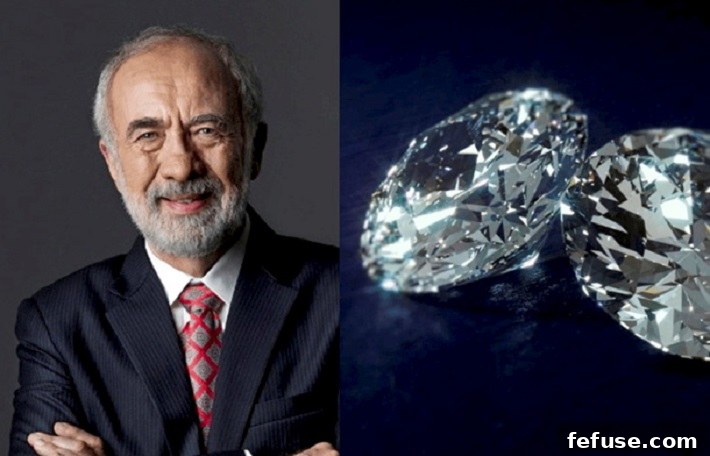
Lusix Faces Creditor Protection Amidst Tumultuous Lab-Grown Diamond Market Downturn
The burgeoning world of lab-grown diamonds, once hailed as a revolutionary force in the jewelry industry, is now experiencing significant turbulence. At the forefront of these challenges is Lusix, the innovative company behind the renowned “Sun Grown Diamonds.” The Israeli-based firm has recently sought court protection from its creditors, a move that underscores the intense pressures currently reshaping the market for cultivated gems.
This development comes as prices for lab-grown diamonds have plummeted, leading many producers to grapple with unsustainable economic models. Lusix’s plea for legal reprieve highlights a broader market correction, signaling a crucial moment for an industry that has seen meteoric growth followed by a sharp reality check.
The Visionary Behind Lusix: Benny Landa’s Legacy
Lusix was founded in 2016 by the illustrious Israeli billionaire Benny Landa, a figure often celebrated as the “father of commercial digital printing.” Landa’s entrepreneurial prowess is well-documented, notably through the sale of his pioneering company, Indigo, to Hewlett-Packard (HP) for an astounding $830 million. His foray into the diamond industry with Lusix was driven by an ambitious vision: to leverage cutting-edge technology to produce high-quality, sustainable lab-grown diamonds, and perhaps more profoundly, to re-establish Israel as a global leader in diamond innovation and production.
Landa’s reputation for disruptive innovation initially brought considerable excitement and investment to Lusix. The company quickly established itself as a significant player, known for its commitment to advanced manufacturing processes and the quality of its Sun Grown Diamonds. However, even a formidable entrepreneur like Landa and his vision have found themselves confronting the unforgiving realities of a rapidly evolving and increasingly competitive market.
Mounting Debts and the Quest for a Lifeline
The current predicament sees Lusix reportedly facing approximately $28 million in debts. In response to this looming financial threat and the spectre of insolvency, the company has formally requested a stay of proceedings from an Israeli court. This legal maneuver is a critical step, granting the company a temporary reprieve from its creditors while it attempts to stabilize its operations and chart a path forward.
According to reports from the business news website Ctech, Lusix has indicated that it requires a six-week period to finalize a crucial merger. This proposed merger is positioned as the essential lifeline, a strategic move designed to secure the company’s long-term future and navigate through its current financial turbulence. The nature of the potential merger partner or the specific terms of the deal remain undisclosed, adding an element of suspense to Lusix’s immediate future.
The necessity for such a drastic measure underscores the severity of the economic headwinds buffeting the lab-grown diamond sector. For a company that once garnered significant investment and industry attention, including a substantial funding round led by a luxury conglomerate, the current situation serves as a stark reminder of the volatile dynamics inherent in innovative, high-growth markets.
The Perfect Storm: A Confluence of Market Forces
In its court submission, Lusix attributes its current challenges to a “perfect storm” of adverse market conditions. Primary among these is a staggering 90 percent drop in lab-grown diamond prices. This dramatic depreciation has eroded profit margins across the industry, catching many producers off guard who had invested heavily in expansion based on earlier, more buoyant market valuations.
Beyond price erosion, Lusix also points to an increasingly crowded marketplace. The initial success and allure of lab-grown diamonds attracted a multitude of new entrants, leading to an oversupply of inventory. This saturation intensified competition, compelling companies to lower prices further to move products, creating a vicious cycle that has proven difficult to break.
Furthermore, the lingering effects of the COVID-19 pandemic have continued to ripple through the global luxury goods sector. While initial lockdowns saw a surge in online jewelry sales, subsequent economic uncertainties, supply chain disruptions, and shifting consumer spending priorities have had a detrimental impact on discretionary purchases, including diamonds. These combined factors have created an exceptionally challenging operating environment for Lusix and many of its industry peers.
Benny Landa’s Enduring Pride and Investment
Despite the current setbacks, Benny Landa, in his capacity as chairman of Lusix, remains remarkably resolute. Speaking to Ctech, Landa articulated his initial vision and unwavering commitment: “Lusix was established to bring the leadership of the diamond sector back to Israel. There is no shame in trying and reaching this situation.” This statement reflects a deep-seated entrepreneurial spirit—one that acknowledges risk and challenge as inherent parts of innovation.
Landa’s personal conviction is not merely rhetorical; he has invested approximately $60 million of his own capital into Lusix, a testament to his belief in the company’s potential and its underlying mission. He further expressed his pride, stating, “I am very proud of the company and hope that it will succeed in embarking on a new path.” This sentiment suggests a belief that Lusix, even in its current struggle, has contributed valuable innovation and that a successful restructuring could lead to a renewed chapter.
His significant personal investment was augmented in 2022 when the luxury conglomerate LVMH led a substantial $90 million funding round for Lusix. This high-profile investment from a titan of the luxury world was initially seen as a powerful validation of Lusix’s technology and the broader appeal of lab-grown diamonds. However, even with such substantial backing, the unpredictable market forces have proven formidable, underscoring the volatility inherent in even the most promising ventures.
Operational Shutdown and Its Human Impact
The severity of Lusix’s financial situation has necessitated drastic operational measures. The company has temporarily closed its factory in Modi’in, a city situated in central Israel. This closure has had an immediate and profound human impact, as 60 of the factory’s 90 staff members have been placed on unpaid leave. This move, while perhaps unavoidable for the company’s survival, highlights the personal cost of market downturns and corporate restructuring.
The temporary cessation of production and the furloughing of a significant portion of its workforce reflect the immediate need for cost-cutting and a strategic recalibration. For the affected employees, it represents a period of uncertainty and hardship, waiting to see if Lusix can successfully navigate its current challenges and resume full operations.
The Broader Implications for the Lab-Grown Diamond Industry
Lusix’s struggles are not an isolated incident but rather a significant indicator of the broader challenges facing the lab-grown diamond industry. The dramatic price drops and market saturation have forced many companies to re-evaluate their business models, production capacities, and marketing strategies. This period of turmoil could lead to a significant consolidation within the industry, with smaller or less efficient producers either exiting the market or being acquired by larger, more resilient players.
The initial narrative surrounding lab-grown diamonds focused heavily on their ethical sourcing, environmental advantages over mined diamonds, and their more accessible price point. While these attributes still hold appeal for a segment of consumers, the rapid influx of supply has commoditized the product faster than anticipated. The challenge now for the industry is to re-establish value beyond just price, perhaps focusing more intensely on craftsmanship, unique designs, and specific consumer experiences.
Looking ahead, innovation will be key. Companies that can differentiate their products, streamline their production processes, and build stronger brand identities may be better positioned to weather the current storm. The industry might also see a shift towards more specialized products or applications, moving beyond solely bridal jewelry into fashion, industrial uses, or advanced technological applications where the specific properties of lab-grown diamonds offer distinct advantages.
The current crisis serves as a critical stress test for the entire lab-grown diamond sector. While the future remains uncertain for Lusix, its journey reflects the dynamic and often unpredictable nature of disruptive industries. The coming months will be pivotal, not only for Lusix’s fate but also for shaping the trajectory and long-term viability of lab-grown diamonds in the global jewelry market.