
Kimberley Process Plenary 2019: India Unites Global Efforts for Conflict-Free Diamonds and Sustainable Practices
The year 2019 marked a significant moment for the global diamond industry as New Delhi, India, proudly hosted the Plenary Meeting of the Kimberley Process (KP). This pivotal gathering brought together a diverse array of dignitaries, experts, and stakeholders from India and around the world, all committed to upholding the integrity and ethical standards of the diamond trade. The inaugural ceremony, a testament to the event’s global importance, set the stage for crucial discussions aimed at reinforcing the Kimberley Process Certification Scheme (KPCS) and addressing emerging challenges in the sector.
A Gathering of Global Leaders and Stakeholders
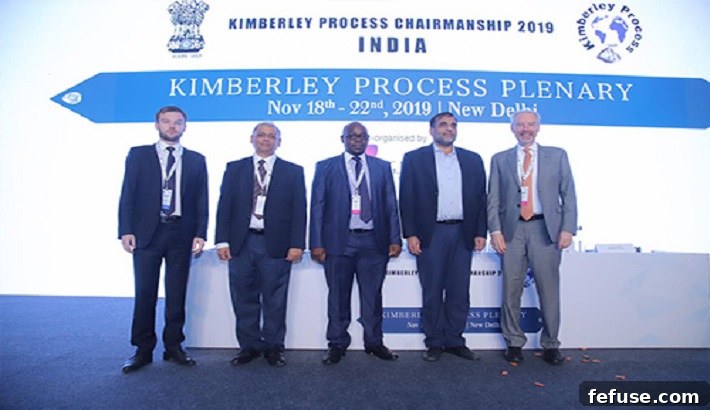
The inaugural session of the KP Plenary was graced by the presence of distinguished personalities, underscoring the collaborative spirit vital to the Process’s success. Leading the proceedings were Mr. B.B. Swain, serving as the KP Chair, and Mr. Alexander Alexeevich Pshenichnikov, the KP Vice-Chair. They were joined by Dr. Anup Wadhawan, the esteemed Commerce Secretary to the Government of India, Mr. Stephane Fischler, President of the World Diamond Council, and Mr. Shamiso Mtisi, Coordinator of the Civil Society Coalition. This esteemed panel represented the tripartite nature of the Kimberley Process – governments, industry, and civil society – working in concert towards a common goal: a conflict-free diamond supply chain.
India’s Unwavering Commitment to the Kimberley Process
As the host nation, India’s commitment to the Kimberley Process was a central theme throughout the Plenary. KP Chair B.B. Swain articulated India’s steadfast dedication, emphasizing the nation’s proactive role in identifying and confronting the industry’s most pressing challenges. “India has always been at the forefront of identifying challenges faced by the industry and will continue to support KP’s efforts in terms of capacity building, providing technical assistance and education and in moving forward,” he declared. This statement highlighted India’s historical engagement and its forward-looking vision for the KP. The Chair further underscored India’s sensitivity to critical issues as the current review cycle neared its conclusion. These issues included the imperative to expand the scope of the KP, the complex challenges faced by artisanal miners, and vital decisions concerning the establishment of a Permanent Secretariat, the Multi-Donor Fund, and the enhancement of the peer review mechanism. These institutional pillars are essential for strengthening the KP’s operational capacity and ensuring its long-term effectiveness.
Dr. Wadhawan’s Vision: Strengthening Administration and Empathy
The Plenary meeting was formally inaugurated by Dr. Anup Wadhawan, India’s Commerce Secretary. In his address, Dr. Wadhawan proudly highlighted India’s foundational role in the Kimberley Process, emphasizing its significant contribution to establishing a robust protocol for diamond trade. He noted the KP’s remarkable achievement: ensuring that an astounding 99.8% of the world’s diamonds are conflict-free. This statistic stands as a powerful testament to the KP’s success in fulfilling its core mandate since its inception in 2003.
However, Dr. Wadhawan also stressed the continuous need to maintain the KP’s efficiency and effectiveness to preserve this conflict-free status. He outlined India’s vision for a stronger Kimberley Process, advocating for enhanced administration and implementation, greater efficiency in delivering on its promises, increased transparency, and crucially, a more empathetic approach towards the livelihoods of communities dependent on diamond production, trade, and manufacturing. This emphasis on human welfare underscores a broadened understanding of responsible sourcing, extending beyond conflict prevention to encompass socio-economic well-being.
Beyond the traditional scope, the Commerce Secretary brought to the forefront an increasingly pertinent issue: the differentiation between natural diamonds and lab-grown diamonds. He affirmed India’s leadership in addressing this challenge, pledging further initiatives to ensure clear distinctions and promote responsible business practices within this evolving segment of the industry. Maintaining consumer trust requires clear and accurate labeling, which is vital for the integrity of both natural and lab-grown diamond markets.
Dr. Wadhawan also reinforced India’s unwavering advocacy for a consensus-based decision-making process within the KP. This approach, he asserted, is fundamental to ensuring that every voice, including that of the most vulnerable stakeholders, is heard and considered in policy formulation. Such inclusivity is a hallmark of effective global governance.
Furthermore, recognizing the profound socio-economic impact of artisanal and small-scale mining (ASM), Dr. Wadhawan expressed India’s sensitivity to the challenges faced by these communities. He acknowledged the invaluable contributions of KP members, observers, and agencies dedicated to their upliftment. The Commerce Secretary reiterated the necessity of continued support for ASM countries through capacity building, technical assistance, and education. This support should focus on critical areas such as accurate valuation of diamonds, clear differentiation between natural and lab-grown diamonds, and promoting adherence to legal and formal mining practices. Empowering these miners through knowledge and resources is key to fostering sustainable and ethical practices at the grassroots level.
Industry and Civil Society Perspectives: Shaping the Future of Ethical Diamonds
The Plenary also served as a crucial platform for key voices from the industry and civil society. Mr. Stephane Fischler, President of the World Diamond Council (WDC), delivered a powerful address, highlighting the gravity of the decisions before the KP members. “After three years of countless meetings, we have arrived in New Delhi. I believe the future of KP will be decided by you KP members this week. Lives will be impacted by your decisions, especially in artisanal mining areas,” Fischler emphasized. His words served as a stark reminder of the human element at the heart of the diamond trade, particularly for the millions whose livelihoods depend on it.
Fischler warned that conflicts not only inflict human suffering but also severely damage the reputation of diamonds. He asserted the collective responsibility to establish clear benchmarks against which the industry’s ethical performance would be judged. A critical component of strengthening the KPCS, he stressed, was securing adequate funding for the Permanent Secretariat (PS) and the Multi-Donor Trust Fund (MDTF). These financial mechanisms are indispensable for the KP’s operational robustness and its ability to expand its mandate effectively.
He also cautioned that “the outside world would characterize this Plenary as a failure, if there is no progress on the KP definition” of conflict diamonds. While acknowledging that “KP is not a sanctions imposing body,” Fischler underscored the collective interest in ensuring that “all diamonds meet international market standards.” This implies a broader expectation of ethical sourcing that extends beyond the strict definition of conflict diamonds. He concluded with a resolute call for a long-term commitment to “protect our weakest stakeholders,” reinforcing the WDC’s dedication to social responsibility.
Echoing the sentiments on the need for evolution, Mr. Shamiso Mtisi, Coordinator of the Civil Society Coalition, reiterated the critical importance of broadening the scope of the KP. Civil society organizations have consistently advocated for an expanded definition of ‘conflict diamonds’ to include a wider range of abuses, such as human rights violations and environmental damage, that can occur within the diamond supply chain. “We need to reach a conclusion on all reform areas. Failure to stop diamonds from funding conflict is a failure of the KP,” Mtisi declared, emphasizing the urgency of these reforms to maintain the KP’s relevance and effectiveness in a changing global landscape.
The Plenary’s Agenda: Charting a Course for the Future
The 2019 KP Plenary was attended by over 55 delegates representing the 82 countries that constitute the Kimberley Process. Over several intensive days, participants engaged in a series of meetings involving various working groups and committees of the KP. These groups delve into specific aspects of the KPCS, including monitoring, statistics, rules of procedure, and technical issues, all vital for the scheme’s ongoing implementation and refinement.
Beyond the formal committee meetings, three special forums were organized, reflecting the evolving priorities and complexities of the diamond industry:
- Financial inclusion and women empowerment through sustainable livelihood creation: This forum addressed the critical role of the diamond sector in economic development, particularly focusing on how to empower women and integrate marginalized communities into formal financial systems, thereby creating more resilient and sustainable livelihoods. This goes to the heart of ethical sourcing and responsible business practices.
- Diamond industry – Adapting to change: This session explored the myriad transformations impacting the diamond industry, from shifting consumer preferences and the rise of e-commerce to technological advancements in traceability and the increasing importance of sustainability. The discussion aimed at fostering resilience and innovation within the sector.
- Diamond origin and identification: As the market becomes more complex with the advent of lab-grown diamonds and the growing demand for transparent sourcing, this forum tackled the challenges and solutions related to accurately identifying a diamond’s origin and ensuring its provenance. This topic is directly linked to consumer confidence and the integrity of the supply chain.
Kimberley Process: A Legacy of Peace, A Future of Responsibility
Since its inception in 2003, the Kimberley Process has been instrumental in reducing the trade in conflict diamonds, thereby contributing significantly to peace, security, and prosperity in many diamond-producing regions. Its success lies in the collective commitment of its members, observers, and stakeholders.
India, as one of the founding members, remains deeply committed to fostering unity within the “KP family” and advancing its crucial mandate. This commitment is underpinned by an inclusive, deliberative, and consensus-based decision-making approach, ensuring that the Kimberley Process continues to adapt, evolve, and remain relevant in a dynamic global environment. The 2019 Plenary in New Delhi was not just a meeting; it was a reaffirmation of global dedication to an ethical and responsible diamond trade, paving the way for a future where diamonds continue to symbolize beauty, love, and hope, untainted by conflict.
Image Caption: At the Inaugural Session of the KP Plenary 2019 in New Delhi (from left) Mr. Alexander Alexeevich Pshenichnikov, KP Vice-Chair; Mr. B.B. Swain, KP Chair; Mr. Shamiso Mtisi, Coordinator of Civil Society Coalition; Dr. Anup Wadhawan, Commerce Secretary, Government of India; and Mr. Stephane Fischler, President, World Diamond Council.
News Source: gjepc