
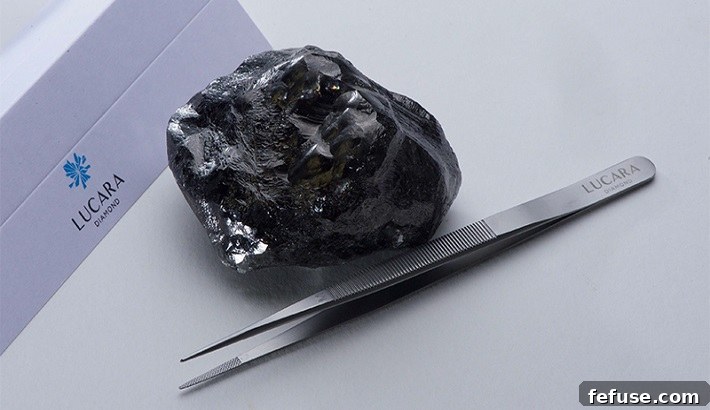
Lucara Diamond Unearths Colossal 1,758-Carat Diamond at Karowe Mine, Reshaping the Future of Gemstone Recovery
Letlhakane, Botswana – The world of high-value gemstones was set abuzz last Thursday when Lucara Diamond Corp., a leading diamond producer, announced the monumental recovery of an astonishing 1,758-carat rough diamond. This colossal stone was unearthed at its renowned Karowe Mine, a site already celebrated for yielding some of the most extraordinary diamonds in recent history, including the legendary 1,109-carat Lesedi La Rona. This latest find not only reaffirms Karowe’s unparalleled geological richness but also underscores the transformative impact of advanced mining technologies on the diamond industry.
Discovered serendipitously over the Easter weekend, the massive diamond is currently undergoing meticulous analysis to fully ascertain its characteristics and potential value. Lucara has initially described the stone as “near-gem of variable quality.” This intriguing classification suggests that while the diamond possesses attributes typical of industrial-grade material, it also contains significant sections that exhibit the clarity, color, and structure indicative of gem-quality material. Such a “variable quality” designation means that expert cutters and polishers will need to carefully plan the stone’s dissection to maximize the yield of precious, potentially gem-quality components, making this discovery a complex yet incredibly exciting prospect for the industry.
The 1,758-carat diamond instantly secures its place among the largest rough diamonds ever recovered globally, marking a pivotal moment in modern diamond mining. Remarkably, this is the second diamond exceeding 1,000 carats to be unearthed from the Karowe Mine since 2015, an achievement that solidifies the mine’s reputation as an exceptional source of gargantuan stones. This consistent recovery of such monumental diamonds at Karowe challenges conventional geological expectations and highlights the unique characteristics of this particular kimberlite pipe.
A Legacy of Giants: Karowe’s Unparalleled Yield
The Karowe Mine, located in the diamond-rich nation of Botswana, has established itself as a true marvel in the diamond mining landscape. Its consistent ability to produce diamonds of exceptional size and quality sets it apart from nearly every other diamond deposit in the world. Since Lucara acquired the mine, it has become synonymous with record-breaking finds, attracting global attention and significantly impacting the high-end diamond market. The discovery of the 1,758-carat stone further cements Karowe’s status, proving that its potential is far from exhausted and that the earth beneath Botswana continues to hold magnificent secrets.
This latest recovery follows the sensational discovery of the 1,109-carat Lesedi La Rona in late 2015. The Lesedi La Rona, meaning “Our Light” in Setswana, was the second-largest gem-quality rough diamond ever found at the time, surpassed only by the legendary Cullinan. Its eventual sale for a staggering $53 million underscored the immense value placed on such rare and magnificent stones. The successive recovery of another thousand-carat-plus diamond within such a short timeframe from the same mine is unprecedented in recent history, suggesting a uniquely rich geological environment that continues to surprise and delight the diamond world.
Giants of the Earth: A Historical Perspective on Diamond Discoveries
To fully appreciate the significance of Lucara’s latest find, it’s essential to place it within the broader historical context of diamond discoveries. The largest known gem-quality diamond ever unearthed remains the magnificent Cullinan, which weighed an astounding 3,106.75 carats in its rough state. Found in South Africa in 1905, the Cullinan was famously cut into several exquisite polished stones, the most prominent being the Great Star of Africa and the Lesser Star of Africa, both of which now adorn the British Crown Jewels. The Cullinan set a benchmark for diamond size and purity that has rarely been approached since.
While the Cullinan holds the record for gem-quality diamonds, an even larger stone, though not gem-quality, was discovered decades prior. The 3,167-carat carbonado diamond, famously dubbed the “Carbonado do Sergio,” was unearthed in Brazil in 1895. Carbonado diamonds represent a unique and enigmatic category of industrial-quality stones. Characterized by their opaque, porous, and often dark appearance, these diamonds are distinct from conventional gem diamonds in both composition and origin. Stephen E. Haggerty, a research professor at Florida International University in Miami, highlighted in the summer 2017 issue of GIA’s Gems & Gemology that Carbonado diamonds are believed to be found exclusively in two regions globally: Brazil and the Central African Republic. Their unique properties and suspected extraterrestrial origins make them subjects of intense scientific interest, despite their lack of gemological appeal. The distinction between gem-quality and industrial diamonds is crucial, as it fundamentally impacts their market value and intended use, with gem diamonds commanding significantly higher prices due to their rarity, beauty, and application in jewelry.
Revolutionizing Recovery: The Power of XRT Technology
The successful recovery of such an enormous and potentially valuable stone like the 1,758-carat diamond is not merely a stroke of luck; it is a testament to significant technological advancements in diamond mining. Lucara achieved this remarkable feat using state-of-the-art XRT (X-ray transmission) technology developed by Tomra Sorting Solutions. Tomra, a global leader in sensor-based sorting equipment, designs and manufactures innovative machinery for a diverse range of industries, including mining, food processing, and recycling. Their XRT technology has proven to be a game-changer in diamond recovery, fundamentally altering how large and precious stones are extracted from kimberlite ore.
At its core, Tomra’s XRT system employs advanced sensor-based bulk sorting techniques. This technology works by exposing the ore material to X-rays, which penetrate the material and allow the system to detect variations in atomic density. Diamonds, being composed of pure carbon, possess a specific density that makes them distinguishable from the surrounding host rock. What makes XRT particularly revolutionary is its ability to identify and separate diamonds even when they present challenges that would render older technologies ineffective. This includes detecting diamonds that are coated with other minerals, those with low luminescence (a characteristic that traditional optical sorting relies upon), or even Type II diamonds, which have a very low nitrogen content and can be difficult to differentiate using other methods. The precision and reliability of XRT technology have enabled Lucara to minimize damage to large stones during the recovery process, a crucial factor when dealing with multi-million dollar assets.
From Oversight to Opportunity: The Evolution of Diamond Mining
The advent and adoption of technologies like XRT stand in stark contrast to historical diamond mining practices. As Gemological Institute of America Senior Analyst Russ Shor highlighted in a 2016 research article, many large rough diamonds were regrettably crushed during recovery in the past. This destructive outcome was largely due to the technological limitations of the era. De Beers, which dominated diamond mining for much of the 20th century, simply lacked the sophisticated equipment to reliably detect large diamonds within the vast quantities of excavated ore.
More surprisingly, Shor noted that De Beers, to an extent, “did not care” about the loss of these colossal stones. In those days, the economic priorities of diamond mining revolved around volume and efficiency. The primary driver of profitability was speed, with miners focusing on processing vast quantities of kimberlite. The per-carat price differential between large diamonds (those exceeding 10 carats) and smaller stones was not significant enough to justify the substantial investment required to retool processing plants or adopt slower, more careful recovery methods. Essentially, the cost-benefit analysis did not favor preserving giant diamonds when the focus was on extracting as many marketable stones as possible through high-throughput operations. This historical context underscores how dramatically market dynamics and technological capabilities have reshaped the industry’s approach to recovering exceptional diamonds.
Ironically, De Beers itself played an early, albeit indirect, role in the Karowe Mine’s history. The company was responsible for the initial discovery of the kimberlite pipe at Karowe back in 1969. However, despite its discovery, De Beers never commercially mined the deposit, presumably due to the prevailing economic and technological considerations of the time. It eventually divested its final stake in the site, selling it to Lucara Diamond Corp. in 2010. This acquisition proved to be a masterstroke for Lucara, as it subsequently unleashed Karowe’s hidden potential for yielding record-breaking diamonds, validating the strategic foresight of investing in both promising deposits and cutting-edge recovery technology.
Today, the landscape is entirely different. Large, exceptional diamonds fetch astronomical sums on the global market, commanding prices that can reach tens or even hundreds of millions of dollars. This exponential increase in value has fundamentally altered the economic calculus for miners. Consequently, companies are now actively investing substantial time and capital into developing and implementing advanced technologies, such as Tomra’s XRT, specifically designed to protect and safely recover these precious giants. The shift reflects a recognition that a single, spectacular find can significantly impact a company’s revenue and market standing, making careful recovery a top priority rather than an afterthought.
Karowe’s Unparalleled Potential: A Geological Anomaly
Lucara Diamond Corp. remains highly optimistic about the future prospects of the Karowe Mine, anticipating the continued discovery of large, high-quality diamonds. This confidence is rooted in the unique geological characteristics of the Karowe deposit, which sets it apart from the vast majority of other diamond mines worldwide. As Lucara has noted, “Each deposit has a characteristic size distribution of diamonds.” Most diamond mines exhibit “fine” distributions, meaning they host very few large or coarse diamonds, regardless of the overall grade or richness of the kimberlite.
The Karowe Mine, however, is a notable exception to this rule. It possesses a remarkably “coarse distribution” of large diamonds, a phenomenon that is exceedingly rare. Lucara’s geological assessments indicate that Karowe’s distribution of large diamonds is up to five times greater than the world average. This statistical anomaly implies that the geological processes that formed the Karowe kimberlite pipe were uniquely favorable for the creation and preservation of exceptionally large diamond crystals. Such a coarse distribution means that the probability of encountering colossal stones like the 1,758-carat diamond or the Lesedi La Rona is significantly higher at Karowe than almost anywhere else on Earth.
The strategic implementation of XRT technology at Karowe in 2015 has dramatically amplified the mine’s ability to capitalize on this unique geological advantage. Since its adoption, Lucara has reported an astounding success rate, recovering a total of 12 diamonds weighing 300 carats or more. Half of these dozen extraordinary diamonds have been confirmed as gem-quality, collectively yielding more than $158 million in sales revenue. This impressive track record includes the 1,109-carat Lesedi La Rona, a true highlight of the mine’s output in the fall of 2015. The consistent discovery of such high-value, large diamonds not only secures Lucara’s financial stability but also reinforces Botswana’s reputation as a premier source of precious stones.
The Future of Diamond Discovery and Valuation
The discovery of the 1,758-carat rough diamond by Lucara Diamond Corp. at its Karowe Mine is more than just another record-breaking find; it is a profound testament to the evolving dynamics of the diamond industry. It highlights the critical interplay between geological fortune, technological innovation, and a keen understanding of market demands. As older mining sites deplete and new deposits become harder to find, the ability to maximize the recovery of existing resources, particularly high-value large stones, becomes paramount.
This latest gem from Botswana not only adds to the country’s rich legacy in diamond production but also signals a promising future for Lucara. It reinforces the company’s position at the forefront of the industry, demonstrating that strategic investments in advanced sorting technologies like XRT can unlock immense value from unique geological formations. As the world continues its fascination with the rarity and beauty of diamonds, especially those of extraordinary size, Karowe Mine stands as a beacon of potential, promising further marvels yet to be unearthed and continuing to redefine the benchmarks for diamond discovery in the 21st century. The anticipation for how this “near-gem of variable quality” will ultimately be transformed and valued will undoubtedly keep industry experts and enthusiasts alike captivated for months to come.