
Indian Jewelers Shine: Unpacking Deloitte’s Global Powers of Luxury Goods 2017 Report
The esteemed “Global Powers of Luxury Goods 2017” report by Deloitte has once again spotlighted the leading companies shaping the international luxury landscape. In a significant win for the Indian luxury sector, three prominent Indian jewelry companies secured coveted spots within the Top 100 global listing. This consistent presence underscores India’s growing influence and formidable capabilities in the high-end jewelry market.
The report, a comprehensive analysis of the luxury industry, meticulously ranks the largest luxury goods companies worldwide based on their consolidated sales data. For fiscal year 2015 (defined as financial years ending within the 12 months to June 30, 2016), Deloitte’s findings illuminate crucial trends and economic outlooks that continue to shape this dynamic sector.
Indian Companies Make a Mark: Gitanjali, Titan, and PC Jewellers in Top 100
The performance of Indian jewelry houses in Deloitte’s 2017 report is particularly noteworthy. Gitanjali, a name synonymous with fine jewelry, demonstrated a remarkable ascent, climbing to No. 30 from its previous position at No. 40. This significant leap reflects its expanding global footprint and robust sales performance during the analyzed period.
Titan Company Ltd, a diversified conglomerate with a strong presence in watches and jewelry through its Tanishq brand, also reinforced its standing, moving up to No. 31 from No. 32. This incremental improvement highlights Titan’s consistent growth and its strategic efforts to capture a larger share of the luxury market.
P.C. Jewellers, another prominent Indian player, maintained its strong position at No. 44 for the second consecutive year. Its stable ranking in such a competitive global arena speaks volumes about its enduring brand strength, customer loyalty, and effective business strategies. The continued inclusion and improved rankings of these Indian entities are a testament to the quality, craftsmanship, and increasing global appeal of Indian jewelry.
Deloitte’s Global Powers of Luxury Goods: An Overview
The “Global Powers of Luxury Goods” report is an annual benchmark for the luxury industry, offering invaluable insights into market dynamics, financial performance, and strategic directions of the world’s largest luxury companies. By analyzing publicly available data, Deloitte provides a clear picture of who the key players are and what trends are influencing their success.
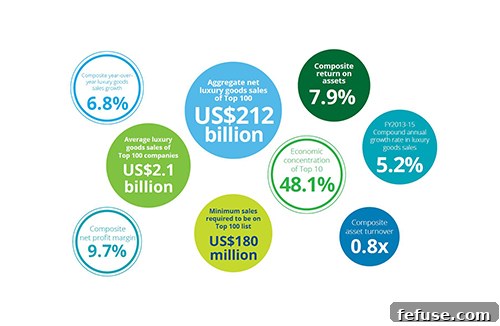
According to the 2017 edition, the Top 100 largest luxury goods companies collectively generated an impressive US$ 212 billion in sales revenue during FY 2015. This substantial figure underscores the vast economic power concentrated within this elite group. On average, each of these top-tier companies commanded approximately US$ 2.1 billion in annual luxury goods sales, illustrating the sheer scale required to be considered a global powerhouse in this sector.
Beyond the rankings, the report delves into macro-economic factors and consumer behaviors that are shaping the luxury market’s evolution. It serves as a vital resource for industry stakeholders looking to understand the forces at play and anticipate future shifts.
Key Trends Shaping the Global Luxury Market
The Deloitte report identified several critical trends that were driving the global luxury market in 2017, many of which continue to resonate today. Understanding these trends is crucial for any brand aiming to thrive in this high-stakes environment.
Emerging Markets: The New Growth Engines
One of the most significant findings highlighted the crucial role of emerging markets in fueling luxury market growth. Deloitte’s analysis revealed that consumers in regions categorized as “emerging luxury markets” – specifically China, Russia, and the United Arab Emirates – exhibited a substantially higher propensity to increase their luxury spending. A remarkable 70 percent of consumers in these markets reported an increase in their spending over the preceding five years.
This contrasts sharply with more mature markets like the EU, US, and Japan, where 53 percent of consumers reported increased spending. This disparity underscores the shifting geographical focus of luxury brands, as rising disposable incomes, a burgeoning middle class, and a strong aspirational culture in emerging economies drive unprecedented demand for high-end products and experiences. Brands looking for sustained growth recognize the imperative of deeply understanding and catering to these dynamic consumer bases.
Global Leaders Maintain Their Stance
Despite the volatile nature of global markets, the report confirmed the enduring dominance of the luxury industry’s titans. The top four companies – LVMH Moet Hennessy-Louis Vuitton, Compagnie Financiere Richemont, The Estee Lauder Companies Inc., and Luxottica Group SpA – successfully maintained their leading positions. Their consistent performance is often attributed to diversified portfolios spanning multiple luxury categories, strong brand equity, extensive global distribution networks, and a relentless focus on innovation and consumer engagement.
Geographical Insights: Italy’s Prowess and France’s Sales Might
The report also offered interesting geographical insights. Italy continued to emerge as the “leading luxury goods country” in terms of the sheer number of companies represented in the Top 100. This speaks to Italy’s rich heritage in design, craftsmanship, and manufacturing across various luxury sectors, from fashion and leather goods to jewelry and automotive. However, when it came to overall sales share, France took the lead. This highlights the powerful global reach and unparalleled brand value of French luxury conglomerates, often driven by iconic fashion houses and robust strategic management.
Multi-Sector Diversification Fuels Growth and Profitability
Another compelling insight from the report concerned companies with a diversified presence across multiple luxury goods sectors. These conglomerates demonstrated nearly double the sales growth compared to the previous year, significantly outperforming their single-sector counterparts. Furthermore, they also led in terms of profitability. This trend suggests that a multi-pronged approach, allowing companies to tap into diverse consumer preferences and mitigate risks across different segments, is a highly effective strategy for sustained success in the luxury market.
Within specific product categories, bags and accessories continued to be identified as the fastest-growing sector. This segment benefits from its accessibility as an entry point into luxury for many consumers, its strong fashion appeal, and its potential for high margins and rapid trend cycles.
The Digital Transformation of Luxury: A Glimpse into the Future
Perhaps one of the most forward-looking insights from Deloitte’s 2017 report was the unequivocal recognition of the digital imperative within the luxury sector. The report clearly stated, “Consumers are clear that they see the future of luxury as digital.” This sentiment was powerfully reinforced by survey data, revealing that over 37% of respondents believed luxury products and technology would become more closely linked.
This finding signaled a pivotal shift in consumer expectations and purchasing behaviors. It underscored the growing demand for seamless online experiences, personalized digital interactions, and the integration of technology into luxury products themselves. For brands, this translates into a critical need to invest heavily in their digital presence, e-commerce platforms, and data analytics capabilities. The report explicitly highlighted that “Digital channels are creating a need for large-scale, high-quality personalized content.” This means generic marketing will no longer suffice; luxury brands must craft bespoke narratives and experiences tailored to individual consumer preferences across various digital touchpoints, from social media to immersive virtual environments. Embracing digital transformation is no longer optional but a fundamental requirement for maintaining relevance and capturing the hearts of the modern luxury consumer.
Implications for the Future of Luxury
The findings of Deloitte’s “Global Powers of Luxury Goods 2017” report painted a clear picture of an industry in transition, driven by evolving consumer demographics and technological advancements. For Indian jewelers like Gitanjali, Titan, and P.C. Jewellers, their impressive rankings validate their strategies and highlight the global potential of Indian craftsmanship and design. Their continued success will depend on adapting to these overarching trends, particularly the increasing influence of digital engagement and the sustained growth coming from emerging markets.
The luxury market’s future hinges on a brand’s ability to balance heritage with innovation, exclusivity with accessibility through digital channels, and global reach with localized relevance. Companies that can effectively navigate these complexities, offering authentic experiences and personalized content, are best positioned to thrive in an ever-more competitive and interconnected luxury landscape.
The insights from Deloitte’s report serve as a powerful reminder that while the allure of luxury remains timeless, the pathways to reaching and captivating consumers are constantly evolving. Brands that embrace change, understand their audience, and leverage technology will undoubtedly continue to shine on the global stage.