
The Piprahwa Gems: Unearthing the Sacred Relics of the Historical Buddha for Auction at Sotheby’s
On May 7, Sotheby’s Hong Kong is set to host a truly monumental event, marking a significant moment in the annals of Buddhist heritage and antiquities. For the first time ever, a collection of sacred relics known as the Piprahwa Gems of the Historical Buddha, attributed directly to Shakyamuni Buddha himself, will be offered for public auction. Unearthed over a century ago in what is modern-day Uttar Pradesh, India, these extraordinary artifacts represent an unparalleled opportunity to connect with the very foundations of Buddhist faith and history. This unprecedented offering not only presents a rare glimpse into the spiritual and material world of ancient India but also provides an intimate encounter with the profound legacy of the Buddha, making it an event of global cultural and religious importance.
A Discovery of Profound Historical Significance: The Piprahwa Stupa Excavation
The remarkable journey of these relics began in 1898, during an archaeological excavation led by William Claxton Peppé. Peppé, a British engineer and estate manager with a keen interest in history, was supervising work at the Piprahwa stupa. This site has long been revered and is widely believed by scholars and devotees alike to be the ancient city of Kapilavastu, the very childhood home of Siddhartha Gautama, who would later become Shakyamuni Buddha. The discovery at Piprahwa was nothing short of miraculous, providing tangible evidence for a figure often shrouded in myth and legend.
Deep within the ancient mound, Peppé’s team uncovered a meticulously carved sandstone coffer, a testament to the reverence and care bestowed upon its contents millennia ago. Inside this protective casing, five reliquaries of various materials lay carefully preserved. One of these reliquaries, crafted from exquisite rock crystal and featuring a distinctive fish-shaped handle, immediately stood out for its artistry and unique design. The anticipation surrounding these containers was immense, and upon opening them, Peppé and his team were met with an astonishing trove: nearly 1,800 gemstones, delicate gold sheets, sacred ash, minute bone fragments, and an array of intricately designed ornaments, all meticulously interred. This collection offered irrefutable proof of a sophisticated culture and a profound spiritual practice dedicated to preserving the memory of its most revered figure.
The Unmistakable Epigraphic Evidence and Authentication
What elevated the Piprahwa finds from a significant archaeological discovery to an unparalleled historical and spiritual revelation was a critical inscription found on one of the reliquaries. Written in late Mauryan Brahmi script, this ancient text presented a direct link to the Buddha himself. Later meticulously interpreted by esteemed scholars Vincent Smith and Harry Falk, the inscription unequivocally identified the remains as belonging to members of the Shakya clan, the noble lineage from which the Buddha himself hailed. This epigraphic evidence, bolstered by corroborating details found in early Buddhist scriptures such as the Mahāparinibbāna-sutta, firmly established Piprahwa as the sole verified archaeological site containing authenticated relics of the Historical Buddha. Unlike other sites where relics are believed to be the Buddha’s, Piprahwa holds the distinction of having direct textual confirmation, lending an unparalleled authority to its finds. This level of authentication makes the Piprahwa Relics not just archaeological treasures, but sacred objects of immense religious importance.
The Journey of Sacred Relics: Dissemination and Preservation
Following their momentous discovery, the Piprahwa Relics began a new chapter in their long history. In a gesture of profound spiritual diplomacy, portions of these revered artifacts were gifted to King Rama V of Siam (now Thailand) shortly after their unearthing. These precious relics were subsequently enshrined in major Buddhist centers across Southeast Asia, including Thailand, Myanmar, and Sri Lanka, where they continue to be venerated by millions of devotees. This distribution underscored the pan-Asian significance of the Buddha’s teachings and the shared spiritual heritage of the region. The bulk of the remaining gemstones, alongside other excavated artifacts, found their permanent home in the prestigious Indian Museum in Kolkata, where they remain preserved as national treasures, accessible to researchers and the public alike.
However, a select and significant portion – approximately 20% of the original find – remained in the possession of the Peppé family. For over a century, these specific relics have been held privately, their profound significance known to a select few. Now, through Sotheby’s, this carefully preserved segment is making its highly anticipated public debut, offering a once-in-a-lifetime opportunity for collectors, institutions, and devotees to acquire a tangible link to the Historical Buddha. The release of this private collection opens a new window into the world of Buddhist art and spirituality, bringing these hidden gems into the global spotlight.
An Unparalleled Collection: Gemstones and Deep Buddhist Symbolism
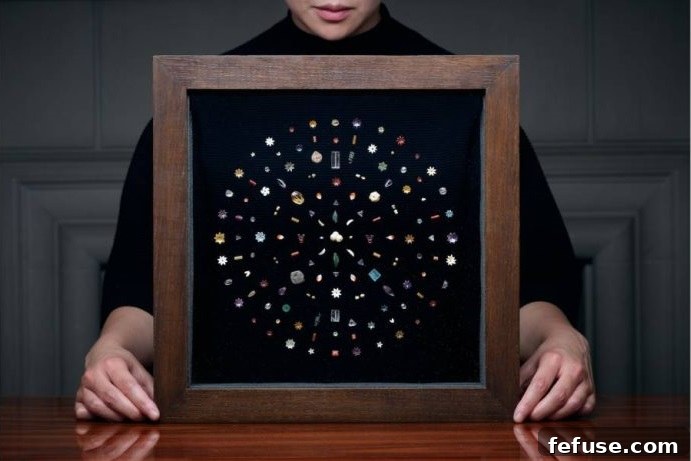
The collection set to be auctioned is remarkable not only for its spiritual gravitas but also for its sheer material richness and artistic sophistication. It comprises an exquisite array of precious and semi-precious gemstones, including luminous amethysts, fiery garnets, iridescent pearls, deep blue sapphires, vibrant coral, and intricate gold adornments. Many of these stones were expertly fashioned by ancient artisans into beads, elegant pendants, and delicate floral motifs, reflecting the aesthetic sensibilities of the Mauryan period. The craftsmanship speaks volumes about the advanced artistic skills prevalent during the time of their creation.
Among the standout pieces are garnet pendants meticulously shaped as tri-ratna symbols. These iconic symbols represent the Three Jewels of Buddhism: the Buddha (the enlightened one), the Dharma (his teachings), and the Sangha (the community of practitioners). Owning such an artifact is to possess a direct representation of the core tenets of the Buddhist faith. Other captivating items depict regal lions, a powerful symbol of the Buddha’s roar of truth and his royal lineage, and auspicious footprints, which served as an aniconic representation of the Buddha before anthropomorphic images became common. Intriguingly, the collection also features what may be one of the earliest known representations of the swastika in Buddhist iconography – a symbol of peace, prosperity, and the revolving cycle of existence, entirely distinct from its later misappropriation. Each piece is not merely an ornament but a narrative, telling a story of faith, philosophy, and ancient artistry.
Imperial Patronage and Unrivaled Artistry
Experts have consistently noted the unrivaled scale, diversity, and artistic sophistication of the Piprahwa finds, which demonstrably surpass comparable relic collections unearthed from other revered Buddhist sites across India, such as Sanchi, Taxila, and Bodh Gaya. While these other sites yield invaluable insights, the sheer volume and intricate design work of the Piprahwa relics suggest a level of investment and artistry that points to imperial sponsorship. This elevated craftsmanship and the precious nature of the materials strongly indicate patronage from a powerful entity – quite possibly Emperor Ashoka the Great himself, during his monumental 3rd century BCE restoration and veneration of Buddhist sites. Emperor Ashoka, a fervent patron of Buddhism, embarked on an ambitious program of constructing stupas and redistributing the Buddha’s relics throughout his vast Mauryan Empire, aiming to spread the Dharma far and wide. The Piprahwa relics, with their exquisite detailing and costly materials, align perfectly with the grandeur and devotion characteristic of Ashoka’s imperial projects, underscoring their profound historical and cultural context.
Sotheby’s Hong Kong: An Unprecedented Opportunity
More than just historical curiosities or valuable antiques, these Piprahwa Relics are profoundly venerated symbols of devotion and living embodiments of the Buddhist faith. For millions globally, relics serve as direct conduits to the spiritual essence of the Buddha, offering inspiration and a focal point for meditation. As an ancient Buddhist maxim eloquently states, “To see the relics is to see the Buddha.” This profound sentiment highlights the deep spiritual connection that these objects foster.
Sotheby’s upcoming auction in Hong Kong therefore offers an unprecedented, perhaps once-in-a-millennium, chance to encounter and, for a fortunate few, to acquire a genuine fragment of sacred history. This event transcends typical art auctions; it is an offering of a piece of global spiritual heritage, a tangible link to one of humanity’s most influential spiritual leaders. The opportunity to own a verified relic of the Historical Buddha is not merely about possession; it is about stewardship of an artifact that embodies centuries of faith, devotion, and enlightenment, connecting the buyer directly to the enduring legacy of Shakyamuni Buddha and the origins of a philosophy that has shaped civilizations.
Conclusion: A Timeless Testament to Buddhist Faith
The Piprahwa Gems represent an extraordinary confluence of history, archaeology, art, and spirituality. Their discovery provided irrefutable proof of the historical reality of Shakyamuni Buddha and the Shakya clan, establishing a tangible link to ancient Kapilavastu. From the intricate craftsmanship of their settings to the profound symbolism embedded within each gemstone, these relics offer invaluable insights into early Buddhist art and the imperial patronage that supported its flourishing. Having traveled from the hallowed ground of Piprahwa, through royal courts and private collections, these sacred objects now come full circle to be presented to the world by Sotheby’s. This auction is not merely a transaction; it is a momentous cultural event that underscores the enduring power and global significance of Buddhist heritage, offering a timeless testament to faith that continues to inspire billions.