
Strengthening Global Diamond Governance: The Kimberley Process Chair’s Visit to India
The global diamond industry, a complex web of extraction, cutting, polishing, and retail, relies heavily on robust governance frameworks to ensure ethical practices and consumer confidence. At the heart of this framework lies the Kimberley Process (KP) Certification Scheme, an international initiative established to prevent the flow of conflict diamonds. In a pivotal moment for international cooperation and the future trajectory of responsible diamond sourcing, Mrs. Hilde Hardeman, Director – Head of Service for Foreign Policy Instruments at the European Union (EU) and the then-current Chair of the Kimberley Process, undertook her inaugural official visit to India. Accompanied by Mr. Ambassador Phillipe Beke, Senior Policy Advisor for the EU, her visit marked a significant step in strengthening dialogue and collaboration between the European Union, the Kimberley Process, and India, a key player in the world diamond trade.
The Kimberley Process: A Cornerstone of Responsible Sourcing
The Kimberley Process Certification Scheme (KPCS) was established in 2003 to address the issue of “blood diamonds” – rough diamonds used by rebel movements to finance wars against legitimate governments. It operates by requiring member states to certify that shipments of rough diamonds are “conflict-free.” The KP has played an instrumental role in curbing the trade in conflict diamonds, fostering transparency, and promoting ethical sourcing practices across the supply chain. However, as the industry evolves and new challenges emerge, the KP itself is undergoing a crucial reform and review process to adapt to contemporary realities, including discussions around a broader definition of conflict diamonds and human rights considerations.
India’s role in this global endeavor is multifaceted and immensely significant. As the world’s largest cutting and polishing center, India processes an overwhelming majority of the world’s rough diamonds, making its active participation and leadership within the KP indispensable. At the time of Mrs. Hardeman’s visit in May 2018, India served as the Kimberley Process Vice-Chair, a preparatory role that underscored its growing influence and commitment. This leadership position was set to culminate in India assuming the esteemed role of KP Chair from January 1, 2019, signifying a major responsibility and opportunity to steer the global dialogue on responsible diamond trade.
Delhi Dialogues: Policy, Reform, and Strategic Partnerships
Mrs. Hardeman’s two-day visit, spanning May 14-15, 2018, commenced in the nation’s capital, Delhi, where a series of high-level engagements underscored the strategic importance of the discussions. A key meeting was held with Mr. Manoj Dwivedi, Joint Secretary at the Ministry of Commerce & Industry, Government of India. Mr. Dwivedi’s role was particularly pertinent, as he also headed the Kimberley Process Working Group on Reform and Review. This confluence of roles made the meeting crucial for aligning perspectives on the ongoing efforts to modernize and strengthen the KPCS. Discussions delved into the intricacies of the KP’s operational framework, the necessity for adaptive reforms, and India’s vision for the scheme’s future effectiveness.
Further strengthening the dialogue, the KP Chair and her accompanying EU delegation also met with representatives from the Gem & Jewellery Export Promotion Council (GJEPC), India’s apex body for the gems and jewellery industry. The GJEPC delegation was led by its Chairman, Shri Pramod Agrawal, and Executive Director, Shri Sabyasachi Ray. These interactions provided an invaluable platform for the Indian industry to convey its perspectives, challenges, and aspirations regarding the global diamond trade and the KP’s impact. Key agenda points included various issues related to the work of the KP, the progress of the ongoing review process, and crucially, specific challenges and opportunities related to artisanal and alluvial mining, particularly prevalent in regions across Africa. The complexities of these mining operations, often characterized by small-scale, informal setups, pose unique challenges for traceability, ethical practices, and ensuring that benefits reach local communities, making them a priority area for KP focus and international cooperation.
Mumbai Immersion: A Deep Dive into India’s Diamond Powerhouse
Following the policy-focused discussions in Delhi, the EU team travelled to Mumbai, the vibrant commercial capital and the heart of India’s diamond and jewellery industry. This leg of the visit was meticulously planned to provide Mrs. Hardeman and Mr. Beke with a deeper, firsthand understanding of the sophisticated workings of the Indian diamond and jewellery sector. Their itinerary in Mumbai was designed to showcase the industry’s immense scale, technological prowess, and commitment to global best practices.
The visit included an extensive meeting with officials from the GJEPC, during which a comprehensive presentation highlighted the remarkable growth and dynamic development of the Indian industry. This presentation likely covered India’s unparalleled expertise in cutting and polishing, its contribution to global diamond supply chains, burgeoning jewellery manufacturing capabilities, export performance, and initiatives aimed at skill development and technological advancement. Such insights are vital for international bodies like the Kimberley Process to understand the practical implications of their policies on major manufacturing hubs.
A significant highlight of the Mumbai visit was a tour of the Bharat Diamond Bourse (BDB), one of the world’s largest and most advanced diamond trading centers. Here, the EU team witnessed a compelling demonstration of synthetic diamond detection machines. These advanced devices, developed by the Gemmological Institute of India (GII) and utilized at the Diamond Detection and Research Centre (DDRC) located within the BDB premises, are critical tools in maintaining the integrity of the natural diamond market. The ability to accurately and efficiently distinguish natural diamonds from their synthetic counterparts is paramount for consumer trust, fair trade practices, and preventing market disruption – an area of increasing importance for all stakeholders, including the KP.
The itinerary further extended to include visits to the Indian Institute of Gems & Jewellery (IIGJ) and a leading jewellery factory located in the SEEPZ Special Economic Zone. The IIGJ visit showcased India’s commitment to nurturing talent and fostering innovation through world-class education and training programs for the gems and jewellery sector. Observing operations at a modern jewellery factory in SEEPZ offered insights into India’s manufacturing capabilities, adherence to quality standards, and the integration of design and technology in creating exquisite finished products. These visits collectively painted a comprehensive picture of an industry that is not only vast in scale but also committed to excellence and ethical conduct.
A Future Forged in Collaboration: India’s Leadership and Global Impact
Mrs. Hilde Hardeman’s visit to India was more than a diplomatic courtesy; it was a substantive engagement that underscored the pivotal role India plays in the global diamond ecosystem and its increasing leadership within the Kimberley Process. The discussions in Delhi on KP reforms, the challenges of artisanal mining, and India’s impending Chairmanship laid the groundwork for future policy directions. The immersive experience in Mumbai provided invaluable insights into the operational realities, technological advancements, and ethical commitments of the Indian diamond and jewellery industry.
As India prepared to assume the KP Chair, the visit served to strengthen the collaborative bonds between the European Union, a strong advocate for ethical trade, and India, a crucial manufacturing and trading hub. This partnership is vital for ensuring the continued relevance and effectiveness of the Kimberley Process in addressing both existing and emerging challenges in the responsible sourcing of diamonds. India’s upcoming Chairmanship promised a renewed focus on practical implementation, fostering greater inclusivity, and championing the welfare of artisanal miners, while upholding the integrity of the global diamond supply chain. The visit concluded with a clear message: the future of responsible diamond trade hinges on robust international cooperation, shared commitment to ethical principles, and proactive engagement from all key stakeholders, with India positioned at the forefront of these critical endeavors.
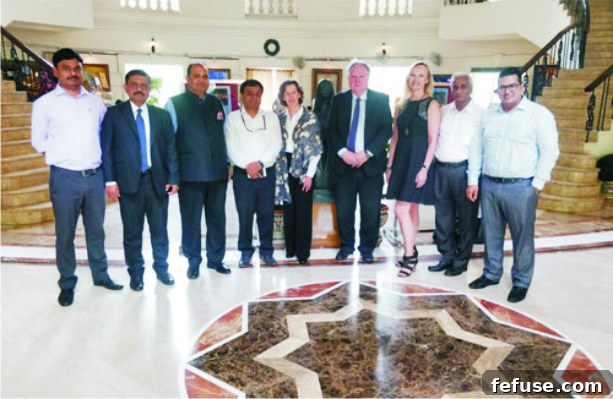
Pic caption: Mrs. Hilde Hardeman, Director – Head of Service for Foreign Policy Instruments, European Union (EU) & KP Chair (centre) and Mr. Ambassador Phillipe Beke, Senior Policy Advisor, EU (to her left) seen with Mr Manoj Dwivedi JS, MoC&I, Mr Pramod Agrawal, Chairman GJEPC, Mr Sabyasachi Ray, ED, GJEPC and other officials.
News Source : gjepc.org