
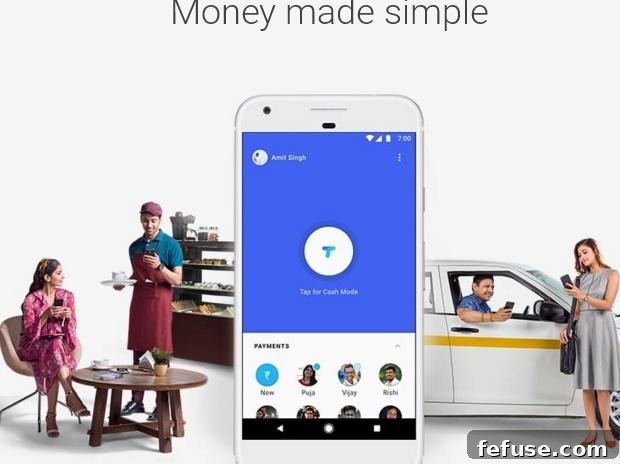
Google Pay (Formerly Tez): Revolutionizing Digital Payments in India with UPI
In a significant stride towards accelerating digital financial transactions across India, Google launched its much-anticipated Unified Payments Interface (UPI)-backed application, Tez (meaning ‘fast’ in Hindi), which later rebranded to Google Pay India. This innovative platform, introduced to the Indian market, was designed to empower users with a secure and seamless way to conduct various financial activities, including paying for goods and services both online and offline, as well as facilitating effortless person-to-person (P2P) money transfers.
Upon its initial rollout, the application’s description on the Google Play Store succinctly captured its core value proposition: “Send money to friends, instantly receive payments directly to your bank account and pay the nearby café with Tez, Google’s new digital payment app for India.” This message underscored the app’s commitment to speed, direct bank integration, and everyday utility, positioning it as a cornerstone for mobile payments in the nation.
The Foundation: Google’s Collaboration with UPI and NPCI
The development of Google Pay India (then Tez) was not an overnight endeavor. The global internet search giant actively collaborated with the National Payments Corporation of India (NPCI) – the umbrella organization for retail payments and settlement systems in India – to ensure the application was built in strict adherence to the country’s pioneering Unified Payments Interface (UPI) standard. This partnership was crucial for integrating Google’s technological prowess with India’s robust financial infrastructure.
Understanding UPI: India’s Game-Changer in Digital Finance
To fully appreciate the impact of Google Pay India, it’s essential to understand UPI. The Unified Payments Interface is an instant real-time payment system developed by NPCI, facilitating inter-bank peer-to-peer and person-to-merchant transactions. It is built on a single platform, allowing users to link multiple bank accounts into one mobile application. Key features that make UPI revolutionary include:
- Instant Transactions: Money transfers are processed in real-time, 24/7, even on holidays.
- Interoperability: Users can send and receive money across different banks and payment apps seamlessly.
- Single Identifier: Transactions can be done using a Virtual Payment Address (VPA) or UPI ID, eliminating the need to share sensitive bank account details.
- Security: UPI transactions are highly secure, requiring a PIN for every transaction.
- Simplicity: The interface is designed for ease of use, making digital payments accessible to a wider demographic.
Google Pay India’s deep integration with UPI allowed it to immediately tap into this rapidly expanding ecosystem. At its launch, Tez was seen as a strong contender, sharing many functional similarities with NPCI’s own BHIM (Bharat Interface for Money) app, which was, and still is, a widely adopted UPI payments application in India.
Key Features and Capabilities of Google Pay India
Google Pay India was designed with a comprehensive suite of features aimed at simplifying and securing digital transactions for millions of Indians. Its direct integration with the banking system, rather than relying on a separate digital wallet, was a significant differentiator.
Instant Bank-to-Bank Transfers
One of the cornerstone features of Google Pay India is its ability to facilitate instant money transfers directly to and from bank accounts. This eliminates the need for users to pre-load money into a digital wallet, providing a more direct and efficient payment experience. Google worked collaboratively with a multitude of Indian banks, ensuring broad compatibility and accessibility. This meant users could effortlessly transfer funds to any UPI-enabled bank account across the country, enhancing the fluidity of financial exchanges.
Seamless Person-to-Person (P2P) Transactions
Beyond bank-to-bank transfers, Google Pay India also streamlines person-to-person payments. Like its contemporary, BHIM, the app allows users to transfer money to other individuals either by using their UPI ID, phone number, or by saving their account numbers and IFSC codes for recurring transfers. This flexibility makes it incredibly convenient for splitting bills, sending money to family, or paying friends back instantly.
Revolutionizing Merchant Payments: Online and Offline
Google Pay India extended its utility to merchant transactions, making it a versatile tool for both online and offline purchases. For physical retail payments, the app introduced an innovative “Tez Mode” (now part of Google Pay), which uses proprietary Audio QR technology. This feature allows users to make secure payments to nearby merchants without needing to exchange bank details or even QR codes. The phone simply detects other Tez/Google Pay users nearby using sound, enabling a quick and secure payment flow. For online transactions, Google Pay India integrated with various e-commerce platforms and payment gateways, offering a streamlined checkout experience.
Future-Proofing: Expanding Payment Options
From its inception, Google outlined a clear roadmap for Google Pay India’s evolution. A key future enhancement promised was the integration of credit and debit card payments directly on its platform. This strategic move aimed to broaden the app’s appeal and functionality, allowing users to manage a wider array of payment methods within a single, unified application, thus enhancing convenience for bill payments and other transactions.
Extensive Language Support for Broader Adoption
Recognizing India’s linguistic diversity, Google Pay India was launched with robust multi-language support. As detailed in its Play Store description, the app offers language options for English, Hindi, Bengali, Gujarati, Kannada, Marathi, Tamil, and Telugu. This inclusive approach was vital for ensuring that the app was accessible and user-friendly for a vast majority of the Indian population, regardless of their primary language, thereby accelerating its adoption in diverse regions.
Google’s Strategic Vision and Impact in the Indian Market
Google’s entry into the Indian digital payments arena with Tez (now Google Pay India) was a highly strategic move, signaling the company’s commitment to a burgeoning market. India’s rapid digitization, coupled with the government’s push for a cashless economy, presented a fertile ground for such innovations.
Fostering Financial Inclusion and Digital Literacy
By making digital payments simple, secure, and accessible, Google Pay India plays a crucial role in fostering financial inclusion. It empowers millions of unbanked or underbanked individuals to participate in the formal economy, providing a gateway to digital transactions without the complexities often associated with traditional banking. The intuitive interface and multi-language support contribute significantly to improving digital literacy among users.
Navigating a Competitive Landscape
While Google Pay India quickly gained traction, it operates in a highly competitive market. It competes with established players like Paytm, PhonePe, and Mobikwik, as well as various bank-specific UPI apps and NPCI’s BHIM. Google’s strategy has been to leverage its brand trust, robust technology infrastructure, and deep integration with the Android ecosystem to carve out a significant market share. The direct bank transfer model, distinct from the wallet-centric approach of some competitors, was a key differentiator that resonated with many users.
User Experience and Security at the Forefront
Google has always prioritized user experience and security, and Google Pay India is no exception. The app features a clean, intuitive interface that simplifies complex financial processes. Furthermore, Google employs multi-layered security protocols, including UPI PINs, screen locks, and Google’s own security technology, to protect user data and transactions. Every transaction is encrypted, and user privacy is maintained, instilling confidence among its growing user base.
The Enduring Impact and Future Outlook of Google Pay India
Google Pay India has undeniably transformed the landscape of digital payments in the country. Its seamless integration with UPI has made it one of the most popular applications for instant money transfers and merchant payments, contributing significantly to India’s digital economy aspirations.
Looking ahead, Google is expected to continue innovating and expanding the capabilities of Google Pay India. This could involve deeper integrations with other Google services, such as Google Maps for local business payments, or enhanced features for financial management and budgeting. As India continues its journey towards a truly digital economy, platforms like Google Pay India will remain at the forefront, driving adoption and fostering a more connected and cashless society.
Ultimately, Google Pay India stands as a testament to how global technology giants can successfully adapt and contribute to local financial ecosystems, making everyday transactions faster, safer, and more convenient for everyone.
News Source: business-standard