
GJEPC Gujarat: Pioneering Trade Dialogue for India’s Gem & Jewellery Export Growth
The Indian gem and jewellery sector stands as a radiant beacon of economic strength, cultural heritage, and global influence. As a leading contributor to the nation’s exports, this industry relies heavily on robust support systems, proactive policy dialogues, and seamless access to vital services. In this context, the Gem & Jewellery Export Promotion Council (GJEPC) plays an indispensable role, acting as the primary facilitator and voice of the trade. The Gujarat Regional Office of GJEPC, strategically located in the heart of India’s diamond industry, consistently champions initiatives designed to empower its members, address their concerns, and pave the way for sustained growth in international markets.
Demonstrating its unwavering commitment to trade facilitation, the GJEPC Gujarat Regional Office recently orchestrated two pivotal programmes. These events served as crucial platforms, enabling members of the trade to seek clarity on complex issues, engage in constructive discussions with key stakeholders, and secure practical solutions to enhance their operational efficiency and export potential. Such proactive engagements are vital in fostering a dynamic and supportive ecosystem for one of India’s most significant export-oriented sectors.
A Landmark Interaction: Dialogue with India’s Commerce Secretary
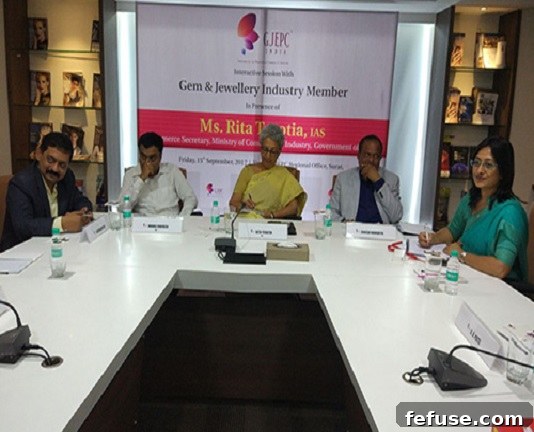
On September 15, 2017, the GJEPC Gujarat office hosted a highly anticipated interaction with Smt. Rita Teaotia, IAS, the esteemed Commerce Secretary to the Government of India, alongside Shri Manoj Dwivedi, Jt. Secretary, Ministry of Commerce & Industry (MoC&I). This high-profile session underscored the government’s recognition of the gem and jewellery industry’s strategic importance and its willingness to engage directly with industry leaders to understand and address their pressing challenges.
Key Discussion Areas and Industry Priorities
The session was characterized by a lively and candid exchange, delving into a myriad of issues pertinent to the thriving diamond and jewellery trade. Discussions likely encompassed critical areas such as:
- Export Promotion Strategies: Exploring new markets, enhancing India’s brand image globally, and optimizing existing export schemes.
- Policy Reforms and Ease of Doing Business: Addressing regulatory hurdles, simplifying customs procedures, and streamlining licensing processes to make India a more attractive hub for global trade.
- Taxation and Fiscal Policies: Deliberating the impact of recent tax reforms, including the then-nascent Goods and Services Tax (GST), on the industry’s competitiveness and operational costs. The industry would have sought clarifications and potential adjustments to ensure a smooth transition and favorable environment for exporters.
- Access to Finance and Credit: Discussing challenges related to working capital, pre- and post-shipment credit, and advocating for more accessible and affordable financing options for manufacturers and exporters, particularly Small and Medium-sized Enterprises (SMEs).
- Infrastructure Development: Highlighting the need for advanced infrastructure, including specialized economic zones, testing labs, and logistics support, to enhance efficiency and reduce turnaround times.
- Skill Development and Manpower Training: Addressing the continuous demand for skilled artisans, designers, and technicians to maintain India’s competitive edge in craftsmanship and innovation.
- Ethical Sourcing and Sustainability: Reinforcing India’s commitment to responsible business practices, ethical sourcing of diamonds and gemstones, and adherence to international standards, which are increasingly crucial for global market access.
- Technology Upgradation and Innovation: Emphasizing the adoption of advanced manufacturing techniques, design software, and digital marketing strategies to stay ahead in a rapidly evolving global landscape.
The presence of such high-ranking government officials provided an invaluable opportunity for industry representatives to voice their concerns directly, offer constructive feedback, and contribute to the formulation of policies that genuinely reflect the ground realities and aspirations of the sector. Such dialogues are instrumental in fostering a collaborative environment where industry insights inform government decisions, leading to more effective and supportive policies.
Empowering Exporters: Guidance on Trade Credit Insurance with ECGC
The momentum of knowledge sharing continued the very next day, September 16, 2017, with another crucial session dedicated to financial risk management. Members of the trade convened to receive invaluable guidance from Shri Saket Kumar, the branch head of ECGC Ltd Surat. This session focused on demystifying the various schemes and solutions offered by ECGC (Export Credit Guarantee Corporation of India) concerning trade credit insurance.
Understanding ECGC’s Vital Role in Export Security
ECGC Ltd. is a government of India enterprise that plays a critical role in promoting Indian exports by providing credit risk insurance and related services. Its primary objective is to safeguard Indian exporters against political and commercial risks arising from overseas buyers’ failure to pay for goods or services. For an industry like gems and jewellery, which involves high-value transactions across international borders, the security offered by ECGC is not just beneficial but often indispensable.
The Indispensable Value of Trade Credit Insurance
Exporting goods, particularly high-value items like diamonds and jewellery, involves inherent risks. International buyers may default on payments due to various reasons, including bankruptcy, political instability in their country, or unforeseen economic downturns. Trade credit insurance, provided by organizations like ECGC, acts as a safety net, protecting exporters from significant financial losses. Shri Saket Kumar’s session would have elucidated how these schemes:
- Mitigate Risks: Protecting exporters against non-payment by overseas buyers, covering both commercial risks (e.g., insolvency, protracted default) and political risks (e.g., war, currency transfer restrictions).
- Enhance Competitiveness: Enabling exporters to offer competitive credit terms to their buyers, which can be a decisive factor in securing international orders, especially in competitive markets.
- Facilitate Financing: With ECGC coverage, banks are more willing to provide pre-shipment and post-shipment finance, as the risk to the lending institution is significantly reduced. This improves exporters’ access to working capital.
- Boost Confidence: Instilling greater confidence in exporters to venture into new and emerging markets that might otherwise be perceived as too risky, thereby expanding their global footprint.
- Support MSMEs: Offering tailored solutions that are particularly beneficial for Micro, Small, and Medium Enterprises (MSMEs) in the gem and jewellery sector, who often have limited financial buffers to absorb large losses.
For the gem and jewellery trade, understanding and leveraging ECGC schemes is paramount. It allows businesses to focus on design, manufacturing, and marketing without the constant worry of payment defaults, thereby fostering stability and growth.
GJEPC’s MSME Help Desk Initiative: A Catalyst for Growth
This crucial meeting with ECGC was meticulously planned and coordinated under the auspices of the GJEPC Regional Office’s MSME Help Desk initiative in Surat. The MSME Help Desk is a testament to GJEPC’s commitment to nurturing smaller enterprises, which form the backbone of the Indian gem and jewellery sector. Through this initiative, GJEPC aims to provide dedicated support, information, and guidance to MSMEs on various aspects of their business, including finance, technology, marketing, and regulatory compliance.
The ECGC session, under this umbrella, specifically targeted MSMEs, ensuring they had direct access to expert advice on securing their export transactions. By empowering MSMEs with knowledge about credit insurance, the GJEPC aims to de-risk their international ventures, encourage bolder market exploration, and contribute to their sustainable growth, ultimately strengthening the entire industry ecosystem.
Gujarat’s Pivotal Role in the Gem & Jewellery Landscape
It is important to acknowledge the strategic significance of Gujarat and particularly Surat in the global gem and jewellery industry. Surat is renowned as the diamond processing hub of the world, where an overwhelming majority of the world’s diamonds are cut and polished. This region is home to countless manufacturers, exporters, and a vast skilled workforce. Therefore, initiatives taken by the GJEPC Gujarat office have far-reaching implications, directly impacting a significant portion of India’s gem and jewellery exports and the livelihoods of millions involved in the trade.
Fostering a Resilient and Future-Ready Industry
The two programmes hosted by the GJEPC Gujarat Regional Office exemplify the council’s proactive approach to industry development. By facilitating direct interaction between trade members and high-level government officials, GJEPC ensures that industry concerns are heard and considered in policy-making. Simultaneously, by providing practical guidance on essential tools like export credit insurance, the council equips businesses with the means to mitigate risks and expand their global reach confidently.
These initiatives are crucial for cultivating a resilient, competitive, and future-ready Indian gem and jewellery industry. They highlight a collaborative model where industry bodies, government, and financial institutions work in tandem to overcome challenges, seize opportunities, and collectively drive India’s prominence in the global gem and jewellery market. The GJEPC remains at the forefront of these efforts, continuously working to empower its members and ensure the sparkling success of India’s precious sector.