
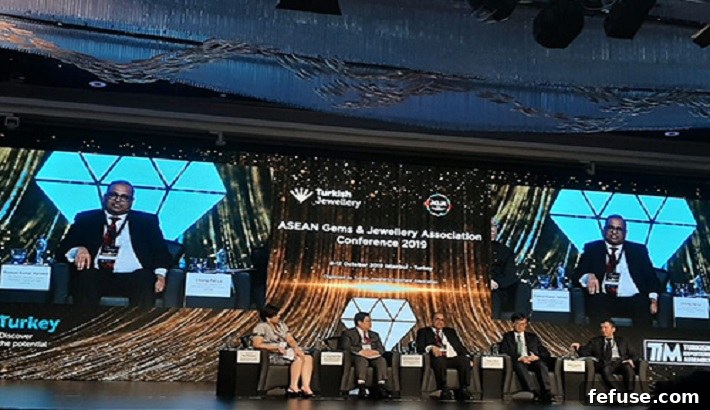
India and Turkey Forge Stronger Ties at the ASEAN Gems and Jewellery Conference: A Vision for Global Collaboration and Seamless Trade
The vibrant city of Istanbul, Turkey, played host to a pivotal gathering for the global gems and jewellery sector on October 9, 2019. The 8th ASEAN Gems and Jewellery Association Conference, an event of significant international importance, convened under the esteemed organization of the Jewellery Exporters’ Association of Turkey. This strategic conference served as a crucial precursor to the much-anticipated 49th edition of the Istanbul Jewelry Show, setting the stage for discussions on cooperation, trade facilitation, and the future trajectory of the industry. India, a powerhouse in the global gems and jewellery market, was a prominent participant, with its delegation led by Pramod Kumar Agrawal, the distinguished Chairman of the Gem & Jewellery Export Promotion Council (GJEPC).
India’s Steadfast Commitment to Regional Economic Integration and Trade Growth
India’s presence at the ASEAN conference underscored its unwavering commitment to fostering deeper economic ties and enhancing trade within the broader Indo-Pacific region. As an active participant in the ‘ASEAN plus 6’ initiative, India has been a vocal proponent of increased cooperation under the proposed Regional Comprehensive Economic Partnership (RCEP). This ambitious Free Trade Agreement (FTA), currently under extensive negotiation among seventeen countries in Asia-Pacific, including the ten ASEAN member states and six dialogue partners (Australia, China, India, Japan, New Zealand, and South Korea), aims to create one of the world’s largest trading blocs. The gems and jewellery sector, a significant contributor to India’s economy and export revenues, stands to benefit immensely from the rationalization of trade barriers and the harmonization of regulations that an FTA like RCEP promises.
The GJEPC, as the apex body for the gem and jewellery trade in India, has consistently represented the nation’s interests in this vital sector on international platforms. This marked the third occasion that the GJEPC participated in the ASEAN G&J Association’s conference, a testament to India’s sustained engagement and its strategic vision for collaborative growth. Such participation reflects India’s proactive stance in shaping regional trade policies and ensuring that the specific nuances and requirements of its thriving gems and jewellery industry are well-articulated and addressed within future economic frameworks. The discussions surrounding RCEP and other bilateral trade agreements are critical for Indian exporters seeking expanded market access and for international players looking to leverage India’s manufacturing capabilities and vast consumer base.
Advocating for Seamless Trade: A Call for Rationalization and Mutual Benefit
During a particularly insightful session titled “Easy trade, trade wars and free trade agreements,” GJEPC Chairman Pramod Kumar Agrawal delivered a compelling address that resonated with the international audience. He passionately advocated for a significant increase in trade volume and efficiency among countries within the region. Chairman Agrawal emphasized that this expansion must be achieved without in any way compromising the mutual interests of individual nations. His discourse highlighted the complexities of global trade dynamics, particularly in an era marked by protectionist tendencies and ongoing trade disputes, underscoring the critical need for collaborative solutions.
Chairman Agrawal articulated a clear pathway to achieving this enhanced trade flow: “through rationalising of taxes and simplifying the rules of negotiation in FTAs.” This dual approach seeks to dismantle existing financial and bureaucratic hurdles that often impede the smooth movement of goods and services across borders. By rationalizing taxes, governments can reduce the cost burden on businesses, making products more competitive and accessible in various markets. Simplifying the rules of negotiation in FTAs, on the other hand, aims to streamline the process of establishing comprehensive trade agreements, making them more adaptable and responsive to the evolving needs of industries like gems and jewellery. Such measures are vital for creating an environment where businesses can thrive, innovate, and expand their global footprint, ultimately benefiting economies and consumers alike. Agrawal’s vision for a level playing field is essential for fostering an equitable global trade environment where all participants, regardless of their economic scale, can compete fairly and contribute to the collective prosperity of the gem and jewellery industry globally.
India’s Progressive Business Environment: Paving the Way for Investment
Chairman Agrawal also took the opportunity to highlight the proactive steps taken by the Government of India to significantly improve the ‘Ease of Doing Business’ within the country. These comprehensive regulatory reforms and ambitious governmental programs are strategically designed to cultivate a highly business-friendly environment, attracting both domestic and international investors. The tangible results of these efforts are evident in India’s impressive climb of 23 places in the World Bank’s Ease of Doing Business report of 2019, a clear indicator of the nation’s commitment to streamlining bureaucratic processes, enhancing transparency, and creating a conducive ecosystem for enterprise.
Further underscoring India’s attractive investment climate, Agrawal proudly mentioned the availability of numerous free zones and specialized jewellery parks across various clusters within the country. These dedicated zones offer state-of-the-art infrastructure, tax incentives, and simplified customs procedures, making them ideal locations for the manufacturing and export of gems and jewellery. A flagship initiative in this regard is the new Jewellery Park that GJEPC is actively establishing in Mumbai, the commercial capital of India. This expansive park is meticulously designed to accommodate over 2,000 manufacturing units, ranging from small-scale artisans to large industrial operations, promising to be a hub of innovation, production, and employment generation for the industry. This infrastructure development is a clear signal of India’s long-term strategy to reinforce its position as a global leader in gem and jewellery manufacturing.
Concluding his remarks with a powerful invitation, Chairman Agrawal reminded the international delegates that India permits 100% Foreign Direct Investment (FDI) in its gems and jewellery sector. This policy not only signals an open economy but also offers unparalleled opportunities for foreign entities to establish a significant presence in one of the world’s most dynamic markets. He declared, “this is the perfect time to do business with India… (to) collaborate with Indian companies for mutual benefits,” emphasizing the symbiotic relationship that can be forged through such partnerships. Furthermore, he extended an equally compelling offer, stating that “Indian jewellery manufacturers are open for entering into collaboration for setting up of manufacturing facilities in any country.” This reciprocal offer highlights India’s readiness to share its expertise and collaborate globally, fostering a spirit of international partnership and technological exchange that can benefit the entire industry.
Turkey’s Ascendant Role in the Global Jewellery Market
The conference’s inaugural session featured insightful remarks from Turkey’s Deputy Trade Minister, Riza Tuna Turagay, who shed light on Turkey’s impressive trajectory in the global jewellery market. Minister Turagay revealed that Turkey’s jewellery exports reached a remarkable US$ 4.4 billion in the preceding year, securing a substantial 4% share of the global jewellery exports. This robust performance underscores Turkey’s growing influence and its emergence as a significant player in the international arena. He confidently asserted the country’s immense potential to further augment its offerings to world markets, attributing this growth to a combination of skilled craftsmanship, innovative designs, and strategic market penetration.
Minister Turagay further elaborated on Turkey’s expanding trade relationships, noting a significant surge in demand from the ASEAN region. Exports to these dynamic Southeast Asian economies witnessed an astounding 82% increase in the last year alone, reaching a noteworthy US$ 50 million. This rapid growth highlights the success of Turkey’s trade policies and its ability to tap into new and emerging markets, particularly in a region that is increasingly becoming a global economic engine. Earlier in the session, Mustafa Kamar, the esteemed Chairman of the Jewellery Exporters’ Association of Turkey, extended a warm welcome to all the Presidents of Jewellery Exporters’ Associations, including those from ASEAN member countries, sectoral dialogue partners, and various other international delegations, collectively representing 35 nations. Kamar emphasized that Turkey’s selection as the host nation for this prestigious conference was a direct recognition of its many significant achievements in exports and the effective and influential role it consistently plays within the global jewellery market. This dual emphasis on export success and global engagement solidified Turkey’s standing as a pivotal player in the international gems and jewellery landscape.
The Global Stage: Istanbul Jewelry Show
While in Turkey, GJEPC Chairman Pramod Kumar Agrawal’s itinerary also included a significant engagement at the inauguration of the October edition of the Istanbul Jewelry Show. This internationally renowned exhibition stands as a beacon for the jewellery industry, attracting a vast array of participants from across the globe. The 49th edition, an eagerly anticipated event, boasted an impressive roster of 800 exhibitors, showcasing a diverse spectrum of exquisite jewellery, precious stones, and related services. The show was expected to draw more than 19,000 trade visitors, including buyers, designers, manufacturers, and industry professionals, all keen to explore new trends, forge business connections, and discover innovative products. Agrawal’s presence at such a high-profile event underscored the importance of international networking and collaboration for the Indian gems and jewellery sector, further strengthening ties with global partners and exploring new market opportunities.
Kuyumcukent: A Marvel of Integrated Jewellery Production and Trade
Deepening his understanding of Turkey’s formidable jewellery infrastructure, Chairman Agrawal also undertook a visit to KUYUMCUKENT in Istanbul. This colossal complex is widely acclaimed as the world’s biggest integrated gold, silver, and jewellery production and trade center, a testament to Turkey’s commitment to the industry. Kuyumcukent is a self-contained ecosystem for the jewellery sector, housing an astounding 3,000 operational units. These units vary significantly in size, ranging from compact 300 sq ft workshops to expansive 3,000 sq ft manufacturing facilities, accommodating a wide spectrum of businesses from independent artisans to large-scale industrial producers. This integrated hub offers unparalleled efficiencies and synergies, bringing together all facets of the jewellery value chain under one roof. Beyond manufacturing, Kuyumcukent features a dedicated Mall catering to both B2B (business-to-business) and retail sales, providing a direct channel for trade and consumer interaction. It also incorporates numerous small manufacturing units, many equipped with display shops, specifically designed to facilitate B2B sales and showcase craftsmanship. Uniquely, this sprawling center operates as a privately-run park, meticulously built and managed by a cooperative, demonstrating an innovative model of industry self-governance and collective success. Kuyumcukent serves as a powerful symbol of Turkey’s advanced capabilities and strategic vision in the global jewellery market, offering a comprehensive platform for production, trade, and innovation.
A Future Forged in Collaboration and Openness
The 8th ASEAN Gems and Jewellery Association Conference, alongside the engagements at the Istanbul Jewelry Show and Kuyumcukent, served as a powerful testament to the intertwined destinies of nations in the global gems and jewellery industry. The discussions championed by GJEPC Chairman Pramod Kumar Agrawal underscored India’s proactive role in advocating for simplified trade mechanisms, rationalized taxes, and a level playing field for all. With India’s progressive ‘Ease of Doing Business’ reforms, 100% FDI policy, and robust infrastructure development including dedicated jewellery parks, the nation presents an unparalleled opportunity for international investment and collaboration. Similarly, Turkey’s impressive export growth, strategic regional engagement, and world-class facilities like Kuyumcukent highlight its rising prominence. The convergence of these strengths – India’s manufacturing prowess and market potential, coupled with Turkey’s advanced trade infrastructure and strong regional ties – paints a vivid picture of a future defined by mutual growth, innovation, and seamless global partnerships. The spirit of collaboration articulated at the conference promises to unlock new avenues for prosperity and solidify the global gems and jewellery sector’s trajectory towards sustainable and inclusive development.