
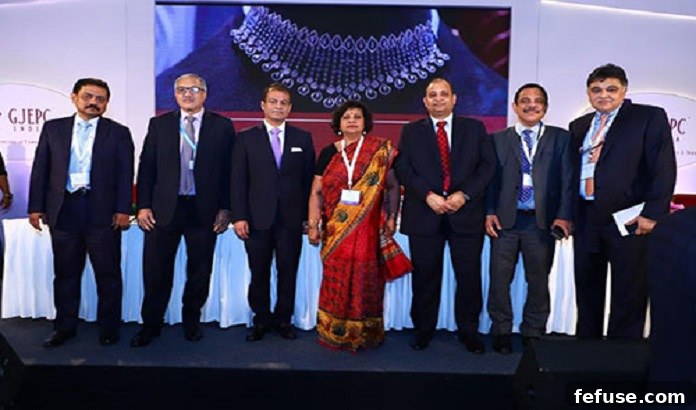
The Indian gem and jewellery sector, a pivotal contributor to the nation’s economy and a global leader in diamond manufacturing, convened its key stakeholders at the fourth annual Banking Summit. Hosted by the Gem & Jewellery Export Promotion Council (GJEPC) on July 31, 2019, this crucial event brought together industry leaders, senior executives from international diamond and jewellery companies, government officials, and representatives from leading financial institutions. The summit served as a vital platform for deliberating the critical financial challenges confronting the industry, celebrating recent policy successes, and charting a strategic roadmap to achieve ambitious growth targets.
GJEPC’s Vision for Growth and Industry Resilience
Pramod Kumar Agrawal, Chairman of the GJEPC, commenced the summit with a comprehensive welcome address to a packed hall, underscoring the dynamic landscape of the gems and jewellery industry. He meticulously outlined the sector’s current status and the proactive measures being undertaken by the Council to propel the industry towards unprecedented levels of growth and global competitiveness. Agrawal emphasized the sector’s enduring resilience despite prevailing market volatilities, highlighting its strategic importance to India’s economic fabric.
The Chairman extended profound gratitude to the Government of India, particularly acknowledging the invaluable support from the Ministry of Commerce & Industry and the Ministry of Finance. He specifically lauded recent policy clarifications and implementations that have significantly enhanced the ease of doing business within the sector. Key among these was the clarification regarding the non-applicability of Goods and Services Tax (GST) on the re-import of goods temporarily exported for exhibition purposes. This measure, he explained, alleviates a significant financial burden and streamlines international trade participation for Indian businesses. Furthermore, the early adoption and implementation of separate Harmonized System (HS) Codes for synthetic diamonds – both rough and polished – and other synthetic gemstones, was hailed as a monumental step. This regulatory clarity is crucial for distinguishing natural and synthetic products, fostering fair trade practices, and bolstering the industry’s credibility on a global scale.
Achieving Ambitious Export Targets: Vision 2022
Reflecting on the industry’s remarkable journey, Agrawal stated, “The gems and jewellery industry has developed over the past five decades to achieve about US$ 40 billion of exports annually.” He further elaborated on the sector’s substantial economic contribution, noting, “This industry contributes 7% to the country’s GDP and 12% to India’s total merchandise exports.” These figures underscore the sector’s profound impact on national wealth generation and employment. Looking ahead, the GJEPC Chairman unveiled an ambitious “Vision 2022,” setting a formidable target: “By this date, we hope to take the exports of the gem and jewellery sector to US$ 75 billion and increase our share in merchandise exports of the country to 15%.” This vision reflects a strategic imperative to expand India’s global market footprint and solidify its position as a dominant player in the international gem and jewellery trade.
Strategic Initiatives for Sectoral Advancement
To actualize the ambitious Vision 2022, Agrawal detailed a series of multifaceted initiatives spearheaded by the GJEPC. These include the establishment of Common Facility Centres (CFCs), designed to provide Micro, Small, and Medium Enterprises (MSMEs) with access to state-of-the-art technology and infrastructure, thereby enhancing productivity and competitiveness. The Council is also actively engaged in cluster mapping to develop tailored growth plans for MSMEs across various regions. Significant progress is being made towards establishing India’s first Jewellery Park in Mumbai, a dedicated hub envisioned to foster innovation, manufacturing excellence, and export growth. Additionally, a Gem Bourse in Jaipur is in the pipeline, aiming to create a centralized trading platform for rough and polished gemstones. Recognizing the indispensable role of human capital, the GJEPC is heavily investing in skilling and upskilling programs to ensure a robust, highly skilled workforce for the industry’s evolving demands. Beyond economic initiatives, the Council is committed to welfare measures for its workforce, exemplified by schemes such as Swasthya Ratna (health insurance) and the Parichay Card (identity and benefits card), promoting social security and well-being.
Addressing the imperative of market demand, Agrawal highlighted the critical need for generic promotions, especially in light of the weakened global market sentiment observed in recent quarters. He revealed that the GJEPC has actively engaged with leading diamond mining companies, De Beers and ALROSA, urging them to significantly increase their investment in promotional campaigns to stimulate consumer demand for diamonds. The Council itself is also substantially contributing to these collective promotional efforts, recognizing that a vibrant market is fundamental to sustained growth.
The Critical Nexus of Finance and Growth
A central theme of the summit revolved around the pervasive challenge of inadequate financing for the sector, a bottleneck particularly acute for MSMEs. Agrawal made an earnest appeal to all stakeholders: “I would like to appeal to all stakeholders to come forward to finance this sector which is the leading diamond manufacturing centre and perhaps the largest jewellery processing centre as well – especially at a time when we aim to become a leading supplier of jewellery to the world.” This impassioned plea underscored the disconnect between the industry’s global significance and the prevailing credit constraints.
Ms. Rupa Dutta, Economic Adviser to the Ministry of Commerce & Industry (MoC&I), Government of India (GoI), reinforced the gravity of the financial situation. In her address, she categorically stated, “Finance is a vital component for all industries and especially so for the gem and jewellery sector which has exports of US$ 40 billion.” Her remarks reaffirmed the government’s recognition of the industry’s strategic importance and the necessity of robust financial support. She added that the government has proactively promoted the gem and jewellery industry as a focus area to ensure it receives adequate financing, acknowledging its critical role in India’s export economy and employment generation.
Ms. Dutta candidly addressed the broader economic context, acknowledging that the international economic situation had repercussions on India’s financial landscape. This, in turn, had led to a more cautious approach from banks. A particular concern she highlighted was the reluctance of banks to extend credit to MSMEs, leading to a credit crunch that directly impacts the overall performance and growth trajectory of the gem and jewellery industry. While urging financial institutions to step forward and provide essential financing to the sector, Ms. Dutta simultaneously emphasized the paramount importance for the industry itself to cultivate and uphold a strong ‘trust factor’. She stressed the need for transparent functioning and robust compliance mechanisms as prerequisites for securing sustained financial backing and fostering stronger relationships with lenders.
Offering a glimpse into forthcoming government support, Ms. Dutta hinted at significant policy schemes in the pipeline. With the Minister of Commerce & Industry taking personal interest, these initiatives, expected within the next month or two, are designed to enhance the availability of finance for the export sector generally, with the gem and jewellery industry poised to be a major beneficiary. While she was unable to disclose specific details due to ongoing policy processes, her announcement instilled a sense of optimism regarding future financial facilitation.
Progress and Recommendations: Stakeholder Collaboration
Building upon the insights from the previous Banking Summit, a dedicated Co-ordination Committee (CoC) was established. This committee was tasked with delving into the intricate challenges and issues faced by the sector, with a clear mandate to identify practical solutions and foster a deeper understanding among all stakeholders regarding the financing of the gem and jewellery sector. P. N. Prasad, Chairman of the CoC and Deputy Managing Director of SBI, presented the inaugural report on the Committee’s progress. He confirmed that notable advancements had been made in several critical areas over the preceding months, attributing this progress to enhanced information exchange between stakeholders and a renewed focus on due diligence by bankers.
Prasad highlighted a fundamental issue identified by the CoC: “The main problem we noticed was a lack of a uniform approach by all banks towards financing the sector.” This inconsistency, he explained, created uncertainty and inefficiencies for businesses seeking credit. To address this, he reported significant efforts towards formulating a standardized approach covering security, margin requirements, and other critical lending parameters, aiming to bring greater predictability and fairness to the financing process.
Another significant area of concern was the “rigid” approach of the Export Credit Guarantee Corporation of India (ECGC) concerning credit lines. Prasad revealed that the Committee had been actively engaging with ECGC to explore amenable methods of operation and fulfill requirements necessary to resolve these issues. He succinctly summarized the Committee’s philosophy: “If risk can be mitigated, credit flow will improve.” Furthermore, he announced that a specific policy tailored for MSMEs was being developed in this context, recognizing their unique needs and challenges in accessing export credit insurance.
Redefining Business Strategy: Addressing Key Challenges
Sanju Kothari, Convener of the Banking, Insurance and Taxation Sub-Committee (BITC) of the GJEPC, advanced the discussions on financing with a compelling presentation titled “Diamond & Jewellery Financing 2019: Redefining Business Strategy.” His detailed analysis commenced by reiterating the trade highlights, vision, industry scenario, and general trade initiatives previously touched upon by the GJEPC Chairman. Kothari’s presentation then critically reviewed the progress made in the past year concerning the “White Paper 2018,” which was submitted at the preceding Banking Summit.
The White Paper had originally outlined five critical challenges confronting the sector. Kothari’s presentation meticulously juxtaposed these identified challenges with the concrete actions taken by the GJEPC, government bodies, and financial institutions. This comparative analysis demonstrated a proactive and results-oriented approach towards resolving systemic issues.
Key Challenges and Actions Taken:
- Credit Limits: Addressing concerns related to the cost of credit, collateral security, the effectiveness of the gold card scheme, and the dollarization of limits. The primary action taken was the formation of the Co-ordination Committee (CoC) specifically tasked with addressing these trade-related financial concerns through a collaborative approach.
- Compliance: Tackling issues around identity verification and compliance risk. The solution implemented was the introduction of the MyKYCBank platform, a centralized system designed to streamline Know Your Customer (KYC) processes. This initiative has seen significant adoption, with over 3300 members registering, thereby enhancing transparency and reducing compliance burdens.
- Valuation of Stock: Resolving complexities and ensuring accuracy in the valuation of inventory. To address this, a GJEPC-recommended and customs-approved panel of stock valuers was formed. This panel ensures standardized, credible, and fair valuation practices, crucial for both financing and customs procedures.
- Insurance: Confronting challenges such as the non-availability of adequate insurance cover and the rising cost of premiums, particularly for MSMEs. The Council is actively working on developing a comprehensive insurance policy specifically tailored for MSMEs in the sector, which is expected to be rolled out soon, providing much-needed risk mitigation.
- General Trade Welfare: Enhancing the ease of doing business, resolving tax-related matters, and establishing mechanisms for arbitration redressal. Significant achievements include the resolution of several complex GST-related issues, simplifying tax compliance for businesses. Additionally, an arbitration committee has been formed to provide an efficient and impartial mechanism for dispute resolution within the trade.
Kothari further underscored another critical operational hurdle: the non-implementation at the ground level of circulars issued by the Reserve Bank of India (RBI) and the Indian Banks’ Association (IBA). These circulars specifically directed banks to re-allocate limits towards export credit in foreign currency. The lack of uniform adoption of these directives by commercial banks continues to impede the flow of crucial foreign currency financing to exporters, affecting their competitiveness in the global market.
His presentation concluded with a holistic overview of the CoC’s achievements and a candid assessment of the persistent challenges facing the trade. Crucially, Kothari presented a series of well-articulated suggestions for each key stakeholder – the industry itself, commercial banks, the government, and relevant government bodies – outlining a clear path forward for collaborative problem-solving and sustained growth. These suggestions emphasized shared responsibility and synergistic actions to overcome the remaining obstacles and unlock the full potential of the Indian gem and jewellery sector.
Conclusion: A Unified Path Forward for the Indian Gem and Jewellery Industry
The GJEPC Banking Summit 2019 served as a powerful testament to the Indian gem and jewellery industry’s unwavering commitment to growth, transparency, and global leadership. Through robust discussions, candid assessments, and a collaborative spirit among industry leaders, government officials, and financial stakeholders, the summit not only highlighted the sector’s impressive achievements and its ambitious Vision 2022 but also meticulously addressed the systemic challenges, particularly those pertaining to financing. The collective resolve to implement policy clarifications, streamline regulatory processes, and foster innovative financial solutions underscores a dynamic approach to overcoming hurdles. With initiatives ranging from infrastructure development and skill enhancement to dedicated welfare schemes and proactive market promotions, the industry is poised for significant expansion. The emphasis on strengthening trust, ensuring transparent operations, and securing adequate, accessible financing remains central to realizing its full potential and cementing India’s position as the world’s premier hub for gem and jewellery manufacturing and exports. The outcomes of this summit lay a solid foundation for a resilient, competitive, and sustainably growing future for this vital sector.
For a complete and detailed insight into the strategies discussed, the full presentation titled “Diamond & Jewellery Financing 2019: Redefining Business Strategy” is available for review:
https://gjepc.org/pdf/Diamond-Jewellery-Financing-2019.pdf
Note: Following the impactful inaugural session, the Summit continued with a series of in-depth panel discussions exploring various themes pertinent to the industry’s financial landscape. A comprehensive report detailing the insights and outcomes of these sessions will be published on www.gjepc.org in due course.
Attendees at the Banking Summit 2019: Pictured from left to right: Sabyasachi Ray, Executive Director, GJEPC; V.G. Kannan, Chief Executive, Indian Banks’ Association (IBA); Colin Shah, Vice Chairman, GJEPC; Ms. Rupa Dutta, Economic Adviser, Ministry of Commerce & Industry, Government of India; Pramod Kumar Agrawal, GJEPC Chairman; P. N. Prasad, Chairman of the Co-ordination Committee (CoC) & Deputy Managing Director, SBI; and Sanju Kothari, Convener of the Banking, Insurance and Taxation Sub-Committee (BITC), GJEPC.
News Source: gjepc