
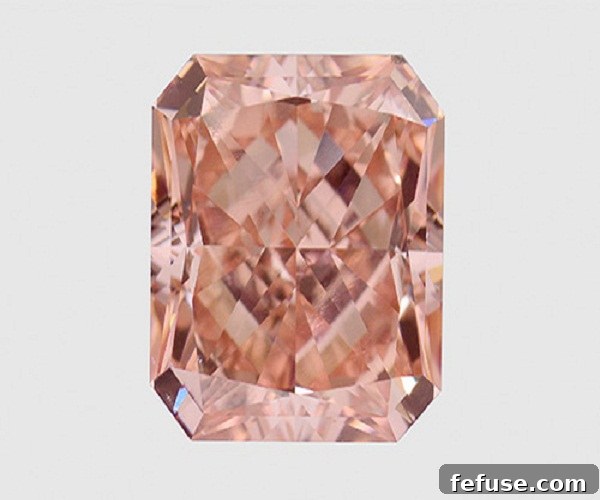
The world of gemology is constantly evolving, driven by remarkable advancements in technology and the tireless dedication of leading institutions like the Gemological Institute of America (GIA). In a groundbreaking article featured in GIA’s esteemed Summer issue of Gems & Gemology, authored by prominent researchers Wuyi Wang and Tom Moses, the institute unveiled details of a truly exceptional lab-grown diamond. This significant piece focused on a sizable, captivating pinkish-orange CVD (Chemical Vapor Deposition) synthetic diamond, which recently underwent rigorous testing at GIA’s state-of-the-art New York Laboratory. The emergence of such a stone underscores the remarkable strides being made in the cultivation of high-quality lab-grown diamonds, challenging traditional perceptions and pushing the boundaries of what is possible in diamond synthesis.
This particular synthetic diamond, presented to GIA’s New York laboratory by Unique Lab Grown Diamond Inc., was a stunning square-cut specimen. Weighing an impressive 5.01 carats and measuring approximately 9.45 mm × 9.10 mm × 6.05 mm, its physical dimensions alone made it a noteworthy example of CVD synthesis. However, its most striking feature was its magnificent color, which GIA expertly graded as Fancy Intense Pinkish Orange. This exquisite hue, a harmonious blend of pink and orange saturation, immediately set it apart. The GIA’s grading system categorizes diamonds with vivid and intense colors as ‘Fancy,’ indicating a saturation level that is highly desirable and exceptionally rare in nature, particularly for diamonds of this substantial size. The fact that a lab-grown diamond could achieve such a remarkable color saturation and impressive carat weight speaks volumes about the sophistication of modern diamond growth techniques.
The authors, Wuyi Wang and Tom Moses, did not shy away from emphasizing the extraordinary nature of this gem, remarking that “Natural diamonds with intense pink-orange colour are very rare, particularly in large sizes.” This statement highlights a crucial point: while all diamonds are precious, those exhibiting intense fancy colors, especially in larger dimensions, command immense value and rarity in the natural world. The ability to create a synthetic diamond that mimics such a rare natural phenomenon, not just in color but also in significant size, showcases an exceptional achievement in diamond technology. They further noted that the stone displayed “some outstanding gemmological features,” prompting an in-depth analysis to understand its unique properties and how they compare to both natural and other synthetic diamonds.
A meticulous examination of the diamond’s visual characteristics revealed an evenly distributed color throughout the stone, a hallmark of well-controlled growth processes. Under microscopic observation at approximately 20× magnification, a few small feathers and pinpoints were detected, internal characteristics that are common in both natural and lab-grown diamonds. Based on these inclusions, the diamond’s clarity was determined to be equivalent to an SI1 grade. SI1 (Slightly Included 1) clarity means that inclusions are noticeable under 10x magnification but typically not visible to the naked eye, indicating a high-quality gem. The blend of impressive size, captivating color, and respectable clarity firmly established this CVD diamond as an exceptional specimen, deserving of extensive scientific scrutiny and admiration within the gemological community.
The GIA’s comprehensive gemological analysis extended beyond visual inspection, employing advanced spectroscopic techniques to unveil the diamond’s internal composition and growth history. Infrared absorption spectroscopy, a critical tool for identifying diamond types, revealed that this was a Type IIa diamond. Type IIa diamonds are characterized by the absence of detectable nitrogen impurities, or at least nitrogen concentrations below the instrument’s detection limit. This is a common feature in high-quality CVD synthetic diamonds, where nitrogen is deliberately minimized during the growth process to avoid color contamination. Crucially, the infrared spectrum also presented a clear and sharp peak detected at 3123 cm⁻¹. This specific spectroscopic feature is a well-known and definitive signature of CVD synthetic diamonds, acting as a “fingerprint” that reliably distinguishes them from natural diamonds and even from diamonds grown using other synthetic methods like HPHT (High-Pressure/High-Temperature). This distinct peak provides irrefutable evidence of the diamond’s synthetic origin and its growth method.
Further insights into the diamond’s color origin were garnered from its absorption spectrum in the UV-Vis (Ultraviolet-Visible) region. This analysis indicated that the observed pinkish-orange body color was directly attributable to a very strong and broad absorption band centered around 520 nm. Absorption bands occur when specific wavelengths of light are absorbed by the diamond’s internal structure or impurities, allowing the remaining wavelengths to be transmitted and perceived as color. The authors noted that this particular 520 nm band can be intentionally “introduced” into a CVD diamond during its growth process. This careful manipulation of growth conditions allows for the creation of specific color effects. Intriguingly, they pointed out that this band creates a color effect strikingly similar to the one produced by the ~550 nm band found in natural pink diamonds. While the visual outcome may be analogous, the underlying scientific mechanisms and characteristic absorption bands differ, providing gemologists with vital clues for accurate identification. The research also highlighted that there is “no report of the ~520 nm band being introduced to a CVD synthetic diamond after its initial growth,” implying that the beautiful pinkish-orange hue of this diamond was primarily an inherent characteristic established during its fundamental growth phase, rather than a result of post-growth treatments aimed at color alteration.
The advanced characterization continued with photoluminescence (PL) spectroscopy, a technique that detects light emitted by a material after it has absorbed photons, revealing information about its defect structures and impurities. In this pinkish-orange CVD diamond, clear emissions were recorded at 737 nm, indicative of SiV⁻ (Silicon-Vacancy) centers, and at 503 nm, attributed to the H3 defect. Both SiV⁻ centers and H3 defects are commonly observed in CVD-grown diamonds and provide valuable information about the specific growth environment. Additionally, strong emissions were detected at 575 nm and 637 nm, stemming from NV (Nitrogen-Vacancy) centers. These NV centers, particularly when they exist in specific charge states, are well-known to play a significant role in imparting pink, red, and orange hues to diamonds, often being created by nitrogen impurities adjacent to a lattice vacancy within the diamond’s crystal structure. The presence and intensity of these specific PL emissions provided a detailed spectroscopic fingerprint of the diamond, confirming its CVD origin and offering clues about the precise conditions under which it was grown.
As a direct consequence of the strong NV center emissions, this synthetic diamond exhibited a robust orange-red fluorescence when subjected to DiamondView imaging. DiamondView is a specialized GIA instrument that uses short-wave UV light to induce fluorescence, revealing characteristic growth patterns that are often invisible under normal magnification. Typically, large CVD-grown diamonds display distinct, often layered or columnar growth patterns in DiamondView images, which can be crucial for confirming their synthetic origin and understanding their growth dynamics. However, in an unexpected turn, the fluorescence images of this particular diamond “hardly revealed the multiple growth layers responsible for its significant thickness.” This unusual characteristic suggests a highly uniform and refined growth process that minimized the visual demarcation of successive growth layers under UV fluorescence. Instead, the subtle boundaries of these multiple growth layers could only be discerned through the use of high-resolution cathodoluminescence (CL) images. CL imaging, which involves bombarding the diamond with an electron beam to induce luminescence, offers even greater spatial resolution and sensitivity to variations in trace elements or defects. The fact that CL was required to reveal these layers highlights the advanced nature of this specific CVD diamond, suggesting a level of control over the growth process that results in remarkably homogenous material, even across significant thicknesses.
Based on the comprehensive array of spectroscopic features and the meticulous analysis, the authors drew a significant conclusion regarding the diamond’s post-growth treatment. They stated: “Based on all spectroscopic features, we believe that this CVD synthetic diamond was not treated by HPHT annealing after its growth for colour improvement, though heating to a moderate temperature could not be entirely ruled out.” This finding is particularly noteworthy because HPHT annealing is a common post-growth treatment applied to many CVD diamonds to improve or modify their color, often by altering the charge state or aggregation of nitrogen and vacancy defects. The absence of evidence for such an aggressive HPHT treatment specifically for color enhancement implies that the Fancy Intense Pinkish Orange hue was achieved primarily through the initial CVD growth process itself, a testament to the precise control and sophistication of Unique Lab Grown Diamond Inc.’s cultivation methods. While moderate heating for other purposes, such as relieving growth stress, could not be definitively excluded, the key takeaway was the inherent origin of its captivating color. Ultimately, the GIA experts concluded that “The combination of size, colour, and clarity made this the most remarkable CVD synthetic diamond GIA has tested so far.” This powerful statement underscores the diamond’s unique position at the forefront of lab-grown diamond technology, setting a new benchmark for quality, beauty, and scientific intrigue.
The groundbreaking research and detailed analysis of this remarkable CVD diamond were spearheaded by two of GIA’s most distinguished figures. Wuyi Wang serves as the Vice President of Research and Development at GIA, a role that places him at the cutting edge of gemological innovation and scientific discovery. Tom Moses, as the Executive Vice President and Chief Lab and Research Officer at GIA in New York, oversees the institute’s extensive laboratory operations and research initiatives, ensuring the highest standards of diamond and gemstone analysis. Their combined expertise and leadership are instrumental in GIA’s ongoing mission to protect consumers and advance the science of gemology. The insights provided by this study not only educate the public but also provide invaluable tools for gemologists worldwide to accurately identify and characterize the increasingly sophisticated array of lab-grown diamonds entering the market. As the lab-grown diamond industry continues to mature and innovate, the work of institutions like GIA, led by experts such as Wang and Moses, remains paramount in maintaining transparency and consumer confidence.
The emergence of such exceptional lab-grown diamonds, like the Fancy Intense Pinkish Orange CVD stone, signifies a new era for the diamond industry. It showcases the incredible progress in controlled synthesis, enabling the creation of stones that rival, and in some aspects, even surpass the rarity of their natural counterparts in terms of specific characteristics. This technological leap provides consumers with more choices, while simultaneously pushing the boundaries of scientific understanding in materials science. GIA’s continued vigilance and comprehensive research play a vital role in ensuring that these advancements are met with robust identification techniques and clear disclosure, maintaining integrity across the entire gem and jewelry supply chain. The study of this extraordinary 5.01 ct diamond not only marks a milestone in CVD technology but also reinforces GIA’s commitment to staying at the forefront of gemological science, continually adapting to new challenges and discoveries.
News Source:- gjepc.org